
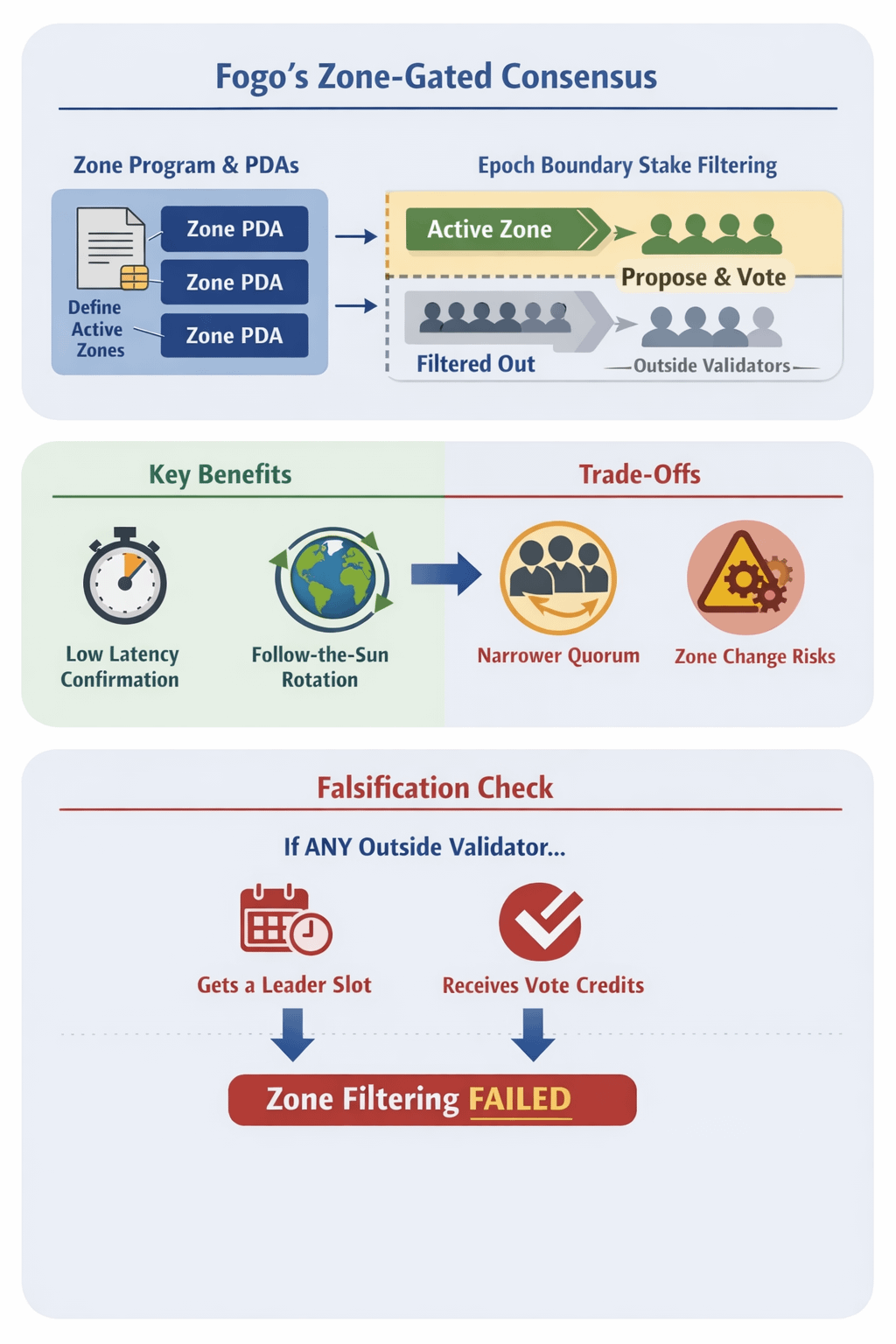
The Zone Program and the Program-Derived Accounts (PDAs) it writes are where Fogo’s low latency is decided. Those PDAs define zones and validator assignments in a way the chain can enforce, not just describe. I do not price Fogo as “SVM parallelism, but faster.” SVM execution mostly determines how much work a leader can process after it is already the leader. The Zone Program changes who is allowed to be leader and whose votes count for finality in a given epoch. That eligibility control is the part that can compress confirmation time without pretending distance does not matter.
I keep one split fixed when I judge performance claims. Confirmation latency is not the same thing as quorum breadth. Faster execution and parallelism can raise throughput under load. They do not automatically reduce the coordination time needed for a widely distributed voting set to converge. Fogo targets coordination by enforcing stake filtering at the epoch boundary so only one active zone participates in proposing and voting for that epoch. If only the active-zone stake is eligible to reach supermajority, the confirmation path depends on a smaller, bounded voting set for that epoch, not on faster transaction execution.
Zone definitions and validator assignments live on chain as PDAs managed by the Zone Program, so membership is inspectable rather than implied. The protocol selects one active zone using a deterministic selection strategy, and it supports rotation policies, including epoch-based rotation and a follow-the-sun option that activates zones by time. At the epoch boundary, stake filtering excludes vote accounts and stake delegations for validators outside the active zone from that epoch’s participation set, and the effect should be visible in which vote accounts receive leader schedule slots and which vote accounts earn vote credits during that epoch. Inside the epoch, the active zone alone contributes to the stake-weighted leader schedule, Tower BFT voting and fork choice, and the supermajority thresholds used for finality. Inactive zones can stay synced, but they are not part of the quorum that produces confirmation for that epoch.
That gating creates an operational constraint most people skip. Zone-gated consensus only delivers predictable confirmation if the active zone is actually latency-bounded in the real network and if epoch-boundary filtering is enforced cleanly. Validator operators have to provision for the active zone environment and be ready for rotation without breaking uptime. They also have to accept that there are epochs where they are inactive by design and do not earn consensus rewards. The design also uses zone security parameters, including a minimum stake threshold per zone, and if that threshold is enforced through the Zone Program PDAs then low-stake zones should not appear as the active zone when epochs advance. This is a protocol rule that shapes who can credibly claim they are securing the chain at any point in time.
The trade-off sits on the same split. Fogo buys lower confirmation latency by reducing quorum breadth within each epoch. When only one zone participates, finality is produced by a subset of validators instead of the full, globally distributed set. Rotation is the intended counterweight, but it does not erase the sacrifice. It schedules it. You get periods where one region dominates the consensus path, and you accept boundary risk when the active set changes. Your risk surface shifts away from global coordination delays and toward zone-level correlation risk and epoch-boundary handoff risk. If the active zone has a networking issue or a correlated failure, the design has less immediate redundancy inside that epoch because excluded stake is not voting.
I do not evaluate Fogo with the usual throughput comparisons. If the Zone Program is the control-plane, the evidence should show up as protocol behavior, not as peak execution figures. Membership should be visible through the PDAs. Epoch boundaries should be the moment stake filtering becomes visible in eligibility and participation. In the active epoch, leader scheduling and reward accounting should behave as if inactive zones are excluded, because that exclusion is the mechanism that justifies the latency design. If those signals are clean, the low-latency claim is grounded in enforceable consensus behavior. If those signals are messy, the explanation collapses back into generic fast execution with a harder-to-defend latency narrative.
Practically, I trust Fogo’s latency claims only when the active-zone PDAs match what the chain credits as eligible in the same epoch, specifically in leader schedule slots and vote-credit accounting. Within a single epoch, any non-active-zone validator receiving a leader schedule slot or receiving vote credits falsifies zone-gated stake filtering as the driver of Fogo’s low-latency confirmation.
