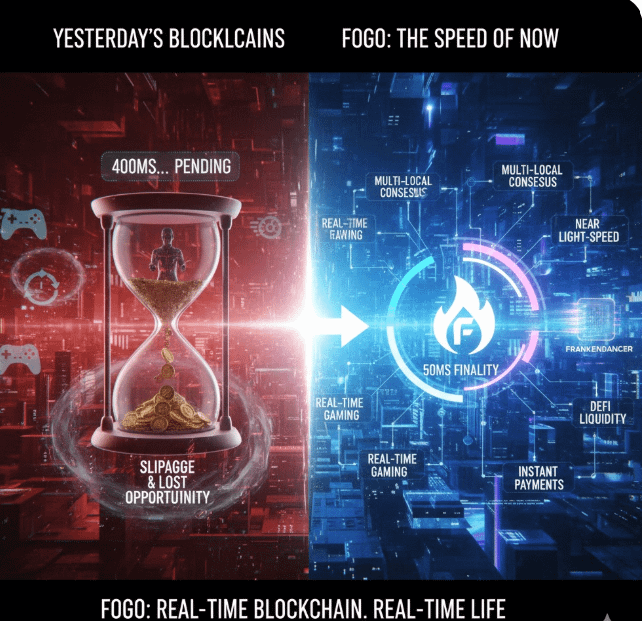
Let's talk about time. Not time in the philosophical sense not the big questions about existence and the arrow of entropy. Let's talk about the very specific, very measurable, very real amount of time that passes between you pressing a button and something actually happening on a blockchain network.
Four hundred milliseconds. That's roughly how long it takes you to blink. By most standards, it's nothing. But in the world of high-frequency trading, gaming, real-time applications, and decentralized finance, 400 milliseconds might as well be forever.
This is the silent cost that most people in crypto don't think about until it bites them. And it bites hard.
The Hidden Toll of Slow Transactions
Imagine you're a developer building a decentralized game. Your players need real-time feedback. When they attack, they need to see the result. When they earn a reward, they need it now not after a three-second confirmation window. If your game runs on a blockchain that takes two to five seconds per transaction, it's not really a game. It's a waiting room with occasional entertainment.
Or imagine you're running a DeFi protocol a lending platform, maybe, or an automated market maker. Prices change in milliseconds. If your transaction takes too long to confirm, the price has moved by the time the transaction settles. This is called "slippage," and it costs users real money every single day on slower networks. It's one reason why sophisticated DeFi users spend enormous amounts on "gas" transaction fees just to get their transactions processed before conditions change.
Now take this further: imagine critical infrastructure identity verification, supply chain tracking, healthcare records, legal contracts running on a blockchain. These applications need reliability AND speed. A healthcare record that takes ten seconds to confirm is ten seconds where a doctor might be making a decision without current information. That's not a theoretical concern. That's a genuine problem.
The reason these problems persist isn't that blockchain engineers don't care about them. It's that solving them at the protocol level is genuinely difficult. Most approaches that improved speed introduced new problems: more centralization, higher hardware requirements, weaker security. Fogo's approach to this challenge is what makes it worth paying attention to.
The Physics of Why Networks Are Slow
At the most basic level, network latency has a hard floor imposed by physics. Information can't travel faster than the speed of light. For a global network with nodes in New York, Tokyo, São Paulo, and Berlin, just the physical travel time for a signal to make a round trip is in the hundreds of milliseconds. Add in processing time, cryptographic verification, and the time for validators to reach consensus, and you understand why most blockchains have confirmation times measured in seconds or longer.
The traditional solution to this has been one of two approaches. First, centralize: if all your validators are run by the same company in the same data center, things go very fast but you've recreated the problems that blockchain was supposed to solve. Second, accept it: just tell your users that finality takes a while, and design applications that don't require immediate confirmation.
Neither approach is satisfying. The first defeats the purpose. The second severely limits what's possible.
Fogo took a third path.
Geographic Clustering: Speed Without Sacrifice
The key insight behind Fogo's architecture is this: you don't have to choose between decentralization and speed if you think carefully about how decentralization is implemented.
Fogo uses what it calls "multi-local consensus." Validators are grouped into geographic zones high-performance data centers where the physical proximity of validators dramatically reduces the communication latency between them. Within a zone, messages travel microseconds rather than hundreds of milliseconds. Blocks get confirmed at a speed that feels, from the user's perspective, essentially instant.
But here's the crucial part: these zones can be rotated. If all validators were permanently in one data center, that would just be centralization with extra steps. Instead, Fogo's architecture is designed to shift which zone is active for a given period, and to run full nodes in multiple data centers globally. This means the network maintains its geographic resilience and fault tolerance if one data center has a problem, the others can take over while still getting the performance benefits of geographic clustering during normal operation.
It's similar to how a relay race works. Individual runners cover their own stretch at full speed, handing off to the next. The baton travels the whole course quickly, even though no single runner covers the entire distance. The performance comes from coordination, not from having one superhuman runner.
What 50ms Block Times Actually Enable
Fogo's architecture targets block times well below those of traditional globally distributed consensus potentially approaching the 50ms range under favorable conditions. To put that in context: a human blink takes 150-400ms. A Fogo transaction could confirm before you even register what you've done.
What does this unlock?
In gaming, it means truly decentralized games where every move is verifiably on-chain, without any noticeable lag. That's not possible on networks where transactions take seconds.
In DeFi, it means tighter spreads and less slippage. When the gap between price and confirmation shrinks, traders lose less to market movement, and protocols can serve users more fairly.
In payments, it means an experience that matches or beats traditional payment networks a critical threshold for any blockchain technology hoping to reach mainstream adoption.
In enterprise applications, it means the difference between a proof of concept and a production-ready tool.
The Validator Economy of Speed
There's an economic dimension to all of this that's easy to miss. In Fogo's system, validators process transactions and earn rewards for doing so. But those rewards aren't distributed equally they're weighted by stake and performance. Validators who consistently produce blocks efficiently and participate in consensus correctly earn more. This creates a powerful incentive to maintain high-quality infrastructure.
On top of the base rewards, there's a priority fee system. Users who need faster processing can attach higher fees to their transactions. Validators are incentivized to process higher-fee transactions first. This creates a market for speed users who need it most can get it, and validators are rewarded for providing it.
The result is a self-reinforcing system. Good validators earn more, invest in better infrastructure, perform better, and earn more still. The network improves over time not because anyone is commanding it to, but because the economic incentives push in that direction.
Why This Matters Now
We're at an interesting moment in blockchain history. The technology has proven itself conceptually. The question is no longer "can blockchains work?" but "can blockchains work well enough for the applications we actually need?"
Latency is one of the last major barriers. Security has improved dramatically. Smart contract platforms have matured. Tooling and developer experience have gotten much better. But the stubborn reality of slow confirmation times has held back entire categories of application.
Fogo is making a serious case that this barrier can be broken not by cutting corners, but by rethinking the architecture from the ground up. The physics haven't changed. But the engineering has.
Four hundred milliseconds. Sometimes it's nothing. On the wrong blockchain, it's the difference between an application that works and one that doesn't.