
The most valuable part of $FOGO choosing SVM is not the headline metric people repeat.
It’s the starting position it creates.
Most new Layer 1s begin the same way:
An empty execution environment.
Unfamiliar developer assumptions.
A slow, painful climb toward real usage.
Fogo is taking a different route.
Instead of inventing a brand-new execution model, it is building around a production-proven engine that has already shaped how serious builders think about performance, concurrency, state layout, and composability.
That decision does not guarantee adoption.
But it meaningfully shifts the early probabilities.
SVM Is Not a Buzzword — It’s a Discipline
When you stop treating SVM like a marketing term, it becomes clear what it really represents:
Parallel execution mindset
State-aware design
Contention avoidance
Performance as a default expectation
The runtime rewards clean architecture.
It punishes sloppy state design.
Over time, that creates a culture.
When Fogo adopts SVM, it isn’t just importing tooling compatibility — it’s importing a performance-first builder mentality.
And that matters more than most people realize.
This is where #fogo 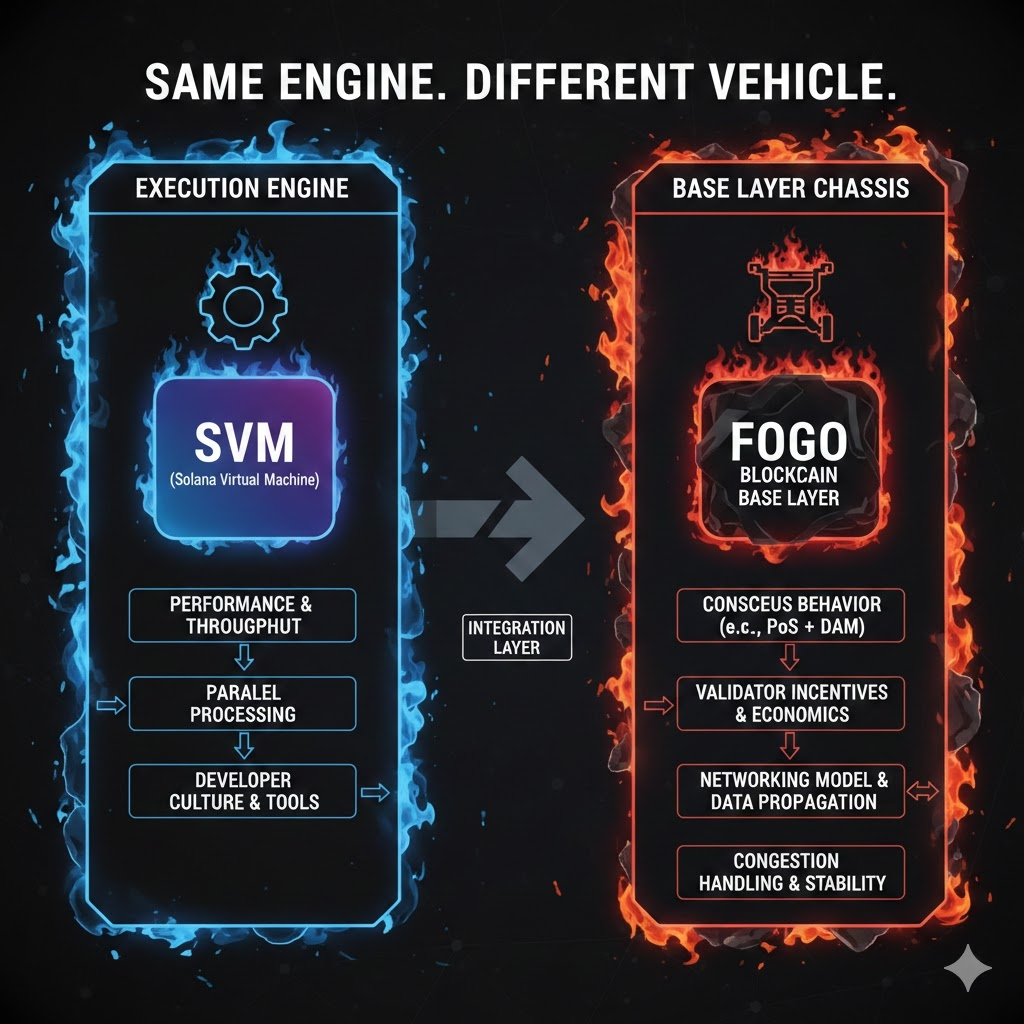 gains a structural advantage in its early lifecycle.
The Cold Start Problem Most L1s Never Escape
Here’s what quietly kills new chains:
Builders hesitate because there are no users.
Users hesitate because there are no apps.
Liquidity hesitates because there is no volume.
Volume stays thin because liquidity is shallow.
It becomes a self-reinforcing loop.
Fogo’s SVM foundation compresses that loop.
Not because developers can copy-paste code —
but because they don’t need to relearn how to think.
The biggest reusable asset isn’t contracts.
It’s architectural instinct.
That muscle memory reduces the friction of the first serious deployments.
And early deployment velocity changes everything.
Reuse Is Real — But Not Magical
Let’s stay honest.
What transfers cleanly:
Concurrency mindset
Performance discipline
State-aware architecture
Tooling familiarity
What does NOT transfer automatically:
Liquidity
Network effects
Market trust
Liquidity does not migrate just because a bridge exists.
Users do not stay just because an app launches.
Trust must be rebuilt.
Market depth must be earned.
Validator behavior must prove itself under stress.
That’s where base layer choices matter.
Engine vs. Chassis — The Simple Mental Model
Solana created a powerful engine.
Fogo is building a different vehicle around that engine.
The engine determines developer ergonomics and performance style.
The chassis determines:
Stability during spikes
Predictability of latency
Consistency of transaction inclusion
Behavior under chaotic demand
Two chains can share an engine and behave very differently when stress hits.
If the engine is shared, differentiation lives in the chassis.
And the chain that survives real load is the one that keeps users.
Why This Matters Long Term
Speed and low fees are easy headlines.
Ecosystem density is the real advantage.
When many high-throughput apps share one execution environment:
More venues → more routing options
More routing → tighter spreads
Tighter spreads → more volume
More volume → deeper liquidity
Deeper liquidity → stronger execution
At that point, a network stops feeling experimental.
It starts feeling inevitable.
That is when an L1 stops being a narrative and starts becoming infrastructure.
The Real Test
If I were watching Fogo closely, I wouldn’t care about demo performance.
I would care about:
Does performance stay consistent under stress?
Do builders treat it as permanent infrastructure?
Does liquidity feel stable rather than fragile?
Does congestion handling remain predictable?
Because that’s when theory becomes reality.
SVM on an L1 is not just about compatibility.
It’s about compressing the time from zero to usable ecosystem.
And time compression is the hidden advantage most people miss.
When that compression works, momentum compounds.
And when it compounds, narratives become ecosystems.
That’s the real thesis behind $Fogo.
Watching closely @Fogo Official