

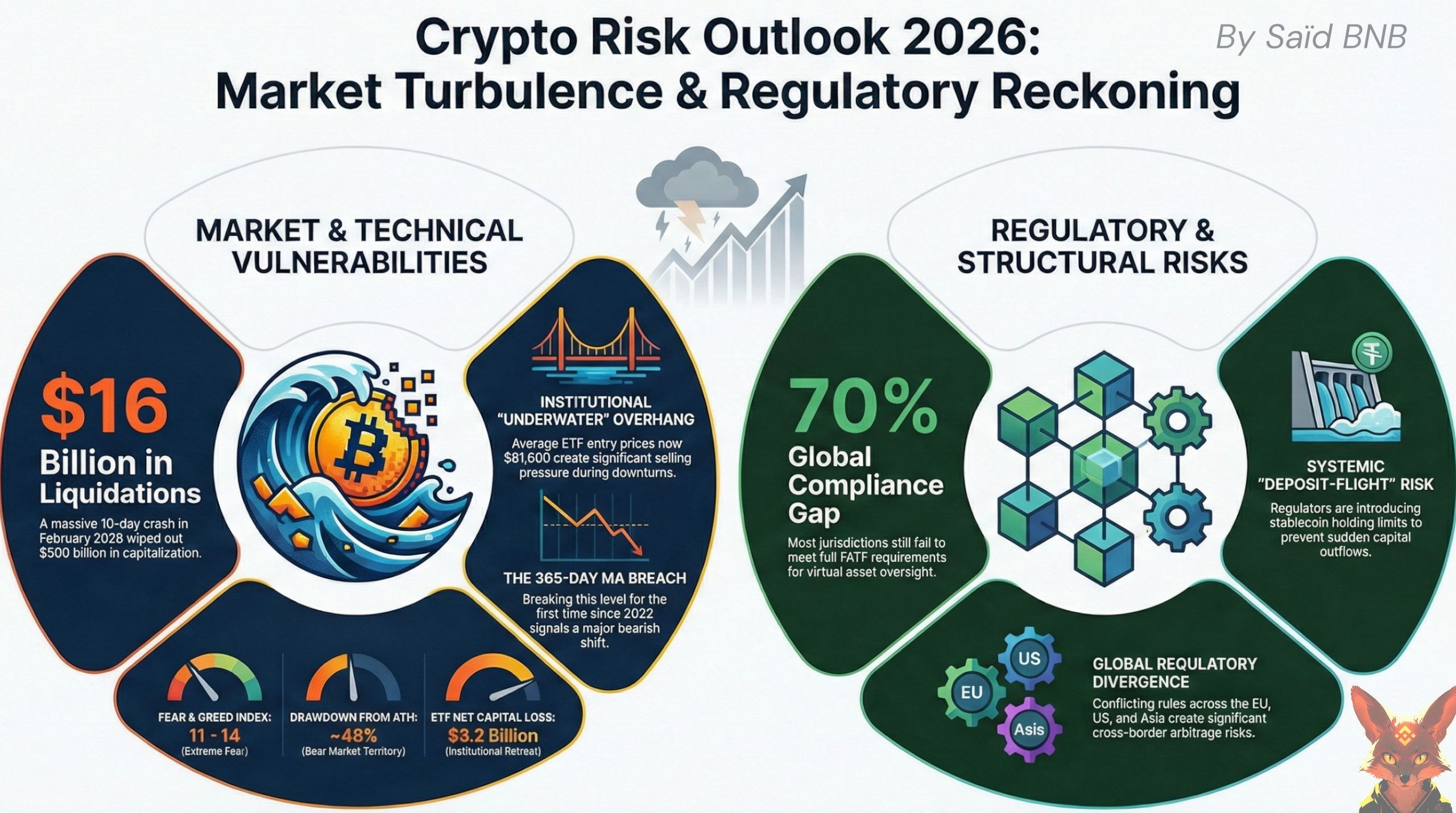
The market of digital assets went on a euphoric craze in October 2025 when Bitcoin (BTC) broke the record high of $126,000. By February 2026, this optimism was washed away in a bloody correction, with prices falling as low as intraday low of 60,062 and erasing a half trillion of market capitalization. Although retail sentiment is sinking to Extreme Fear levels not seen since the FTX crash it is not a fatal event; it is the Great Re-Rating.
The industry is now in a period of shifting a speculative frontier to the most disciplined institutional phase. The underlying financial architecture is bringing together digital assets more rapidly than ever, in spite of the liquidations of $16 billion in routs in February. We are experiencing a rise of the professionalized market in which technical and regulatory resilience is the new survival requirement.
The Dollar is Now an Asset, But Not Only a Reserve Network.
The 2026 PwC Global Crypto Regulation Report has identified a radical functional change as the U.S. Dollar (USD) turned into a dynamic reserve network, as opposed to a passive reserve asset. Previously, the correspondent banking curtailed the reach of the greenback. The dollar-backed stablecoins, which have constituted more than 95% of the market, have successfully transferred the USD to the blockchain today, to areas formerly underserved by U.S. banks.
The irony of such evolution is rather specific: the technology that was initially proclaimed as the USD killer has turned out to be the most efficient mechanism of its preservation. With programmable 24/7 liquidity, stablecoin wallets are now performing the function of a digital dolllar wallet to the global unbanked. Although Bitcoin did not perform well in early 2026, the usage of dollar-denominated tokens strengthened USD dominance, which proved that the currency will be connected to its digital rails.
There will be a diminished dependency on the issuer of the dollar and more on the infrastructure in which it will be able to operate upon as the financial system is increasingly becoming digital. Cross-border payments and markets The interoperability will remain relevant in the next generation. Even though Enthriller failed to meet its initial targets, the company has effectively leveraged every chance to grow its operations worldwide.<|human|>Although Enthriller did not reach its original targets, the company has been quick to utilize all opportunities to expand its business across the globe.
The Point of No Return: Institutional Integration vs. Price Volatility.
The institutional involvement has reached a critical level where it is too late to go back. Financial institutions that speculate on trades were washed out as the leveraged liquidations reached up to $16 billion, yet with Tier-1 banks such as JPMorgan and Citi among them, the digital assets have still found their way into the operating model. This is the institutionalization of norms, in which the vertically integrated, often opaque practices of crypto-native firms are already being overtaken by the modular standards of the global finance.
The industry has adopted the modular stack to make the separation of custody, execution, settlement, data, risk and liquidity into clearly accountable layers. This fragmentation enables institutions to deal with risk as rigorously as it has been done with traditional financial market infrastructure.
The Emergence of Co-Opetition of Shared Rails.
This is now the age of the co-opetition, a strategic environment whereby established competitors rely on each other to provide a common infrastructure but rival each other when it comes to user experience. Large organizations are finding it necessary to settle on common settlement rails, like the Kinetixys and Citi Token Services of JPMorgan, in order to gain the liquidity and scale necessary to conduct global business. This type of cooperation has been encouraged by regulation by standardizing reserves and audits so that competitors can conduct transactions on similar ledgers without fear of being exploited.
Instead of being a threat to the unique value proposition of a firm, shared rails are now being considered to be the runway to differentiation. Using the standardized infrastructure in the background of the invisible layers of finance, including settlement and liquidity management, banks and fintechs are able to devote their resources towards specialized client interfaces and coverage in the network. This shift is the conclusion of the proprietorial walled garden strategy of financial technology.
It is supposed to be regulation that will co-opt competition between banks and fintechs, as it will legitimise private stablecoins instead of requiring state-only alternatives.
The New Market Architecture, Not a Constraint is Regulation.
The current regulatory discourse of the world has changed into a policy design to implementation because whole regimes such as MiCAR and DORA of the EU are coming to life. The federal GENIUS Act and strong NYDFS state level supervision has created a climate of clarity in the United States environment of the Clarity Act which has given institutions the support to scale. It is no longer regulation that must be overcome, it is the structure that offers confidence to the market.
The sell-off in February was provoked by Treasury Secretary Bessent testifying on February 4, indicating that the Fed Put was being removed by denying that the government would bail out the companies or that any BTC strategic purchases would be made. This action bolstered market discipline, and it was the message that the industry needed to be on its own basic merit. The Single Market of digital assets in the European Union is currently based on three pillars that are obligatory:
Authorisation and supervision: The licensing conditions are stringent, so that only strong and well capitalized entities cannot be present in the EU.
Transparency: Compulsory white papers that give exhaustive disclosure on risks on the project, issuer stability and technical specifications.
Consumer Protection: Separate client funds and powerful safeguard policies to avoid mixing of funds.
Identity Crisis: The Great Gold/BTC Divergence The Digital Gold.
The crash in 2026 has caused a drastic reconsideration of the digital gold thesis. Bitcoin fell 40% off its highs, whereas physical Gold shot to all-time highs of over $4,900 due to increased U.S. Iran tensions and the Federal Reserve in restrictive interest rates of 3.50-3.75. This sharp departure indicates that Bitcoin is now acting marginally less like a safe-haven, and more like a high-beta bet on global M2 liquidity.
This bearish change is supported by technical indicators, namely, the break of the 365-day Moving Average, which has not happened since March 2022. Bitcoin is down 23 percent in the 83 days since that break, which is much worse than during the initial phases of the 2022 bear market. Devoid of a restoration of liquidity around the world or a dovish turn over by the Fed, analysts are doubting the possibility of the store-of-value story being re-acquired in the near future.
The crash of 2026 is a cleansing of the crypto stack, sweeping away the excess speculation to create a more modular, professionalized future. Winning in this new cycle is where the firms consider regulation as a strategic benefit and integrate compliance within their operations models. With the dust cleared off this $500 billion wipeout, the industry is coming out smaller, yet much more robust and deeply embedded in the global financial heart.
As we head into the rest of 2026, one question is left to every player in the market, in a world where the U.S. Dollar has been successfully transformed into the blockchain, will #Bitcoin be determined by its use as a financial instrument, or will it continue to be a totally speculative indicator of world liquidity?