

I spent a few days going through Fogo’s documents. Not the homepage. I’m talking about the technical stuff validator rules, zone rotation, how consensus works. I’m reading everything because I want to understand what they’re really building.
And here’s what I’m noticing.
They’re not promising magic. They’re not saying “fastest chain ever” or “perfect decentralization.” Instead, they’re asking a different question: Why do blockchains break when everyone needs them most?
I’ve seen this too many times. Things look fine when nothing is happening. Then markets get volatile. Everyone rushes to trade. And suddenly confirmations slow down. Fees spike. Transactions fail.
That’s the real problem.
Fogo seems to be building around that exact moment — when pressure hits.
They’re Accepting Physics Instead of Fighting It
Here’s how I understand it.
Most blockchains have validators all over the world working at the same time. Different internet speeds. Different hardware. Different time zones. The slowest participant ends up slowing everyone down.
You can’t change the speed of light. You can’t make data travel instantly from Tokyo to New York.
So Fogo is making a bold choice.
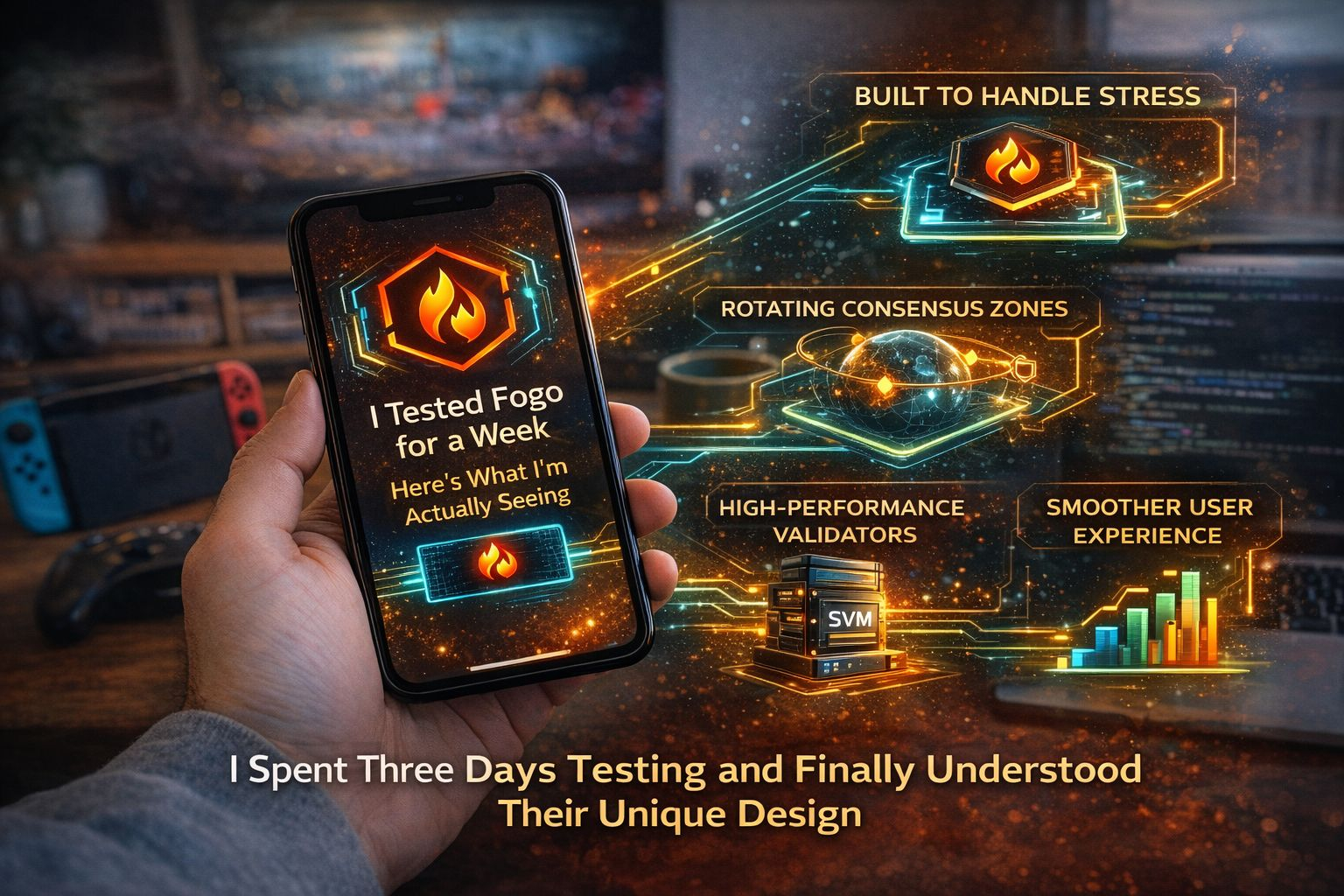
Only one geographic “zone” participates in consensus at a time. The other zones stay synced, but they don’t vote on blocks during that period. Then the active zone rotates.
When I first read this, I thought: Okay… isn’t that just centralizing things?
But when I think about it more, I see what they’re doing. Instead of forcing the entire planet to coordinate every single block, they’re shrinking the critical path at any moment. They’re distributing power across time instead of demanding global coordination every second.
You may like that trade-off. You may not. But at least they’re being honest about it.
They Care About Stability Under Stress
I’m not impressed by demo speeds anymore.
I’m watching what happens when things get messy. When people are panic-selling at 2am. When volume spikes. That’s when blockchains show their real character.
Fogo talks a lot about “tail latency” and variance. That just means they’re trying to reduce unpredictable slowdowns when traffic gets heavy.
From what I’m seeing, they care less about average speed and more about staying consistent when things get loud.
That’s a different mindset.
They Want High-Performance Validators Only
This is where things get controversial.
Fogo doesn’t want weak validators dragging down performance. They’re pushing toward a single high-performance client — Firedancer long-term, Frankendancer right now.
They’re basically saying: if you can’t keep up, you shouldn’t validate.
In traditional finance, that’s normal. Exchanges have strict technical requirements. In crypto culture, though, this feels uncomfortable. Permissionless participation is supposed to be sacred.
So I’m asking myself: What matters more — open participation or reliable execution?
There’s no perfect answer. But Fogo is clearly choosing reliability.
The risk? If one client has a bug, everyone is affected. That’s real systemic risk. I’m aware of that while I’m watching how this develops.
Validator Curation Is a Big Deal
If you start deciding who can validate, governance becomes powerful.
Now we’re talking about rules, enforcement, politics. Who decides when someone is “underperforming”? Are those rules clear? Are they applied fairly?
If those standards ever change during a crisis, markets will notice immediately.
So I’m not just watching performance. I’m watching governance discipline.
Sessions Feel Smoother But There’s a Trade-Off
Fogo Sessions are interesting.
I’ve been testing them. Instead of signing every single action, you can set scoped permissions. Paymasters handle gas fees. The experience feels smoother. Less clicking. Less friction.
Honestly, I like using it.
But I’m also thinking about the trust model. Paymasters are centralized right now. They have policies and limits. That means part of the smooth experience depends on intermediaries.
That’s not automatically bad. Traditional finance works that way. But I’m not pretending it’s pure decentralization either.
It’s a design choice.
Token Distribution Looks Cleaner
One thing I respect: they didn’t hide the unlock schedule.
A chunk of tokens was unlocked early. That created real selling pressure. Price action was rough at first. But at least it wasn’t fake scarcity.
I’ve seen too many projects where supply is locked, price pumps, and then massive unlocks crush the market later.
Fogo seems to be letting real price discovery happen early. It’s painful, but it’s honest.
What I’m Really Watching
I’m not judging Fogo on marketing claims.
I’m watching what happens during volatility.
I’m watching:
Do confirmations stay stable under stress?
Do serious trading apps choose it because execution feels better?
Does validator governance stay fair when decisions get uncomfortable?
Do Sessions become more open over time, or concentrate power?
That’s the real test.
The Big Picture
When I zoom out, I see a coherent design:
Localize consensus for speed
Rotate zones for distribution
Standardize the client for consistency
Curate validators for performance
Smooth UX with Sessions
It all fits together.
But coherence also means if one piece fails, the system feels it.
Zone rotation adds complexity.
Single-client dominance adds risk.
Validator curation adds political pressure.
Paymasters add dependency.
None of these are automatic failures. But these are exactly the stress points.
So I’m not cheering blindly.
I’m not dismissing it either.
I’m watching.
I’m using it.
I’m testing it during busy moments.
I’m paying attention to how it behaves when things get uncomfortable.
Because that’s when we find out whether Fogo is real infrastructure or just another fast chain that looks impressive until the pressure hits.