

I’ll be honest — when I first heard about Vanar, I almost ignored it.
Not because it looked weak… but because it didn’t look loud.
No over-the-top marketing.
No unrealistic “10,000 TPS will change the world tomorrow” claims.
No aggressive hype raids flooding every comment section.
And ironically, that’s exactly what made me curious enough to dig deeper.
Because sometimes the projects making the most noise aren’t the ones building the strongest foundations — and sometimes the quieter ones are laying rails for something much bigger behind the scenes.
The more I researched Vanar, the more I realized it’s not trying to compete in the usual crypto arenas.
It’s not positioning itself as “the next DeFi hub.”
It’s not chasing meme liquidity.
It’s not trying to out-market every Layer-1.
Instead, it’s focused on something that feels far more grounded — onboarding real people into Web3 through experiences they already understand.
Gaming.
Virtual worlds.
Digital ownership.
Brand ecosystems.
AI-driven environments.
And when you step back, that approach makes a lot of sense.
Most people on Earth don’t care about yield farming.
But billions care about gaming and entertainment.
That’s the user base Vanar is designing for.
At its core, Vanar is a Layer-1 blockchain — but calling it just another L1 doesn’t really capture its direction. The infrastructure is built specifically to support high-activity environments like games and metaverse spaces where thousands of micro-transactions happen constantly.
Think about buying in-game skins, upgrading characters, trading collectibles — those actions need speed and low fees or the experience breaks.
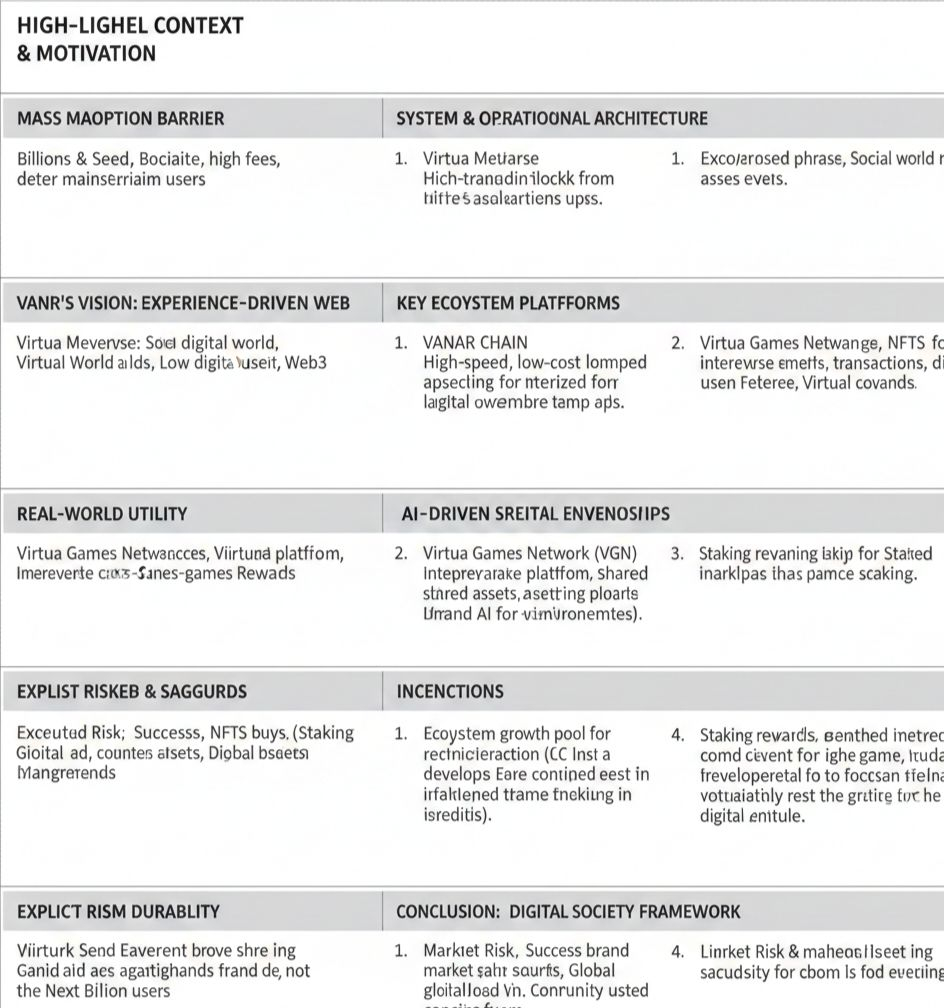
Vanar’s architecture is optimized for exactly that kind of activity. Fast confirmations, minimal costs, and the ability to scale without choking under user volume.
But what stood out to me more than the raw tech specs was the UX philosophy.
The team seems obsessed with removing friction.
They understand that the average gamer or brand customer doesn’t want to deal with seed phrases or gas settings. So the ecosystem is being designed in a way where blockchain operates quietly in the background.
Log in.
Play.
Own assets.
Trade items.
Attend events.
All without needing to “feel” crypto complexity.
That invisible blockchain layer might end up being one of Vanar’s biggest adoption drivers.
Then there’s the ecosystem itself — and this is where things start getting interesting.
Virtua, the metaverse environment connected to Vanar, isn’t just a speculative land grid. It feels more like a social digital world in progress. Users can build spaces, showcase NFT collections, create fan zones, host events, and interact with branded experiences.
It’s less about flipping land… more about what you actually do with it.
I’ve always believed metaverses only succeed when there’s activity inside them — not just ownership — and that seems aligned with how Virtua is evolving.
On the gaming side, the Virtua Games Network (VGN) connects different titles into a shared infrastructure. This means assets and rewards aren’t locked into a single game.
Imagine earning an item in one game and having value or identity carry into another. That interoperability creates stronger digital ownership — and more reason for players to stay within the ecosystem.
And of course, powering all of this is the VANRY token.
What I found notable is how embedded its utility is.
It’s not just a gas token sitting idle unless people trade it. It flows through the ecosystem — gaming rewards, NFT purchases, metaverse transactions, staking incentives, marketplace activity.
Basically, if value is moving inside Vanar, VANRY is usually involved.
That kind of usage matters long term because it creates demand from participation, not just speculation.
Token distribution also appears structured to sustain ecosystem growth — with allocations supporting rewards, development, partnerships, liquidity, and long-term team incentives.
For gaming and metaverse economies, that balance is critical. Over-incentivize and you inflate. Under-incentivize and users leave.
Use case-wise, Vanar stretches beyond what most people expect from a blockchain project.
Yes, gaming is central — but it extends into digital real estate, brand loyalty programs, NFT memberships, AI-driven content, and virtual commerce.
Brands can build tokenized engagement systems.
Creators can monetize digital spaces.
Communities can form inside immersive environments.
It starts looking less like a chain… and more like a digital society framework.
Partnerships will obviously determine how far that vision goes. The involvement of gaming studios, entertainment IP, and global brands will be key in attracting non-crypto users.
And that’s another area where Vanar feels different — the entertainment DNA behind the project. The team’s background isn’t purely blockchain-native. There’s experience rooted in gaming and media industries, which shapes how products are designed.
They’re thinking like experience builders, not just protocol engineers.
Community growth reflects that multi-audience strategy too. You don’t just see traders — you see gamers, NFT collectors, metaverse builders, and brand communities forming around the ecosystem.
That diversity could become a strength because adoption isn’t tied to one narrative cycle.
Looking forward, the roadmap focuses on expanding content and accessibility — more games, deeper metaverse functionality, AI integrations, brand collaborations, and developer tools to onboard builders faster.
When comparing Vanar to competitors, it sits in an interesting position.
Some chains specialize only in gaming.
Others focus purely on metaverse land.
Others chase AI compute narratives.
Vanar blends all three — gaming, virtual worlds, AI — plus brand infrastructure.
That multi-sector positioning could either dilute focus… or create powerful network effects if executed correctly.
Personally, I think the convergence play is intentional.
Because the future of Web3 probably won’t exist in silos.
Gaming economies will connect to virtual social spaces.
Brands will operate inside those spaces.
AI will power interactions within them.
Vanar seems to be building rails for that combined environment rather than betting on a single vertical.
And if adoption truly comes from experiences instead of finance dashboards, that strategy could age well.
Of course, none of this guarantees success. Execution always decides outcomes in crypto.
User growth.
Partnership depth.
Game quality.
Metaverse activity.
Those metrics will matter far more than token price in determining long-term relevance.
But stepping back, I can say this — Vanar feels like one of the few projects building for people who don’t even know they’ll be using blockchain yet.
And onboarding those users might be the biggest opportunity in Web3.
Because the next billion won’t arrive through trading terminals…
They’ll arrive through worlds they want to spend time in.
Curious to hear your perspective.
Do you think gaming and metaverse ecosystems will drive the next adoption wave — or will DeFi remain the primary gateway?
Let’s talk in the comments 👇
