
I've been watching decentralized exchanges struggle with the same problem for years—they copy centralized exchange architecture and wonder why execution quality never matches. When Fogo launched last month, most people focused on the speed metrics and validator colocation. I got stuck on something quieter: how Fogo processes trades fundamentally differently than every other chain, and why that difference matters more than block times.
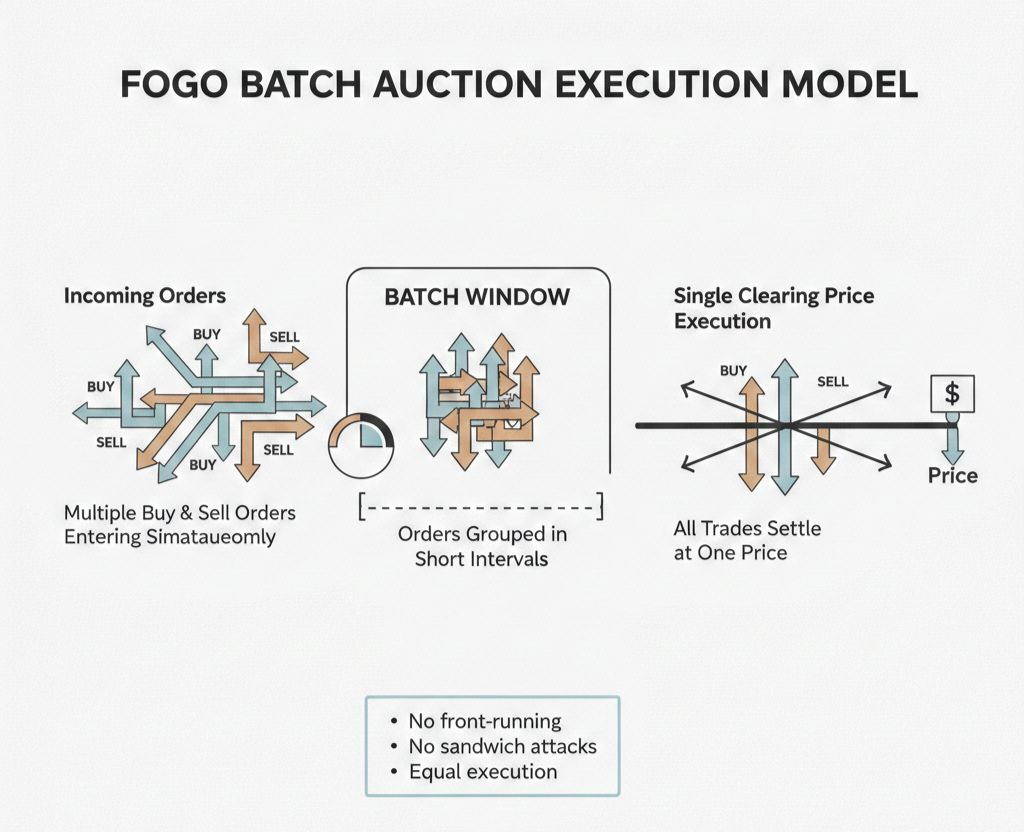
Fogo didn't just build a faster DEX. Fogo rebuilt how trading works on-chain.
Right now $FOGO sits at $0.02408, up 1.22% with 205.14 million in 24-hour volume. RSI at 54.54 showing neutral momentum after bouncing from oversold territory. Price movement tells you about speculation. What's more interesting is that Ambient Finance—the enshrined DEX at Fogo's protocol layer—processed thousands of trades over the past week using Dual Flow Batch Auctions instead of continuous limit order books. That architectural choice eliminates problems other DEXs can't solve without completely rebuilding their infrastructure.
When I first examined how Fogo handles trade execution, the economics became immediately clear. Traditional order books process transactions continuously in the order they arrive. First transaction gets executed first. Sounds fair until you realize that "order of arrival" on a blockchain means whoever pays more gas or has better connections to validators gets priority. That creates the MEV problem—bots sandwich your trades, front-run your orders, extract value from the sequencing itself. Every major DEX deals with this because continuous order books make MEV mathematically inevitable.
Fogo solved it by refusing to process trades continuously. Instead, Ambient batches incoming orders over short intervals—usually a few hundred milliseconds—and executes them all simultaneously at a single clearing price. No transaction goes first. No bot can see your order and sandwich it because there's no "before" and "after" within the batch. Everyone in the batch gets the same price, determined by the balance of buy and sell pressure across all orders. That's not just different execution mechanics. It's different economics.
Understanding that mechanism helps explain why Fogo integrated the DEX directly into the protocol layer rather than keeping it as a separate application. Batch auctions only work if you control the entire transaction flow from submission to execution. You need to collect orders, hold them temporarily, compute a clearing price, then execute everything atomically. That requires coordination at the consensus level, not just at the application layer. Fogo built Ambient as part of the base protocol specifically so batch auctions could function properly.
The result is MEV resistance that doesn't depend on hiding transaction data or using off-chain relayers. On Ethereum, projects like Flashbots try to mitigate MEV through privacy or priority ordering. Those are patches on architecture that's fundamentally vulnerable. Fogo's batch auction model makes MEV unprofitable by removing the information advantage that makes it work. When all trades in a batch execute simultaneously, there's nothing to front-run. The value extraction opportunity disappears at the architectural level.
That foundation enables something most DEXs can't deliver—predictable execution for traders who aren't playing the MEV game. If you're a market maker on a continuous order book DEX, you need to account for the fact that sophisticated bots will pick you off during volatility. You widen your spreads to compensate for that risk, which makes trading more expensive for everyone. On Fogo, batch auctions eliminate the picking-off risk because there's no continuous order flow to exploit. Market makers can quote tighter spreads because they're not constantly defending against MEV bots. Tighter spreads mean better prices for traders. Better prices mean more volume. More volume means more fees flowing to Fogo validators through revenue-sharing agreements.
What struck me about this approach is how it mirrors traditional finance without admitting it's copying homework. Stock exchanges moved from continuous trading to batch auctions for the exact same reason—eliminating information advantages from speed. IEX in the US built its entire value proposition around frequent batch auctions that prevent high-frequency traders from exploiting speed advantages. Fogo recognized that the problem exists on-chain too and implemented the same solution. The difference is that Fogo can enforce batch execution at the protocol level, while traditional exchanges need regulatory approval and constant monitoring.
The obvious criticism is that batching adds latency. If trades batch every few hundred milliseconds, that's slower than continuous execution where your trade might settle in the next block. That's true but misses the point. The latency matters less than execution certainty. Would you rather have your trade execute 200 milliseconds faster but at a worse price because bots sandwiched you, or wait the extra milliseconds and get fair execution? For most traders moving real size, the answer is obvious. Speed matters, but not getting MEV'd matters more.
Meanwhile, the validator structure reinforces why Fogo's batch auction model works consistently. All validators operate from a colocated facility with 40-millisecond block times. That predictability means batch windows stay consistent. On chains where block times vary, batch auctions become unreliable because you can't guarantee when the next batch will process. Fogo's consistent block production makes batch auctions dependable enough to build trading strategies around. The validator colocation that everyone criticizes as centralized is actually what enables the fair execution model to function reliably.
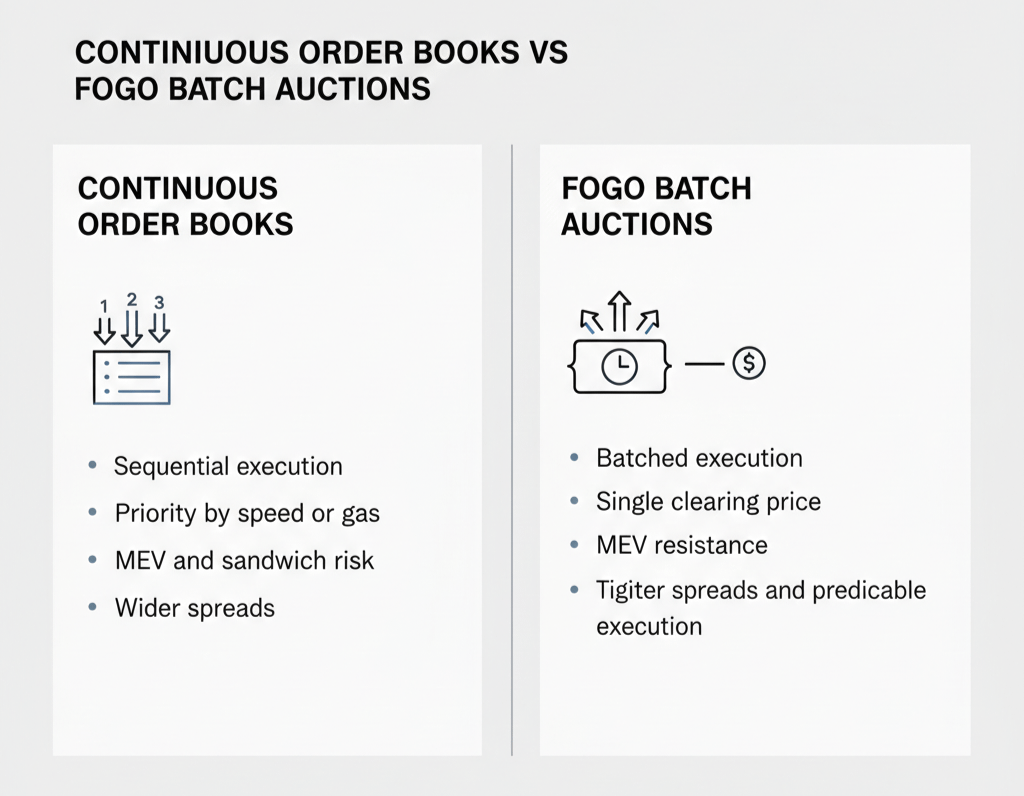
Batch auctions turn speed into predictability instead of an MEV weapon.
What this reveals about where DeFi is heading is that execution quality is starting to matter more than just accessing liquidity. Early DeFi succeeded by making trading permissionless. Now that liquidity exists, the next competition is who can offer the best execution. Continuous order books created MEV problems that extracted billions in value from users. Fogo's batch auction model eliminates those problems architecturally rather than trying to patch them with privacy or ordering tricks.
The current price of $0.02408 sitting 61% below January's all-time high reflects typical post-launch dynamics. Airdrop recipients sold, speculators moved on, and the token found its floor. But underneath that price action, Ambient keeps processing batches every few hundred milliseconds, executing trades fairly, and generating fees that flow to validators through revenue-sharing agreements. The gap between token performance and execution innovation tells you about timing, not fundamentals.
Volume of 205.14 million $FOGO traded today shows sustained interest beyond launch hype. Whether that interest converts to trading volume on Ambient depends on traders discovering that fair execution matters enough to justify learning a new model. Batch auctions feel different from continuous order books. They require trusting that simultaneous execution actually prevents MEV rather than just moving it somewhere less visible. Early signs suggest professional traders understand the value, but retail adoption remains to be seen.
Time will tell if batch auctions become standard for on-chain trading or if most users prefer the familiar continuous model despite its MEV problems. For now, Fogo proves you can build fair execution architecturally rather than hoping economic incentives prevent value extraction. That's a foundation worth watching even if the token price hasn't caught up yet.
