
I don’t get excited easily by new blockchains. Over the years, I’ve seen countless Layer-1 projects promise speed, scalability, and innovation, only to deliver slightly improved versions of what already exists. That’s exactly why Fogo caught my attention. Not because it’s loud, not because it’s everywhere on social media, but because it feels deliberately focused. Fogo doesn’t try to be everything for everyone. It tries to solve one problem extremely well: real-time, high-performance on-chain finance.
Most blockchains today are overloaded. They want to support payments, NFTs, gaming, social apps, governance, DeFi, and whatever the next trend might be — all on the same base layer. The result is predictable: congestion, latency, delayed execution, and poor trading experiences. Fogo starts from a different mindset. It asks a simple but powerful question: what if a blockchain was designed from day one specifically for speed-critical financial activity?
That single design choice changes everything.
Fogo is a high-performance Layer-1 blockchain optimized for ultra-low latency and fast finality. It’s not just about higher transactions per second on a chart — it’s about predictability. In trading, predictability matters more than raw throughput. When liquidations happen late, risk spreads. When orders fill too slowly, traders lose money. When block times fluctuate, entire strategies break. Fogo’s architecture is built to minimize those issues by keeping execution tight, fast, and consistent.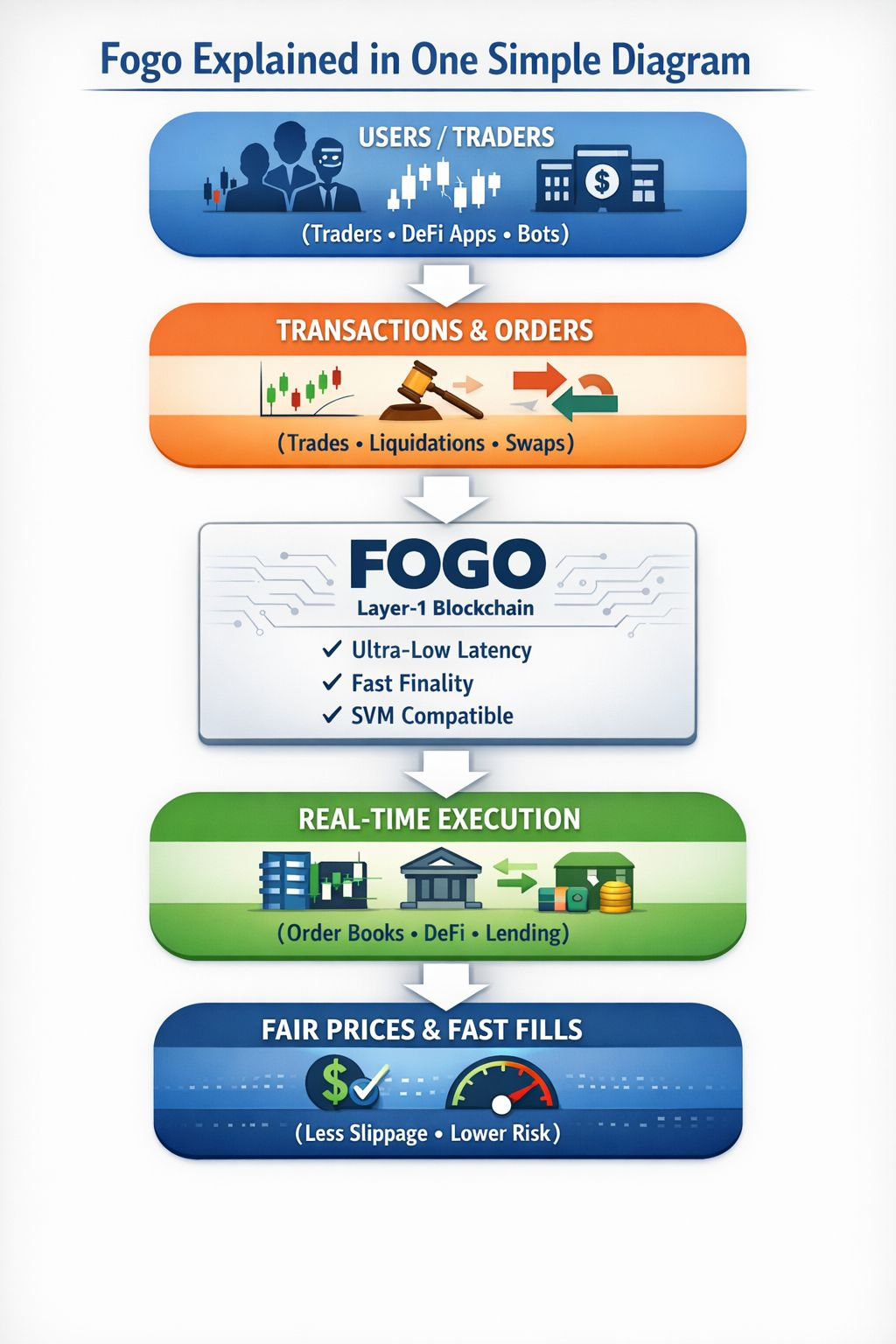
One of the most important technical decisions behind Fogo is its compatibility with the Solana Virtual Machine (SVM). This means developers familiar with Solana tooling don’t need to relearn everything from scratch. They can deploy performance-heavy applications — especially trading and DeFi protocols — without sacrificing execution speed. Combined with an infrastructure optimized for milliseconds, not seconds, Fogo positions itself closer to the experience traders expect from centralized exchanges, while staying fully on-chain.
To understand why this matters, think about how most DeFi works today. Automated market makers dominate because they’re simple and resilient on slower chains. Order books, which are standard in traditional finance, struggle on-chain because latency destroys their efficiency. Fogo flips that limitation. With fast finality and low latency, on-chain order books become practical again. That opens the door to better price discovery, tighter spreads, and more transparent markets.
This isn’t just theory. The early Fogo ecosystem is already shaping itself around these strengths. We’re seeing trading platforms designed for speed, lending protocols that rely on rapid liquidations to control risk, and staking mechanisms focused on capital efficiency rather than idle locking. Instead of copying what works on slower blockchains, builders on Fogo are designing products that assume fast execution as a baseline.
The FOGO token itself follows this same practical philosophy. It isn’t framed as a meme or a purely speculative asset. Its role is clear: securing the network through staking, powering transactions, supporting governance, and incentivizing ecosystem growth. When token utility is directly tied to real network usage, sustainability becomes much more realistic. Growth isn’t dependent on hype cycles alone; it’s linked to whether people actually use the chain.
What really stands out to me is how calm Fogo feels compared to most new Layer-1 launches. There’s no attempt to dominate every narrative. No exaggerated promises of replacing all existing blockchains. Just a clear lane and disciplined execution. In a market full of noise, that restraint is refreshing.
Will Fogo replace Ethereum or Solana? That’s the wrong question. It doesn’t need to. If Fogo becomes the go-to infrastructure for real-time on-chain trading and performance-sensitive DeFi, it earns a permanent role in the crypto stack. Speed isn’t a luxury anymore — it’s a requirement. And Fogo understands that at a structural level, not just a marketing one.
I see Fogo as part of a broader shift in crypto: specialization. General-purpose chains will always exist, but the future belongs to blockchains that are unapologetically built for specific use cases — and built well. Fogo is a strong example of that future taking shape.
If you’ve read this far, I’m genuinely curious about your perspective. Do you think performance-focused blockchains like Fogo are the next evolution of DeFi, or will general-purpose chains continue to dominate everything? Drop your thoughts in the comments — I’d love to discuss this with you.