
The launch of a blockchain mainnet is often treated as the finish line, but in reality, it is only the beginning of a far more difficult journey. For Fogo, the transition from technical promise to real-world adoption represents its most important phase. While early benchmarks and testnet performance may demonstrate theoretical speed and efficiency, the true measure of success lies in how the network performs under real demand, real users, and real economic activity.
Fogo’s immediate technical roadmap focuses heavily on ensuring network stability. In the early stages of any blockchain, stability is more valuable than raw speed. Even the fastest network can lose credibility if it suffers outages, delayed confirmations, or inconsistent performance. This phase will require constant monitoring, rapid bug fixes, and infrastructure optimization to ensure the mainnet can handle growing transaction volumes without compromising reliability.
Another critical technical priority is the gradual expansion of Fogo’s validator set. Validators are the backbone of decentralization, and their distribution determines how secure and censorship-resistant a network truly is. Initially, many new blockchains operate with a limited validator group to maintain performance. However, long-term credibility depends on expanding participation while maintaining efficiency.
The validator scaling process can be understood through the following flow structure:
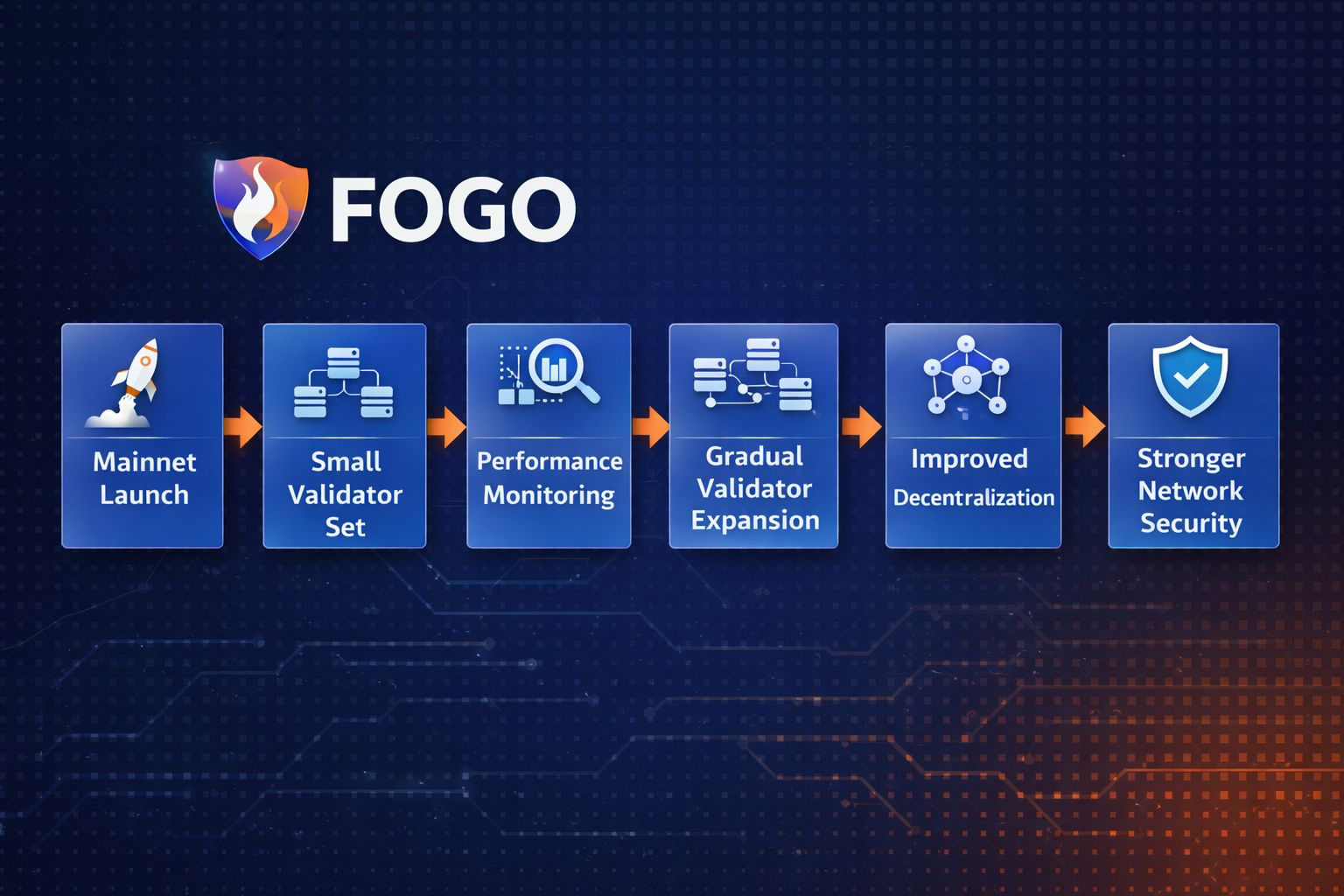
This progression highlights how decentralization is not instant but evolves over time.
At the same time, Fogo must onboard its first wave of decentralized applications, commonly known as dApps. These applications are essential because they transform a blockchain from infrastructure into a functioning ecosystem. Without useful applications, even the most advanced blockchain remains an empty platform with no real-world relevance.
Early dApps often play a disproportionate role in shaping a network’s reputation. Successful applications attract users, developers, and liquidity, creating a positive feedback loop. Conversely, a weak initial ecosystem can slow adoption and reduce momentum. For Fogo, attracting high-quality projects will be critical in defining its early identity.
To support this process, Fogo’s broader adoption strategy will focus on developer grants and ecosystem funding. Financial incentives encourage developers to experiment, build, and deploy applications on the network. Many of today’s leading blockchain ecosystems achieved early growth through aggressive developer support programs, which helped accelerate innovation.
Strategic partnerships will also play a central role. Collaborations with infrastructure providers, wallets, exchanges, and existing projects can significantly reduce adoption barriers. These partnerships help integrate the network into the broader blockchain economy, making it easier for users and developers to participate.
The importance of ecosystem development can be illustrated through this simplified growth flow chart:
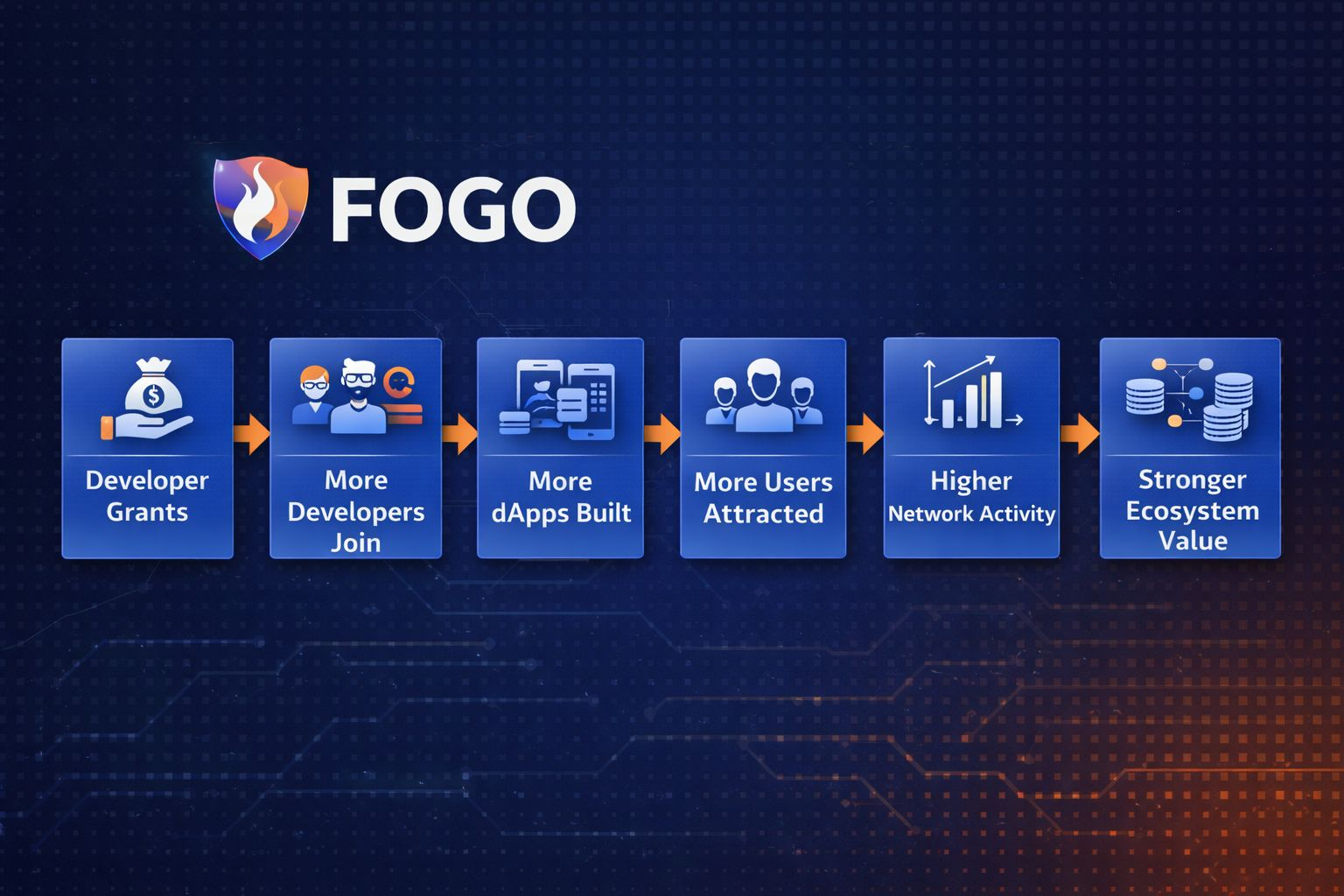
This cycle demonstrates how adoption builds upon itself.
However, speed alone will not guarantee Fogo’s success. Many blockchain projects have claimed superior performance, but only a few have managed to convert that advantage into meaningful adoption. Real-world usage depends on usability, reliability, and the availability of useful applications.
The difference between theoretical performance and practical success can be illustrated in the following comparison:
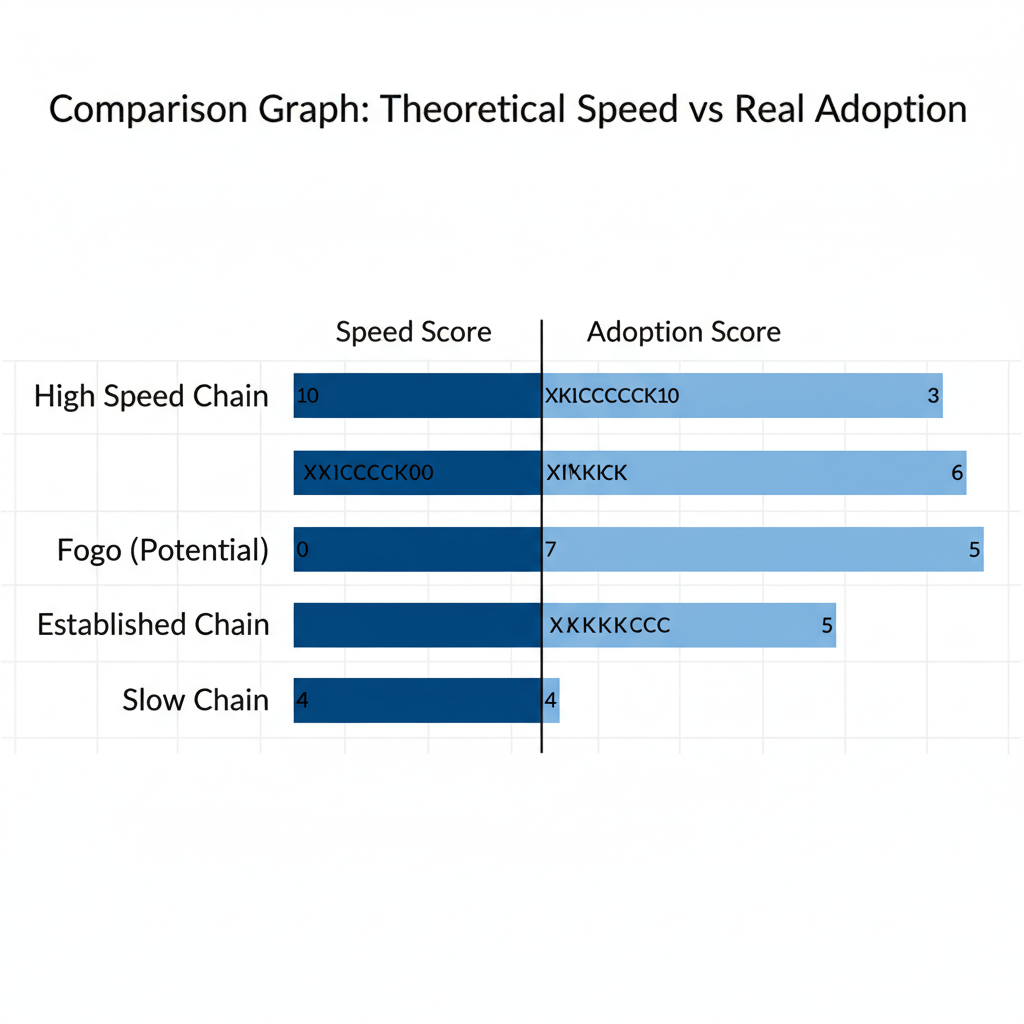 This shows that speed alone does not automatically translate into adoption.
Fogo’s long-term viability will ultimately depend on the originality and usefulness of the applications built on top of it. Networks that enable unique use cases tend to develop stronger ecosystems. Innovation, rather than raw performance, is often the deciding factor in long-term success.
The coming year will serve as a critical proving ground. During this period, Fogo will face real-world stress, including unpredictable user behavior, market volatility, and technical challenges. How the network responds to these pressures will shape its reputation.
If Fogo successfully maintains stability while expanding decentralization and supporting developers, it could position itself as a competitive platform. Strong early execution would build trust among users, investors, and builders, creating a foundation for sustained growth.
Ultimately, Fogo’s future will not be decided by its launch, but by its ability to deliver consistent performance and meaningful utility over time. The transition from promise to proof is the most difficult stage for any blockchain. Fogo has now entered that stage, and the results of this proving ground will determine whether it becomes a lasting ecosystem or simply another experimental network.