
For a long time I believed the main problem in crypto was speed. Everyone kept repeating it, so it sounded obvious. Faster blocks, higher throughput, lower latency that was supposed to fix everything. But the longer I watched people actually use these systems, the less that explanation made sense. Even on fast chains, people behaved carefully. They hesitated before clicking. They checked the explorer twice. They avoided doing important actions when the network felt “busy.” It wasn’t slowness making them pause. It was uncertainty. The system didn’t feel predictable enough to relax around.
You could see it most clearly in how developers wrote their applications. Instead of writing clean logic, they wrapped every action in safety nets. Retry loops, delayed confirmations, mirrored records, manual overrides. None of this showed up in the public narratives about performance, yet everyone quietly built it. Over time it felt like blockchains weren’t just infrastructure they were environments you had to manage emotionally. You didn’t trust them; you negotiated with them.
When I look at Fogo, it feels less like someone trying to win a race and more like someone tired of negotiating. The idea seems simple: maybe the real scaling problem is behavioral. If users constantly adjust themselves to avoid strange outcomes, the system hasn’t scaled no matter how fast it is. A reliable environment should let people act normally, without rituals.
The decision to keep the Solana Virtual Machine intact says a lot about that mindset. Instead of inventing new rules to stand out, it avoids forcing developers to rethink execution from scratch. Anyone who has built across multiple chains knows the mental exhaustion of relearning edge cases. You don’t just write code you constantly simulate how the chain might surprise you. Removing that cognitive burden is not flashy, but it’s deeply calming.
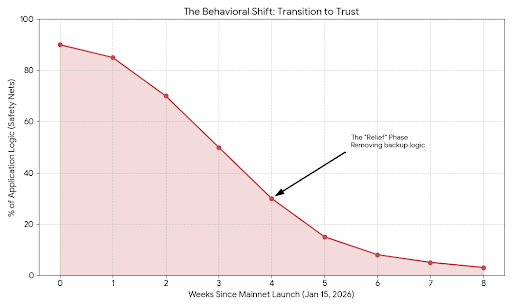
The first developers approached it cautiously. They didn’t assume it would behave well. They logged everything, duplicated important state elsewhere, and treated it like something useful but not fully trustworthy. Not because they disliked it, but because experience had taught them systems eventually act strangely under pressure. They were waiting for the moment it would.
Weeks passed. Then more weeks. Nothing odd happened. No strange ordering during activity spikes, no inconsistent responses across nodes. You could almost feel their posture change. Not excitement relief. They started removing backup logic, one small piece at a time. That process told more than any announcement could. People don’t delete safeguards unless reality convinces them.
New builders arrived without carrying that history. They designed as if responsiveness was normal. Their apps looked simpler, almost naive compared to the earlier defensive versions. Watching the two generations side by side was striking. One group wrote around fear. The other wrote around expectation. When a platform produces that difference, it’s no longer just software it’s shaping human confidence.
Over time conversations changed. At first, people talked about whether the network would hold up. Later, they talked about what they could build now that they didn’t have to plan for unpredictable behavior. The focus moved from the system to the work itself. That’s a quiet milestone. Infrastructure becomes real when it disappears from the center of attention.
What stands out is restraint. Many projects expand quickly to stay interesting. But every added feature multiplies possible edge cases, and edge cases are where trust dies. Here the pace feels deliberate, almost protective. The priority seems to be preserving expectations rather than constantly refreshing them. That discipline doesn’t generate hype, but it preserves confidence.
You can see trust forming in small human habits. Engineers stop staring at monitoring dashboards late at night. Teams remove redundant checks. Integrations connect directly instead of through layers meant to soften failure. These aren’t announcements they’re behavioral changes. And behavior is harder to fake than enthusiasm.
If a token exists in this kind of environment, it stops feeling like a lottery ticket and starts feeling like a promise to maintain stability. Governance becomes less about dramatic upgrades and more about protecting the consistency people rely on. Holders begin to act like caretakers instead of spectators. The tone becomes quieter, but more serious.
What I find most meaningful is how minor inconsistencies are treated. In many systems, only downtime counts as failure. Here even small unpredictability matters because humans feel it immediately. You can forgive a rare outage. You struggle to forgive a system that behaves slightly differently every day. Designing against that kind of discomfort requires empathy as much as engineering.
Eventually you notice something subtle: people stop discussing the chain itself. They just use it. Builders mention their product, their workflow, their users not the infrastructure underneath. That’s when a technology shifts from experiment to environment. It no longer needs attention to survive.
The difficult part ahead will be change. Stability builds trust, but growth demands evolution. The challenge is improving without making people relearn confidence. Move too quickly and old fears return. Move too slowly and relevance fades. The balance will define whether the calm feeling remains.
If that discipline continues, Fogo might not wA the loudest place in crypto. Instead it could become the place people quietly depend on when they need something to keep working tomorrow exactly the way it worked today. And in a space built on constant excitement, something dependable can feel almost emotional like finally not needing to worry anymore.
@Fogo Official #fogo #Fogo $FOGO