
When people talk about new blockchains, the conversation usually sounds the same. Faster. Cheaper. More scalable. It has almost become a ritual every new Layer-1 promises to fix the weaknesses of the last one. But Fogo feels different. It doesn’t arrive with loud rebellion energy. It arrives with a specific purpose.
To understand Fogo, you have to understand the moment we’re in. Blockchain technology has matured past the experimental stage. The early years were about proving decentralization works. Bitcoin proved value can move without banks. Ethereum proved programmable money is possible. Solana proved that blockchains don’t have to be slow.
Solana’s breakthrough was performance. By introducing parallel execution and Proof of History, it showed the world that a decentralized network could process transactions at speeds that once seemed impossible. Developers flocked to it. DeFi protocols flourished. But something became clear as the ecosystem evolved: raw speed is not enough. What financial markets really need is consistency predictable execution, stable block times, minimal latency spikes.
This is where Fogo enters the story.
Fogo is a high-performance Layer-1 blockchain built around the Solana Virtual Machine (SVM). That detail is important. Instead of building a brand-new execution environment from scratch, Fogo uses the same virtual machine that powers Solana. This means developers who already understand Solana’s architecture can build on Fogo without starting over. Smart contracts, tooling, and workflows feel familiar. It’s not a disruption — it’s an extension.
But Fogo is not trying to be “another Solana.” It is trying to sharpen what Solana started.
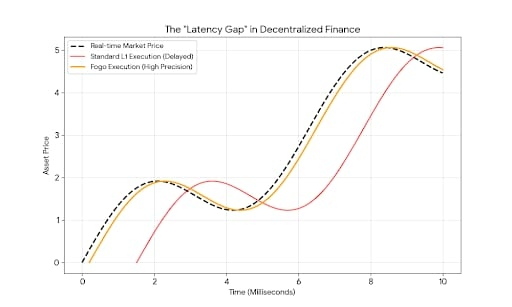
At the core of Fogo’s design is an obsession with latency. Not just throughput numbers for marketing slides real, measurable latency. The kind that matters for trading engines, liquidation systems, and on-chain order books. In decentralized finance, milliseconds can mean millions. When prices move quickly, execution delays create unfair advantages and unpredictable outcomes. Fogo is built to reduce that gap.
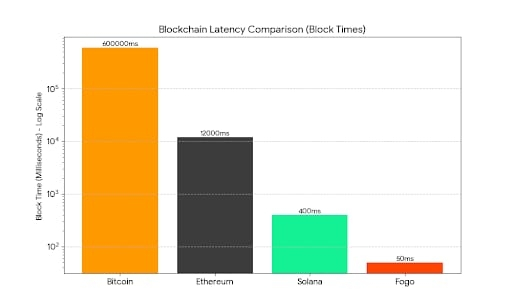
One of the ways it does this is through the Firedancer validator client. Firedancer was originally developed to push Solana’s performance limits even further. It’s engineered for efficiency at a deep systems level networking, memory management, transaction processing. Fogo embraces this implementation as its foundation. Instead of juggling multiple validator clients, it leans into a unified performance standard.
The result is a network targeting block times measured in tens of milliseconds. That doesn’t just make it “fast.” It changes how the chain feels. Transactions don’t sit waiting in long queues. They move almost immediately. For traders and financial applications, that responsiveness matters more than theoretical TPS ceilings.
Fogo also experiments with how validators are organized geographically. Traditional blockchains emphasize constant global distribution. Fogo introduces a rotating structure where validators cluster within specific regions during certain periods to reduce physical network delay. Later, those zones rotate. The goal is to balance decentralization with performance, rather than treating them as enemies.
This design choice is controversial and intentionally so. It forces the industry to confront an uncomfortable truth: financial systems have always optimized for proximity. Stock exchanges operate in tightly controlled data centers for a reason. Fogo doesn’t pretend that physical distance is irrelevant. It treats latency as a technical constraint to engineer around, not ignore.
Beyond infrastructure, Fogo pays attention to user experience. One small but meaningful innovation is session-based permissions. Anyone who actively uses DeFi knows how exhausting constant transaction signing can be. Every interaction demands another approval. Fogo introduces temporary session authorizations that allow users to interact fluidly within defined limits. Security remains intact, but the friction drops.
These details reveal something deeper about Fogo’s philosophy. It is not chasing hype cycles. It is targeting serious financial use cases decentralized order books, perpetual futures, high-frequency strategies, liquidation engines. These systems require precision and reliability, not just decentralization in theory.
The FOGO token powers the network used for gas fees, staking, and governance. Early in its development, the project reportedly shifted away from a large private presale toward broader community distribution. That decision signaled an awareness of the trust issues that have plagued many new chains. Sustainable ecosystems are built by users and builders, not just early investors.
Still, no system is without tradeoffs. High performance networks often require stronger hardware from validators. Geographic clustering raises decentralization debates. Adoption depends on liquidity, and liquidity depends on trust. Fogo’s future will depend less on its architecture impressive as it is and more on whether developers and traders see it as indispensable.
What makes Fogo interesting is not just what it does, but what it represents. The first generation of Layer 1 blockchains tried to be universal platforms. The emerging generation is more specialized. Some chains optimize for gaming. Some for privacy. Fogo optimizes for real-time finance.
It reflects a broader shift in the industry: blockchain is no longer just about decentralization ideology. It’s about competing with existing systems. If decentralized markets want to rival centralized exchanges, they must operate at comparable speeds. They must settle transactions quickly. They must behave predictably.
In that sense, Fogo is less about being the biggest chain and more about being the most precise one.
Its name meaning “fire” feels symbolic. Fire refines metal. It removes impurities. Fogo attempts to refine blockchain execution itself, burning away latency and unpredictability. Whether it becomes a dominant financial venue or a catalyst for further innovation, it pushes the conversation forward.
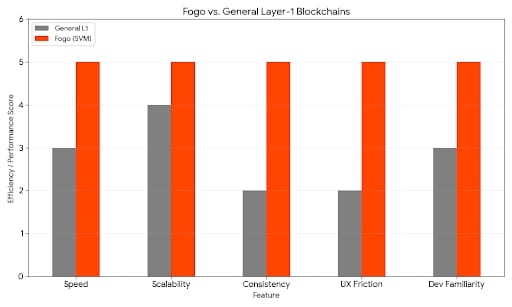
The real question Fogo asks is simple but powerful: can decentralization operate at the speed of modern markets?
That question will shape the next era of blockchain infrastructure. And Fogo is one of the boldest attempts to answer it not through slogans, but through engineering.