
While exploring the cross-platform asset utility of $VANRY on Vanar Chain, one detail lingered: the quiet way token rewards in games like World of Dypians draw in thousands of players without demanding they grasp blockchain mechanics. It wasn't the marketing promises of seamless integration across games, media, and marketplaces that paused me—it was seeing how, in practice, the token functions more as a subtle incentive layer than a flashy bridge between worlds.
Take the stat from their partnerships: over 30,000 active players in a single game earning $VANRY directly through gameplay. This isn't abstract; it's real engagement where rewards flow on-chain, convertible to assets that can theoretically move to marketplaces like Bazaa_io. But the behavior shifts subtly—players aren't just grinding for fun; many treat these earnings as tradable items, fostering secondary markets that extend beyond the game. Vanar's design choice here, with programmable royalties baked in, ensures creators capture a cut from every resale, turning one-time sales into recurring streams. Yet this same mechanism invites speculation, where asset values fluctuate based on market sentiment rather than in-game utility.
In media and broader entertainment, like the Virtua Metaverse, the cross-platform promise feels aspirational but less immediate. Assets minted in one context don't yet fluidly dominate marketplaces or media experiences in the same volume as gaming rewards do. It's as if the chain prioritizes reliable, low-friction entry points for developers in high-engagement sectors first, leaving wider interoperability to evolve organically.
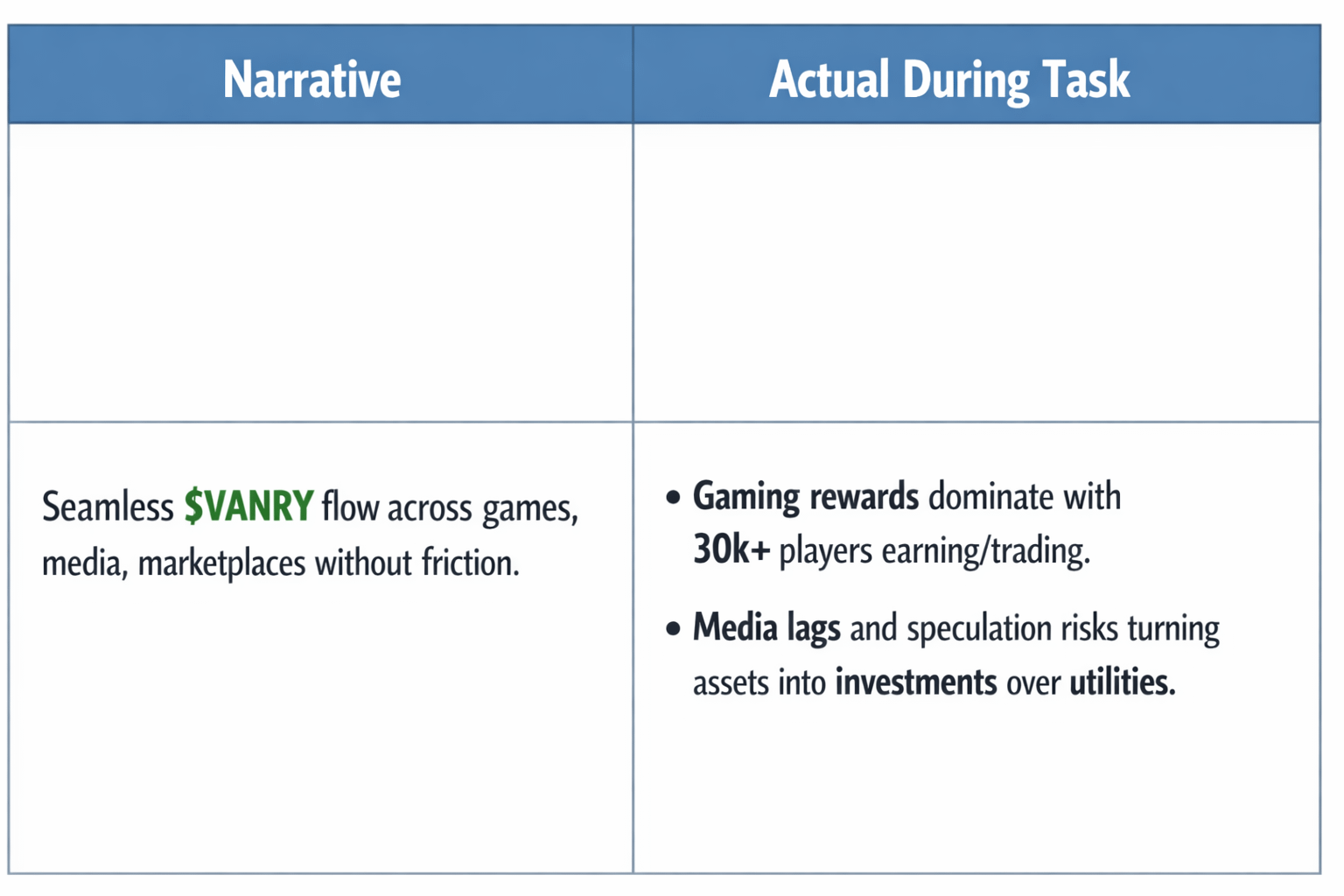
Reflecting on this, it reminds me how blockchain projects often start with one strong foothold—here, gaming's economic redesign—before expanding. There's a calm efficiency in that focus, but it leaves room for uneven adoption across promised domains.
What if media integrations accelerate? Does the utility stay creator-centric, or does trading overshadow the original intent?
@Vanarchain #Vanar