
I used to think “faster” was always the answer. Faster phone. Faster internet. Faster laptop. Then one day my laptop started overheating every time I pushed it too hard, and I realized something simple: speed without structure eventually cracks. That thought comes back to me whenever I read debates about blockchain scaling. Horizontal scaling versus vertical speed sounds like an engineering argument, but it feels more like a personality test.
Vertical speed is the obvious move. Make the chain faster. Shorter block times, meaning transactions are confirmed more quickly. Higher throughput, which simply means more transactions processed per second. Lower latency, so the delay between clicking “send” and seeing confirmation shrinks. On paper, it looks clean. If a network confirms in 400 milliseconds instead of 4 seconds, that difference matters. Especially for traders. When markets move fast, hesitation costs money. I understand why speed becomes the headline.
But here’s the thing people don’t say enough: peak speed numbers are usually measured in controlled conditions. Real markets are messy. They spike. They stall. They overload systems at the worst possible moments. A chain that screams during calm hours can behave very differently during panic. I’ve watched that happen before. It’s not dramatic when it breaks. It’s just slow. And frustrating.
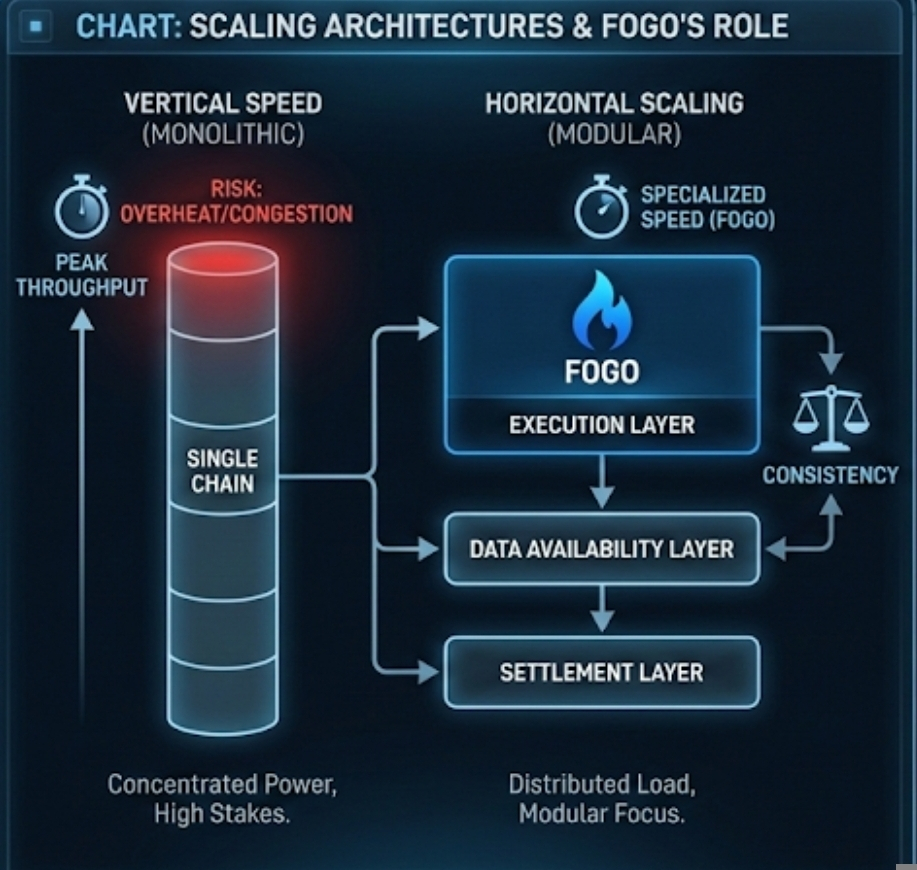
Horizontal scaling feels less glamorous. Instead of making one chain handle everything, you spread activity across multiple layers or parallel environments. Execution layers process transactions. Data availability layers store and publish the data so others can verify it. Settlement layers finalize and secure the results. It’s more modular. More distributed. Harder to explain in one sentence.
That’s where Fogo becomes interesting to me. is often described through its speed profile. Low latency. Fast finality, which means transactions become irreversible quickly. For trading environments, that matters a lot. If confirmation takes five seconds, that feels like an eternity during volatility. If it takes under a second, behavior changes. Traders take tighter positions. Bots adjust faster. Liquidity feels more alive.
But I don’t see Fogo as just “the fast one.” That framing feels lazy. From what I’ve observed, it behaves more like a specialized execution layer than a general-purpose everything-chain. That distinction matters. Execution layer simply means it focuses on processing transactions efficiently, possibly relying on other systems for long-term security or data storage. It’s a modular mindset, even if the marketing leans toward speed.
There’s a quiet tension there. If you optimize vertically, you concentrate power and responsibility. You push hardware, validators, networking limits. The upside is responsiveness. The risk is fragility or centralization pressure if only high-end infrastructure can keep up. If you scale horizontally, you distribute responsibility. You gain resilience in theory. But you also introduce complexity. More moving parts. More assumptions about how layers interact. And complexity has its own failure modes.
What complicates this debate even more is perception. On platforms like Binance Square, numbers win attention. Throughput metrics. Latency screenshots. Dashboard graphs. Ranking systems and engagement metrics reward content that is easy to compare. “X chain is 5x faster than Y.” That narrative spreads because it’s digestible. AI-driven visibility systems amplify posts that drive interaction, and clean performance stats drive interaction. It subtly shapes how projects position themselves. It also shapes how communities evaluate them.
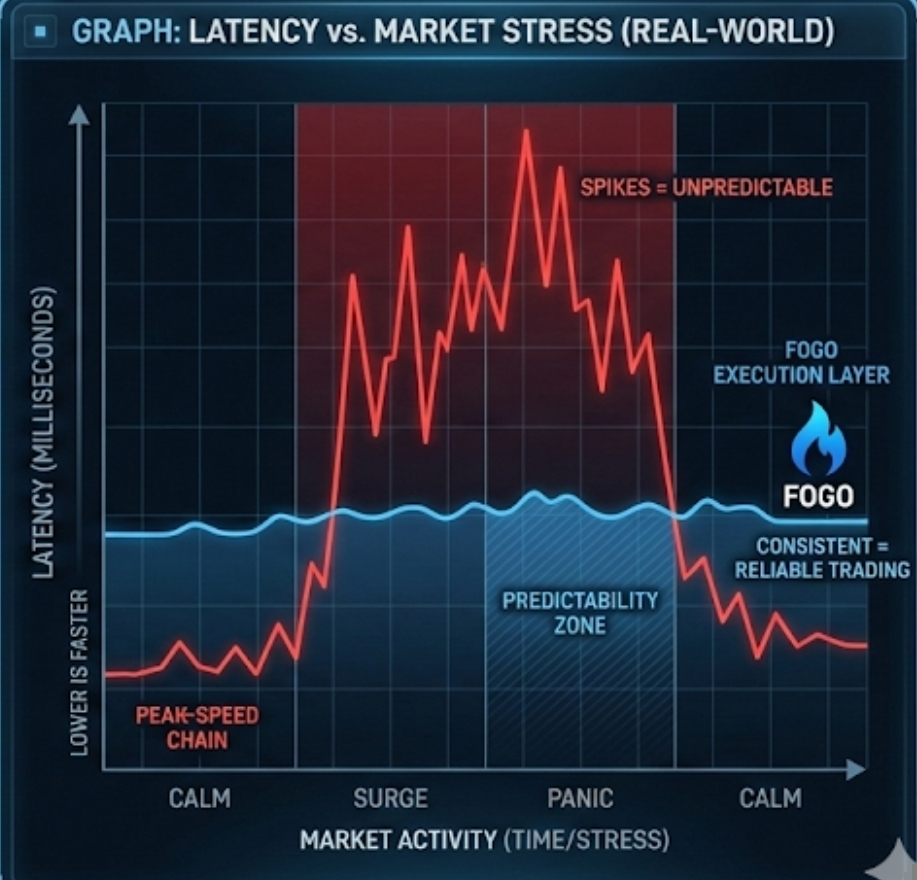
I sometimes wonder if we’re measuring the wrong thing. Not entirely wrong, but incomplete. In trading, consistency is underrated. A network that confirms every transaction in one second, reliably, under stress, might be more valuable than one that occasionally confirms in 200 milliseconds but struggles during surges. Markets don’t just price speed. They price predictability.
That’s where horizontal ideas creep back in. Splitting responsibilities across layers can reduce systemic pressure. If one component is stressed, others continue functioning. In theory. In practice, integration becomes the hard part. When something goes wrong, users don’t care which layer failed. They just know it failed.
So where does Fogo fit? I don’t think it sits cleanly in one camp. It leans into vertical performance because its use case—especially trading-heavy environments—demands it. Low latency changes user behavior. It reduces mempool congestion, which is the waiting area where transactions compete before being confirmed. Fewer mempool games mean fewer surprise fee spikes. That’s attractive.
But if Fogo positions itself as an execution-focused layer within a broader modular ecosystem, then it is indirectly part of a horizontal framework too. It optimizes one piece of the stack instead of claiming to be the entire stack. That feels more realistic than trying to win every scaling battle at once.
There are risks, obviously. If it depends on external layers for settlement or data security, then weaknesses elsewhere can ripple inward. If it becomes too optimized for high-frequency actors, smaller participants might feel sidelined. Speed can empower professionals more than retail users. That tension isn’t theoretical. It shows up in liquidity patterns.
I don’t see horizontal scaling and vertical speed as opposites anymore. They’re instincts. One says, “push harder.” The other says, “spread smarter.” Fogo seems to push hard in its lane. Whether that becomes a long-term advantage depends less on benchmark numbers and more on how it behaves when the market is uncomfortable.
And markets are almost always uncomfortable eventually. That’s the real test. Not how fast something runs when everything is calm, but how steady it feels when it isn’t.