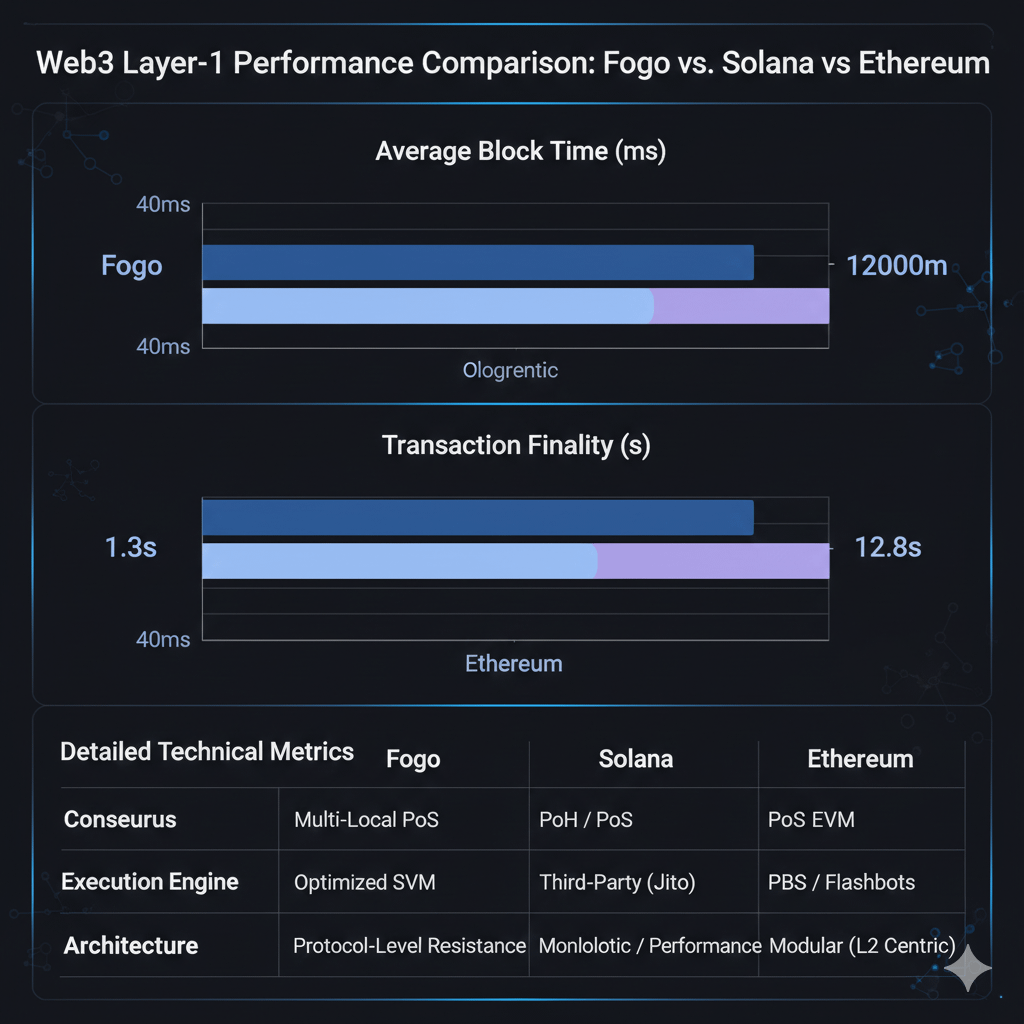
The digital asset landscape is undergoing a structural shift from the Batch Era characterized by high-latency settlement cycles and sequential executionto the Synchronous Era. At the vanguard of this transition is Fogo, a purpose built Layer1 blockchain engineered to function as the Fiber Optic Highway of Web3. While legacy architectures operate like congested urban streets, forcing participants to navigate the friction of MEV (Maximal Extractable Value) and variable block times, Fogo provides a dedicated, high frequency conduit for value. By leveraging a pure play Firedancer optimization on the Solana Virtual Machine (SVM) stack, Fogo achieves a deterministic execution environment that approximates the speed of light in local network conditions.
Fogo’s competitive moat is not merely high throughput, but determinism. In the context of institutional grade trading and real-time decentralized applications, the arrival time of data is as critical as the data itself. Fogo’s Highway metaphor extends to its infrastructure where Ethereum represents a robust but slow interstate for heavy freight, and Solana a multi lane expressway occasionally prone to bottlenecks, Fogo is the dedicated optical line for high frequency impulses.
Fogo’s architecture employs sub second finality and MEV resistance through its 40ms block frequency. By reducing the time between blocks to the limits of physical propagation, the extraction window for sandwich attacks and front-running is virtually eliminated. This architectural choice forces MEV bots to compete on the merits of liquidity provision rather than predatory latency exploitation.
The economic stability of a high performance network is inextricably linked to its supply side management. Fogo’s tokenomics are designed to prevent liquidity shocks while ensuring that the infrastructure's builders remain incentivized during the critical expansion phase of the 2027 horizon.
Fogo operates with a fixed total supply of 10 billion tokens. As of Q1 2026, the current circulating supply stands at 3.78 billion FOGO. This initial float comprises
Providing immediate decentralization of the fee paying and staking base.
Fueling the earlystage deployment of dApps that require sub 40ms execution.
Ensuring deep liquidity for the native Central Limit Order Book (CLOB) primitives.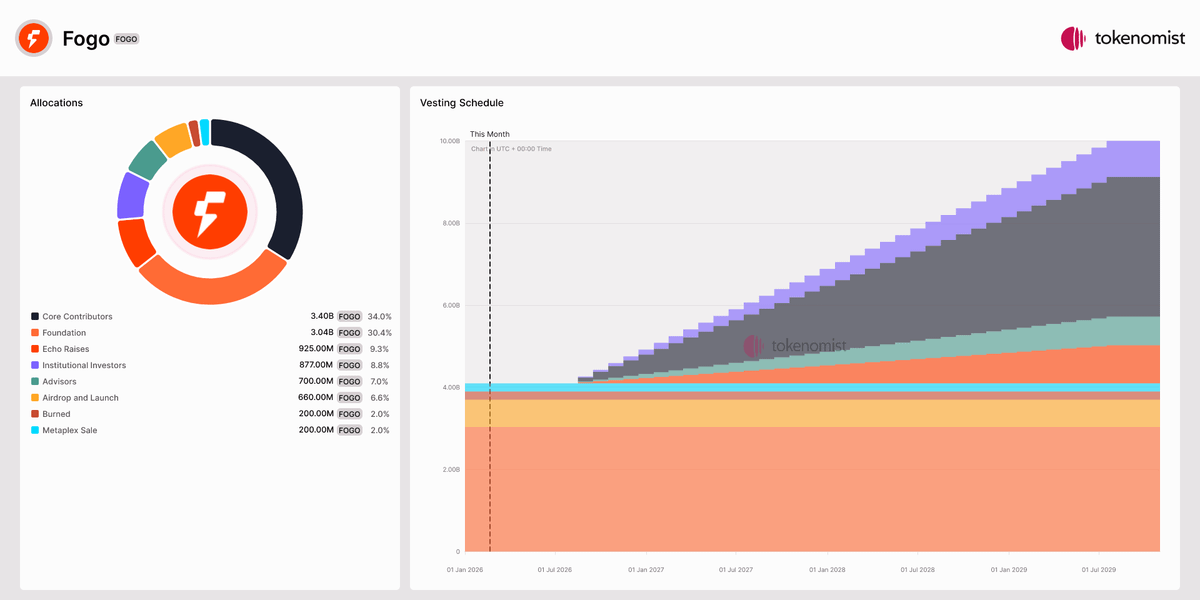
The remaining 6.22 billion tokens are subject to a rigorous vesting schedule. This delta represents the latent energy of the network, designed to be released only as the ecosystem’s utility matures.
The most significant event in Fogo’s economic lifecycle is the 34% core contributor allocation. This 3.4 billion FOGO portion is governed by a one year cliff followed by a four year linear vesting period. Crucially, the unlock trigger for the primary tranche of this allocation is set for January 2027.
By locking 34% of the supply until 2027, the core development team is forced to prioritize the Fiber Optic stability of the network over short-term market fluctuations. This creates a skin in the game mandate that spans the entire initial growth cycle.
The 2027 horizon provides the network three years from its initial conceptualization to build sufficient Total Value Locked (TVL) and transaction volume. By the time the cliff expires, the Highway must be handling enough traffic (gas consumption) to absorb the potential sell side pressure through native utility demand.
The synthesis of this lock-up structure suggests a thesis of Forced Long-Termism.In the volatile Web3 landscape, early stage contributor exits often lead to brain drain and technical stagnation. Fogo’s 2027 cliff acts as a gravitational anchor.
Because 34% of the supply is strictly non circulating during the 2026 expansion phase, the float remains concentrated among active users and institutional backers who are subject to their own separate vesting. This reduces the risk of a founder dump during the critical period when the 40ms blocktime infrastructure is being stress tested.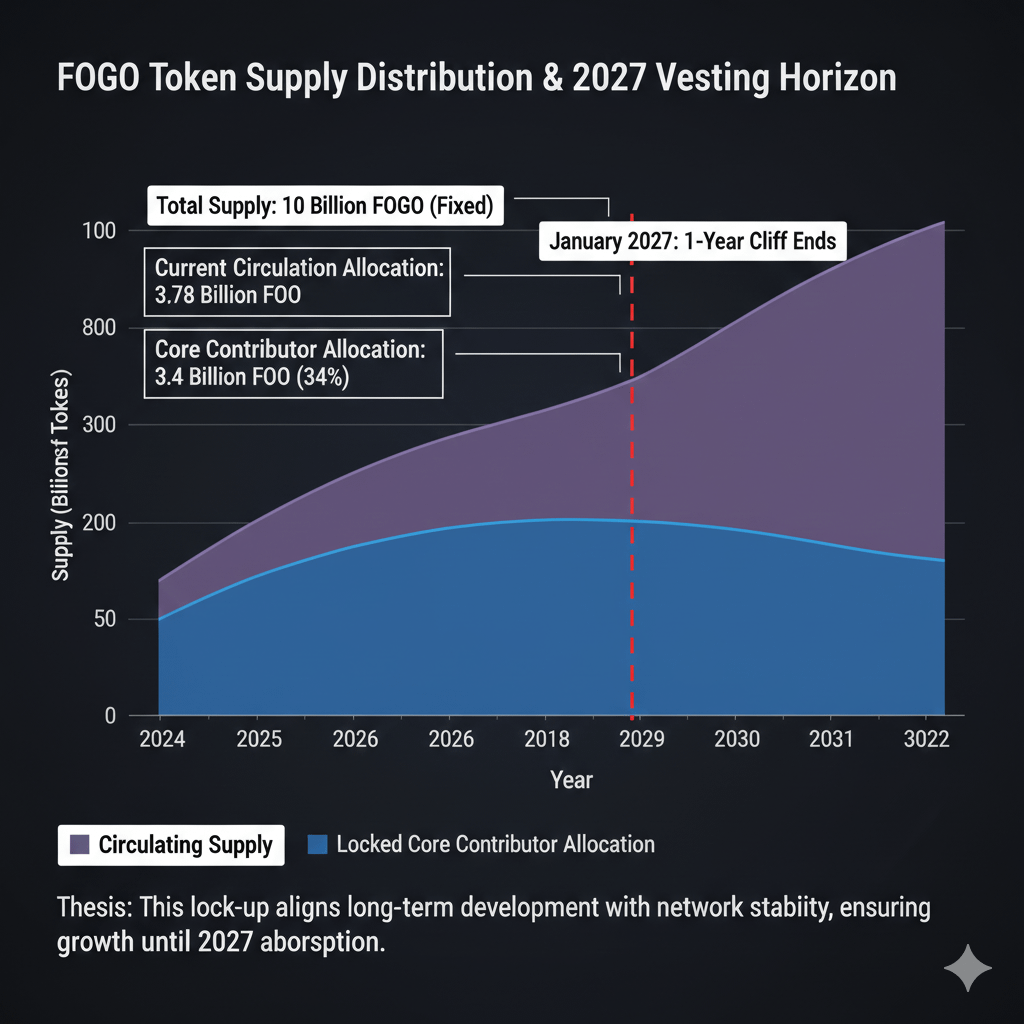
January 2027 marks the convergence of technical maturity and economic liquidity. At this juncture, the initial construction phase of the FiberOptic Highway concludes, transitioning into the Operations and Maintenance phase. The release of core contributor tokens aligns with the point at which the network should be self sustaining through its protocol level primitives, such as enshrined oracles and native sessions.
In conclusion, Fogo’s tokenomics do not merely represent a distribution schedule they are a strategic roadmap. The 10 billion supply cap provides the scarcity framework, while the 2027 cliff ensures that the architects of the highway remain at the steering wheel until the pavement is dry and the traffic is flowing at full capacity.