
The latest on-chain sequence deserves attention.
Bitcoin mining difficulty just jumped 12.04%, pushing network difficulty to 144.39T. That increase lifted the estimated average production cost to roughly $44,823, compressing miner profit margins to about 51.3%.
When margins contract that quickly, behavior shifts.
Miners don’t speculate — they manage cash flow.
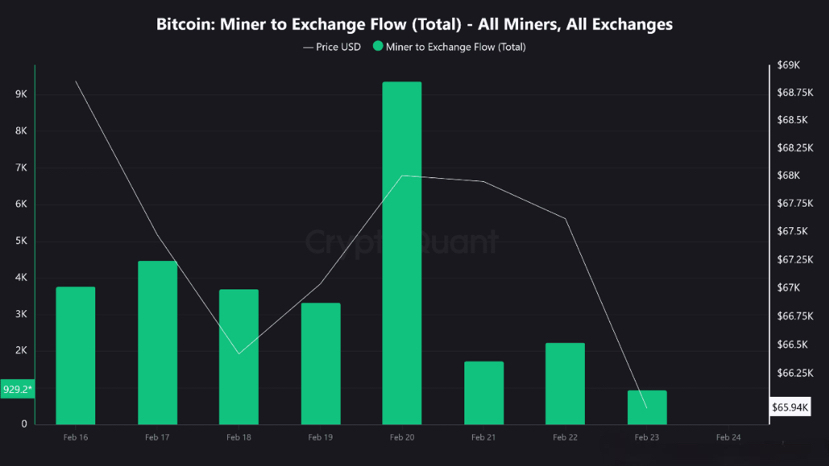
On February 20, roughly 9,354 BTC moved from miner wallets to exchanges. The timing aligned almost perfectly with price testing the $68.3K resistance zone — a logical area for profit realization and operational coverage.
That’s mechanical selling pressure.
The Immediate Countermove: $933M Stablecoin Inflow
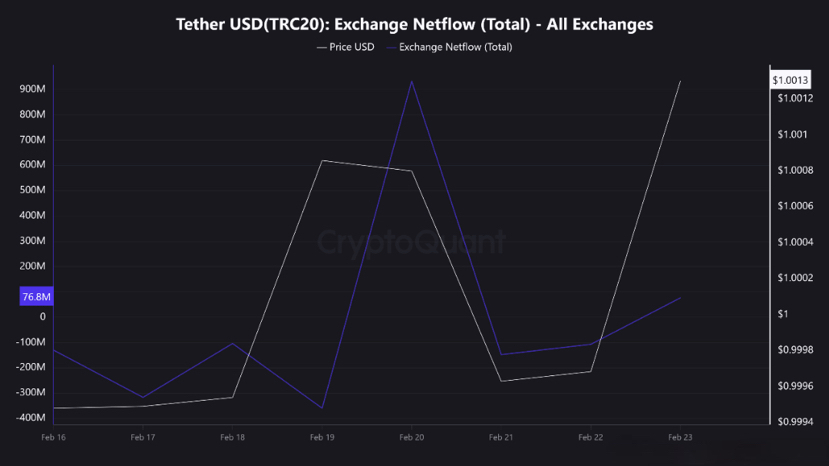
At the exact moment miner supply increased, a net inflow of approximately $930M+ in USDT hit exchanges.
That liquidity:
• Absorbed sell pressure rapidly
• Prevented immediate downside expansion
• Created visible price rigidity
On the surface, that looks constructive.
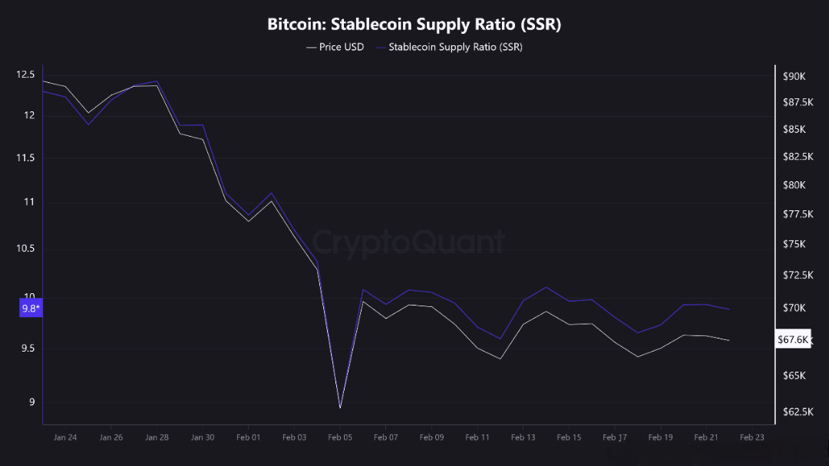
The Stablecoin Supply Ratio (SSR) remains compressed near 9.6–9.8, historically low levels. That suggests substantial potential buying power relative to Bitcoin’s market cap.
Liquidity exists.
But intent matters more than size.
The Critical Question: Offensive or Defensive Capital?
There are two very different interpretations of this $933M inflow:
Scenario 1 — Offensive Accumulation
Capital entered to build exposure.
Liquidity absorbed supply with intent to push price higher.
Breakout potential remains intact.
Scenario 2 — Defensive Absorption
Capital entered only to neutralize forced miner selling.
Liquidity was reactive, not proactive.
No follow-through momentum develops.
If it’s defensive liquidity, the risk becomes clear:
Once absorption stops, and if miner pressure persists, the bid weakens quickly.
Why This Matters Now
A low SSR signals available firepower.
But liquidity must convert into expansion, not just stabilization.
If capital absorbs supply yet price fails to:
• Break pivot resistance
• Expand volume sustainably
• Establish higher-high structure
Then the market becomes fragile again.
Defense without offense leads to exhaustion.
What To Watch Next
The key variable isn’t whether liquidity exists.
It’s whether that liquidity transitions from absorption mode to expansion mode.
If new inflows continue and price pushes through structural resistance, this episode becomes accumulation.
If inflows fade and miner supply reappears, support could thin rapidly.
Right now, the market is balanced between resilience and vulnerability.
Liquidity showed up.
Now we wait to see whether it attacks — or simply shields.