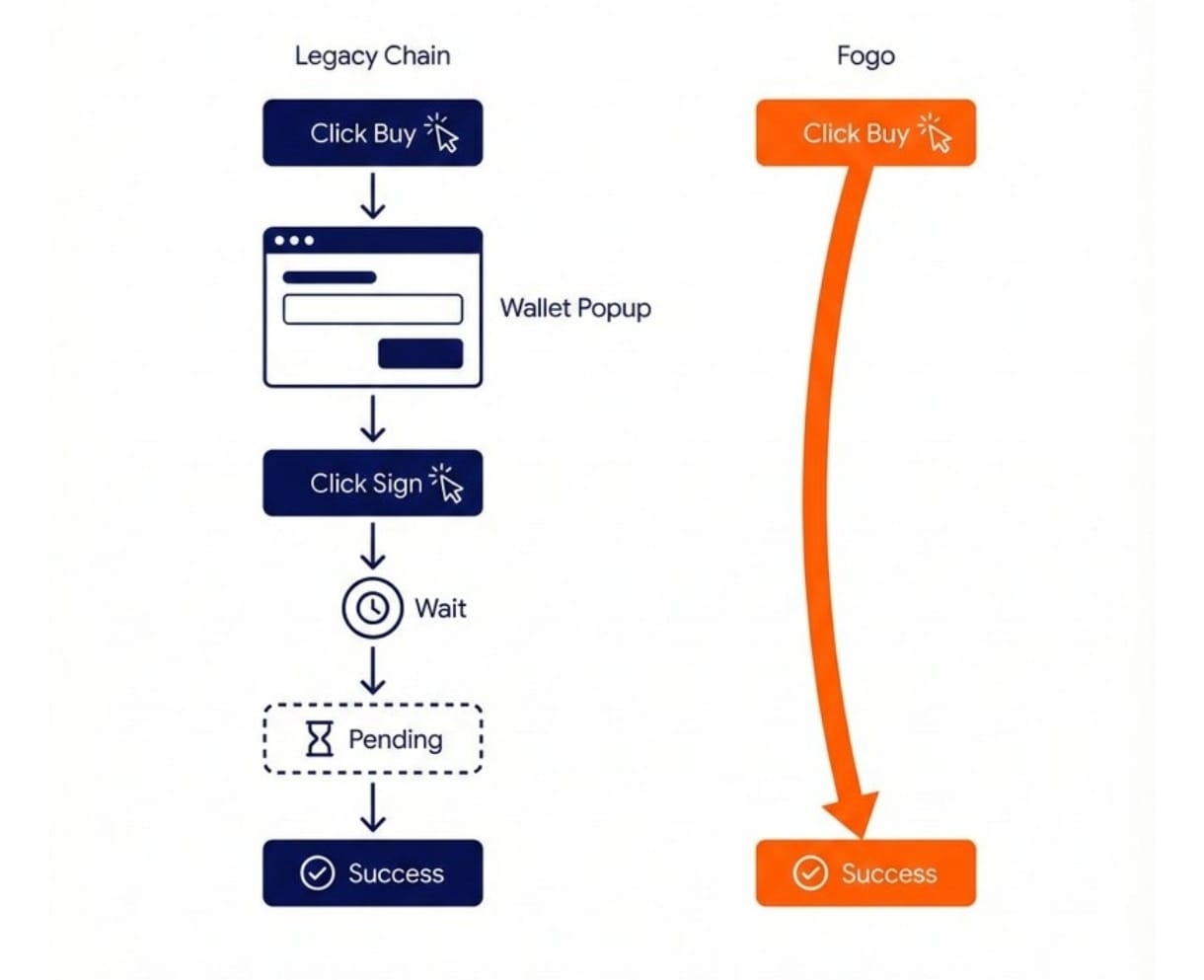
A network built around execution quality, not slogans.
The old assumption
If you have spent any real time trading on chain, you know the moment I am talking about. The candle moves. Your plan is clear. Your hand does not hesitate. You hit confirm and then reality hits back. The screen stalls. The fee estimate jumps. The transaction sits there like a message that never gets delivered. In that pause, your entry slips, your exit fades, and the confidence you had five seconds ago starts leaking out of your body.
People call this normal. They call it decentralization. They call it the price of openness.
But for anyone who has traded through real volatility, it does not feel like a philosophical trade off. It feels personal. It feels like being the last person through the door while the room is already on fire. You did everything right, and the system still made you late.
That assumption has shaped the entire industry. We treat latency like weather. We treat gas fees like gravity. We accept that in the exact moments when precision matters most, the chain will become a crowded highway, and your only choices are to overpay or accept a worse outcome. Even the projects that talk about performance often mean it in the abstract. They mean throughput in a clean lab, not execution quality when everyone shows up at once.
Markets do not reward lab results. Markets reward timing. They reward certainty. They reward systems that stay calm when humans are not.
Fogo’s real claim is not just speed. The claim is that trading grade behavior is the goal, and the chain’s structure should reflect how trading activity actually flows across the world.
The hidden failure mode
Most chains fail traders in the same way, even when the chain is technically working. They become unpredictable at the exact moment predictability becomes priceless.
In calm conditions almost everything feels usable. Blocks land. Fees are tolerable. Confirmations arrive in time. It is only when stress hits that the truth shows up. The network becomes a rationing system.
You see it in the fee spikes that make small trades feel pointless. You see it in the latency that turns a planned entry into a chase. You see it in the strange feeling that you are competing, not just with the market, but with the chain itself. Your transaction lands out of sync with what you saw on screen. Liquidations fire late and then pile on top of each other. Slippage becomes a quiet tax you never agreed to pay.
And the most damaging part is psychological. Traders stop trusting execution. Market makers widen spreads to protect themselves. Liquidity pulls back right when it is needed most. The chain might still be alive, but the market on top of it starts to feel unsafe.
What makes this failure so stubborn is that it is not only a speed problem. It is a coordination problem. A blockchain is not one machine. It is many machines trying to agree, across distance, across imperfect networks, across human mistakes. When everyone acts at once, you are not just testing compute. You are testing the system’s ability to stay coherent under pressure.
Fogo is built around a simple idea that most chains avoid. Stop treating the worst day as an edge case. Build for the worst day first.
The new design principle
One of the strangest truths in real world systems is that reliability sometimes comes from allowing parts of the system to be unavailable on purpose. Not random downtime. Not chaos. Planned absence, structured absence, bounded absence.
Most blockchains treat absence like sin. A validator goes offline and it is punished. The assumption is easy to understand. If you want security, you want as many validators online as possible, all the time.
But the real world is not tidy. Always on is not a neutral requirement when your validators are spread across the planet. Network quality varies. Power stability varies. Operational risk varies. Even basic internet routing varies. Forcing always on behavior can push operators toward the same shortcuts, the same hosting providers, the same homogenous setups, because staying online becomes more important than staying resilient.
Fogo flips the posture. Instead of pretending the network is equally healthy everywhere at all times, it tries to align the active performance core of the system with where demand actually is. This is the idea people call follow the sun. As trading moves from Asia into Europe and then into the Americas, the low latency center of the chain moves with it.
This is not about geography for its own sake. It is about reducing the distance between where orders are created and where consensus is finalized, without forcing the entire network to behave like a single sleepless creature.
How it works (mechanism and incentives)
Think about how the internet survives. It does not insist every packet take one fixed route across the planet. It routes around congestion. It routes around failures. It routes around distance. The goal is not purity. The goal is delivery.
Follow the sun is applying that logic to performance critical consensus participation. During the hours when Asia is active, the chain is optimized so that the fastest finality path is close, in network terms, to the users and venues generating the most flow. As the day rolls forward, the network shifts toward Europe, then toward North America.
If this design works the way it is meant to, the system starts to feel different. Not just faster, but steadier. The confirmation window becomes something you can build instincts around. The fees stop behaving like a mood swing.
But rotation is not the whole story. The harder question is what happens to validators that are not in the performance center at that moment. This is where structured absence matters. Validators can be out of the hot path without being treated like failures. They can be cold without being dead.
The incentives have to match that reality. If only the hot set earns, everyone fights to be hot and the network becomes political. If participation barely matters, you invite freeloading and weak security. A serious design needs a middle ground, rewards that encourage high quality participation when it is needed, while still allowing the network to operate with a smaller faster active core during peak trading hours.
The goal is a chain that behaves like a real trading venue. Low and stable costs. Tight confirmation windows. A predictable feel even when the crowd shows up.
Why it is safer (failure cases and fallback modes)
This is where the story either becomes real or collapses.
Any chain can promise speed. What matters is how it fails.
Aviation is safe not because nothing goes wrong, but because when something goes wrong the system degrades in a controlled way. Pilots do not pray that an engine never fails. They train for the failure. They rely on redundant instruments. The plane is designed to land even when conditions are ugly.
A trading grade blockchain needs the same mentality. It needs a fallback mode.
If the chain is following the sun and something disrupts the hot region, routing issues, infrastructure problems, unexpected congestion, the system must have a path that preserves correctness even if it sacrifices speed. It should widen participation, slow down with intention, and keep finality honest.
That is the role of fallback consensus. Speed in healthy conditions, conservatism when conditions degrade. In plain language, when the fast lane stops being safe, you merge into the slow lane without crashing.
For traders, that matters more than marketing ever will. A slower but predictable chain during stress can be better than a fast chain that becomes uncertain. Uncertainty is what kills markets. Not just price uncertainty, but infrastructure uncertainty.
What it changes for the industry
If a chain can deliver low fee, low latency execution under real stress, it changes what can live on chain.
You stop designing exchanges that assume users will tolerate sloppy fills. You stop hiding delay behind animations. You stop pretending that failed transactions are a user education problem. You start thinking about on chain markets like serious venues. What is the true cost of execution. How stable is it when volume spikes. How often does the system behave differently than it did yesterday.
It also changes the liquidity conversation. Liquidity does not migrate because a chain posts a big number. Liquidity migrates when market makers can quote tighter spreads without being punished by latency and fee unpredictability. The real buyers of performance are not casual users. It is the people providing two sided markets who need their risk models to match reality.
If Fogo becomes a place where those participants can operate with less execution risk, you can imagine the second order effects. Tighter spreads. More depth. Less of the invisible tax that appears whenever the market gets interesting.
That is the path from infrastructure design to trading relevance. Not hype. Execution quality.
A fair critique and a fair response
The strongest critique of this approach is not shallow. It is serious.
If the chain is optimized around certain regions at certain times, does that create a kind of geographic privilege. If you rely on a smaller active set for performance, does that concentrate power and make the system easier to influence, censor, or destabilize.
Those concerns matter because they attack the core promise of blockchains.
The honest response is that every blockchain already has geographic and infrastructure privilege, it is just accidental and unspoken. Latency already favors users near major data centers and backbone routes. Fee spikes already favor users who can pay. Outages already favor actors who can react fast. The difference here is that Fogo is trying to design around these realities instead of pretending they do not exist.
The second part is that performance modes do not have to equal centralization if the fallback mode is real, if validator rotation is transparent and contestable, and if the protocol preserves a credible path for broad participation over time. The burden of proof is heavy, but the critique does not automatically kill the idea. It forces the idea to grow up.
Balanced conclusion (benefits and risks)
At its best, Fogo reads like a chain built by people who are tired of pretending the worst day does not matter. The core intuition is simple. Markets are global. Demand follows time zones. And a serious trading venue should not turn into a congested auction every time volatility shows up. Structured absence, follow the sun coordination, and fallback consensus are attempts to make the chain behave more like infrastructure and less like an experiment.
But the risks are real, and they are not branding risks. They are systems risks.
Rotation has to work in the messy world of real networking. Incentives must avoid turning the active set into a club. Fallback consensus must be more than a line in a document, it has to work under adversarial conditions and still deliver clear finality. And the chain must prove in public that it can survive the worst day without rewriting history or freezing the market.
If those things are proven, then the trading giant narrative stops sounding like a slogan and starts sounding like a plausible outcome of design.
If they are not, then Fogo will join the long list of chains that were fast until speed actually mattered.
That is the real test. Not how it runs when nobody cares, but how it behaves when everyone does.