

Every few years, the blockchain space gets flooded with promises — faster chains, safer systems, greener tech. Most fade after the noise. But Fogo feels different. It’s not trying to shout the loudest; it’s just quietly building something that actually works.
When I first came across Fogo, I wasn’t expecting much. I’ve seen too many Layer 1 projects claiming to be “next-gen.” But Fogo caught my eye because of one simple thing — balance. It’s not just about raw speed. It’s about doing three things right: running fast, staying secure, and not burning the planet in the process.
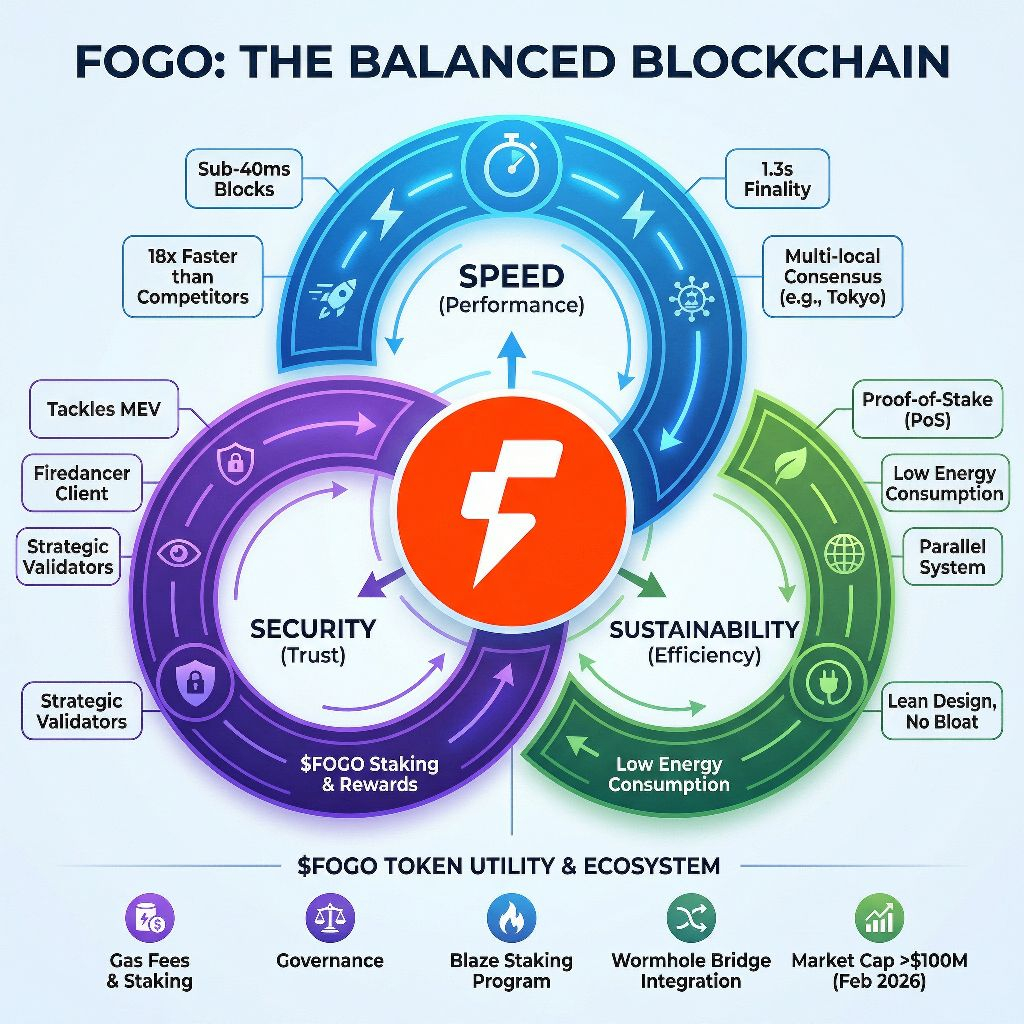
Under the hood, Fogo runs on the Solana Virtual Machine (SVM) — the same tech Solana uses to process tons of transactions at once. But Fogo has tuned it for traders and DeFi apps, where even a small delay can cost real money. Its mainnet quietly went live in mid-January 2026, right after a token sale on Binance, with some solid early backing from serious investors.
Now, about the speed — Fogo aims for sub-40 millisecond blocks. That’s insanely quick. For context, even Solana and Sui usually take a few hundred milliseconds to confirm. Fogo claims to be up to 18x faster, with finality in just about 1.3 seconds. For on-chain traders, that’s not just an upgrade — it’s a game changer.
What’s cool is how they’ve managed it. Validators aren’t just scattered randomly. They’re placed strategically — like around Tokyo — to cut latency for global markets. This “multi-local consensus” setup keeps the system tight and efficient without making it too centralized.
Security is another place where Fogo doesn’t cut corners. They’re tackling MEV (Maximal Extractable Value) — that sneaky practice where bots or validators front-run your transactions. Fogo uses a single Firedancer client (originally from Solana) and a carefully selected validator set to reduce that. Plus, staking $FOGO tokens gives users a reason to play fair — you secure the network, and you earn from it too.
And yeah, bugs happen. But Fogo’s team moves fast — they patched a wallet display issue back in January within days. That kind of quick response gives me more confidence than any whitepaper could.
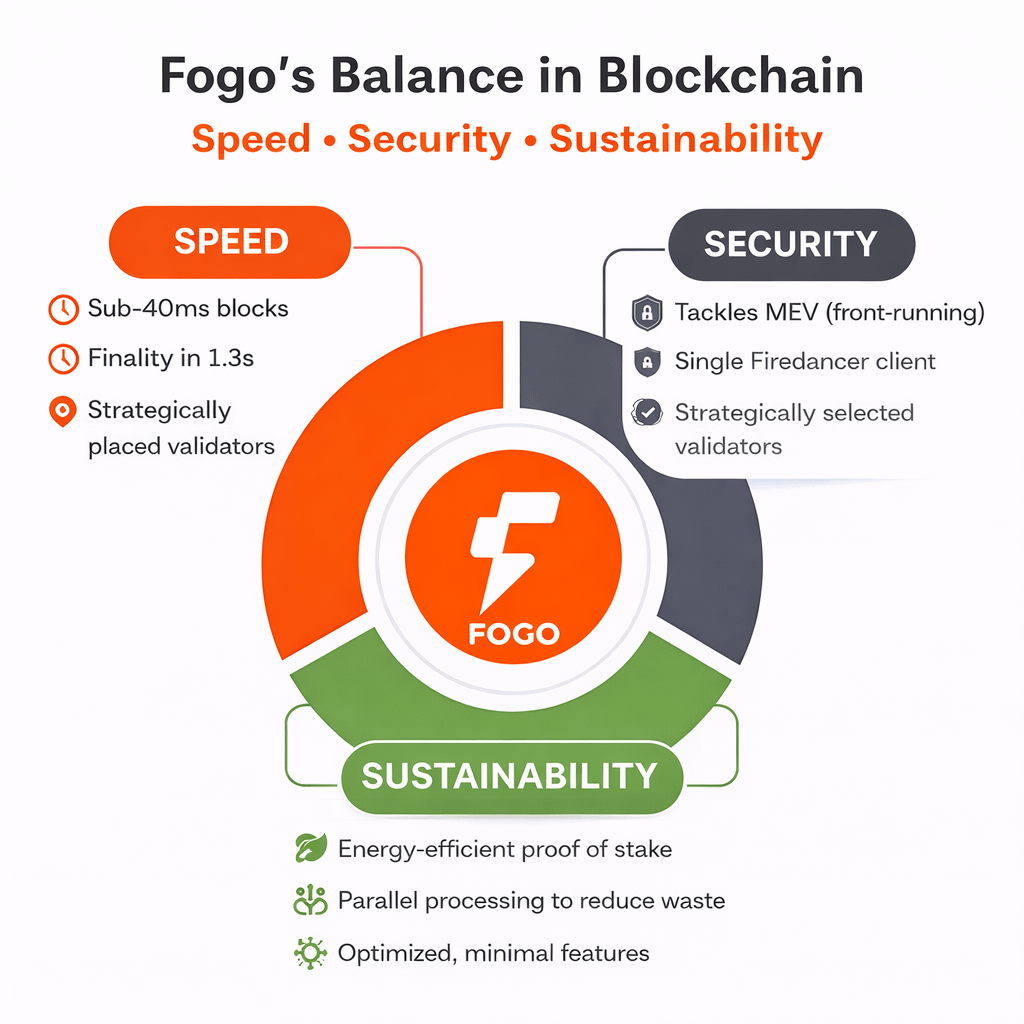
Then there’s the sustainability angle. The crypto world still gets flak for being wasteful, but Fogo’s design proves performance doesn’t need to drain power. Being a proof-of-stake chain already saves energy, but it goes beyond that — its parallel system means less wasted computation, and it avoids loading the chain with useless features. It’s simple, focused, and efficient.
The $FOGO token itself holds everything together. It’s used for gas fees, staking, and future governance. Sometimes they even offer gas-free sessions for users, which is a nice touch. As of February 2026, it trades around $0.027–$0.028 on Binance, with over $100 million market cap and strong daily volume. The early volatility was normal, but the fundamentals look healthy.
What I like most is the long-term approach. The team’s Blaze staking program, partnered with Wormhole and other bridges, pushes people to use the chain — not just speculate. That’s the kind of design that lasts.
Looking at the market, I think we’re moving toward specialized blockchains. Traders want low latency, not a chain that tries to do everything. Fogo fits that mold. Its integration with Wormhole has already started pulling liquidity from Ethereum and other ecosystems, and the total value locked keeps growing.
Sure, it’s still early. Adoption takes time, and competition is tough. But Fogo feels real. It’s built for people who actually trade — not for hype or buzzwords.
Finding the right balance between speed, security, and sustainability is hard in blockchain. Most projects overdo one and forget the rest. Fogo’s doing something rare: using proven tech, improving what matters, and keeping it lean. Maybe it’s not perfect yet, but it’s one of the few worth watching as things heat up this year.