
Introduction: The Mystery of the Clockwork Dip
Bitcoin has once again defied the bears, staging a robust recovery that saw price action peak at $66,300 on Bitstamp.
As the premier digital asset sought to reclaim $65,000 as a structural floor heading into a recent Wall Street open, the narrative shifted from technical indicators to institutional suspicion.
Market participants have identified a perceived structural anomaly: a recurring price contraction occurring at exactly 10:00 AM Eastern Time.
This "clockwork dip" has ignited a debate among strategists—is this the footprint of sophisticated institutional manipulation, or merely a convenient market myth designed to humanize the chaos of global liquidity flows?
The 10 AM Price Slam: Algorithmic Ghost or Market Reality?
The prevailing theory dominating crypto-focused social circles centers on the quantitative powerhouse Jane Street.
Rumors suggest the firm has deployed a high-frequency selling algorithm specifically calibrated to execute at the 10:00 AM Eastern window.
Proponents of this hypothesis argue that this coordinated distribution has been the primary impetus for months of BTC price downside, a trend they trace back to October 2025.
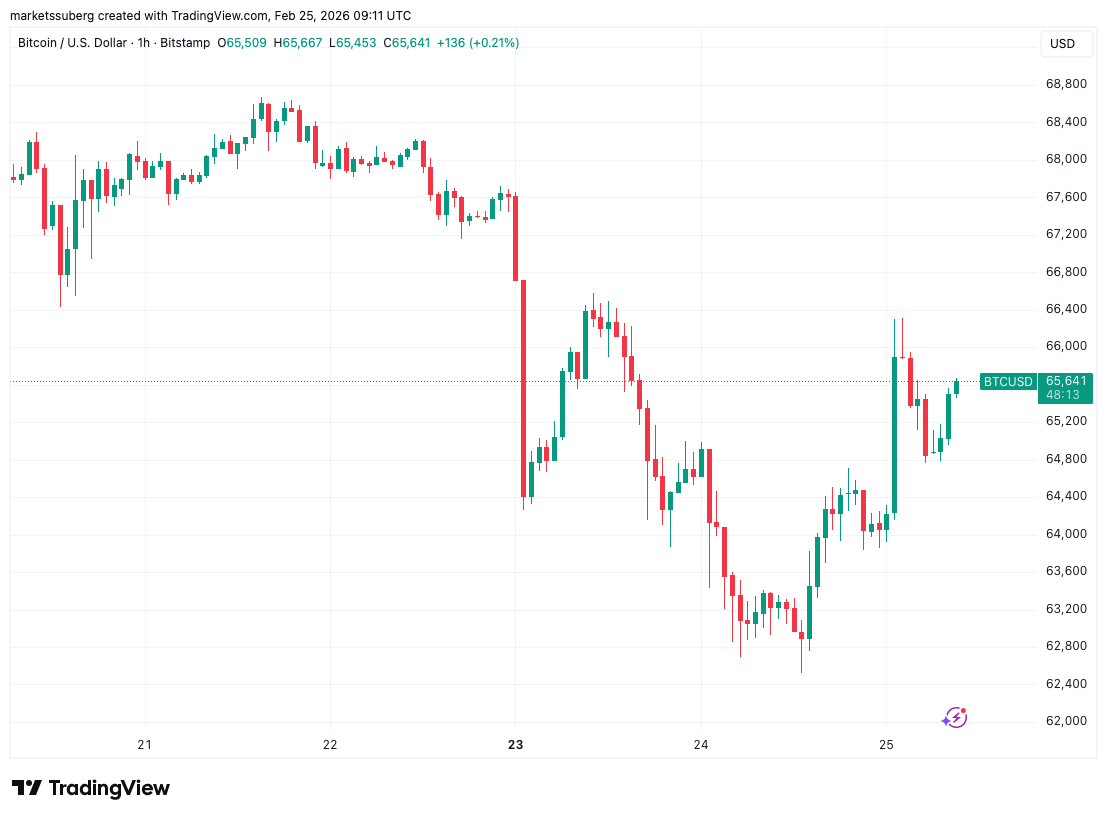
In a market often characterized by opaque movements, the "10 AM Price Slam" provides a tangible "villain." By focusing on a specific timestamp and a high-profile institutional actor, traders have constructed a narrative that seeks to simplify the multifaceted nature of market volatility into a predictable, trackable event.
Legal Battles and Allegations of Past Manipulation
These rumors are gaining traction against the backdrop of a significant legal confrontation.
Terraform Labs has launched a focused legal assault against Jane Street, alleging market manipulation during the grueling 2022 bear market—a period that saw Bitcoin eventually crater to a cycle bottom of $15,600 in the final quarter.
Jane Street has dismissed these allegations with clinical precision:
"Jane Street told Cointelegraph that the accusations were ‘baseless, opportunistic claims.’"
Despite this firm rebuttal, the market remains on edge. Speculation is rife that the firm may have been forced to suspend certain proprietary trading strategies due to the ongoing litigation, potentially creating the vacuum that allowed Bitcoin to "break free" and surge past the $66,000 threshold.
The Volatility Engine: Why "Razor Thin" Liquidity Matters
While algorithmic conspiracy theories capture the public's imagination, a more mechanical explanation lies within the exchange order books.
Keith Alan, co-founder of Material Indicators, has highlighted that liquidity depth remains "razor thin." This lack of depth serves as a volatility multiplier; when order books are shallow, the price can "rip through" levels with deceptive ease.
A critical catalyst for the recent upward velocity was a "roof pull"—the strategic removal of overhead sell orders (ask liquidity).
According to Alan, this liquidity was withdrawn in anticipation of Donald Trump's State of the Union address. When sell-side resistance evaporates in this manner, even moderate buying pressure can trigger vertical price moves that look like a "short squeeze," regardless of whether a specific institutional algorithm is active.
Too Obvious to Be True? The Case for Market Skepticism
The "10 AM Price Slam" theory faces significant intellectual pushback from those who understand the operational DNA of top-tier quant firms. Critics argue that the theory is far too simplistic to hold water.
Crypto YouTuber Wise Advice pointed out the inherent absurdity of a world-class firm leaving a trail that retail traders could easily front-run.
"Do you really think they're that stupid? You're talking about Jane Street. A top quant firm. And they supposedly: Ran a visible daily pattern [and] let everyone track it…"
From a strategic standpoint, highly visible patterns in high-frequency trading are typically "arbitraged away" almost immediately.
The idea that a firm with Jane Street’s pedigree would allow a predictable daily footprint to persist for months strikes many seasoned strategists as a narrative trap—a case of the market finding patterns where only noise and coincidence exist.
The Short Squeeze: When Theories Meet Reality
While traders were busy debating the existence of the "Jane Street algorithm," the market delivered a catastrophic reality check to the bears.
Data from CoinGlass reveals that the rebound to $66,000 triggered a massive liquidation event, punishing those who had over-leveraged on the downside.
In a single 24-hour window, total crypto liquidations reached $333 million. The pain was heavily concentrated, with short positions accounting for $213 million of that total.
There is a profound irony here: while many market participants were distracted by the "10 AM manipulation" narrative, those betting on a continuation of the dip were decimated by the very move they claimed was being suppressed.
Conclusion: Beyond the Algorithm
The clash between the "Jane Street" narrative and the reality of thin order books underscores the current fragility of the Bitcoin market.
While the 10 AM theory provides an easy scapegoat, it ignores the technical reality that Bitcoin is currently facing major resistance at $66,000.
This level is a confluence of local range lows and the four-hour trend; in this context, the "slam" might not be an algorithm at all, but simply the price hitting a natural wall of technical exhaustion.
Until Bitcoin can decisively "flip" this $66k resistance into support, the bearish trend established in late 2025 remains the path of least resistance.
As we look toward the next Wall Street open, the question remains: Is the 10 AM pattern a genuine discovery of institutional footprints, or is the crypto market simply looking for someone to blame for the inherent volatility of a "razor thin" order book?