
The current state of on-chain trading is basically a tax on your sanity. Every time you try to catch a move on a perp dex or swap a token, you are stuck in that twitchy cycle: click, sign, wait for the pop-up, sign again. It is like trying to have a conversation where you have to show your ID before every sentence. This signature fatigue is not just annoying; it is a psychological barrier that makes dApps feel like clunky experiments instead of real tools. Even bridging feels like a chore, and the constant fear of an insufficient gas error often kills the motivation to try a new protocol before you even start. You spend more time managing your wallet than actually executing your trade ideas.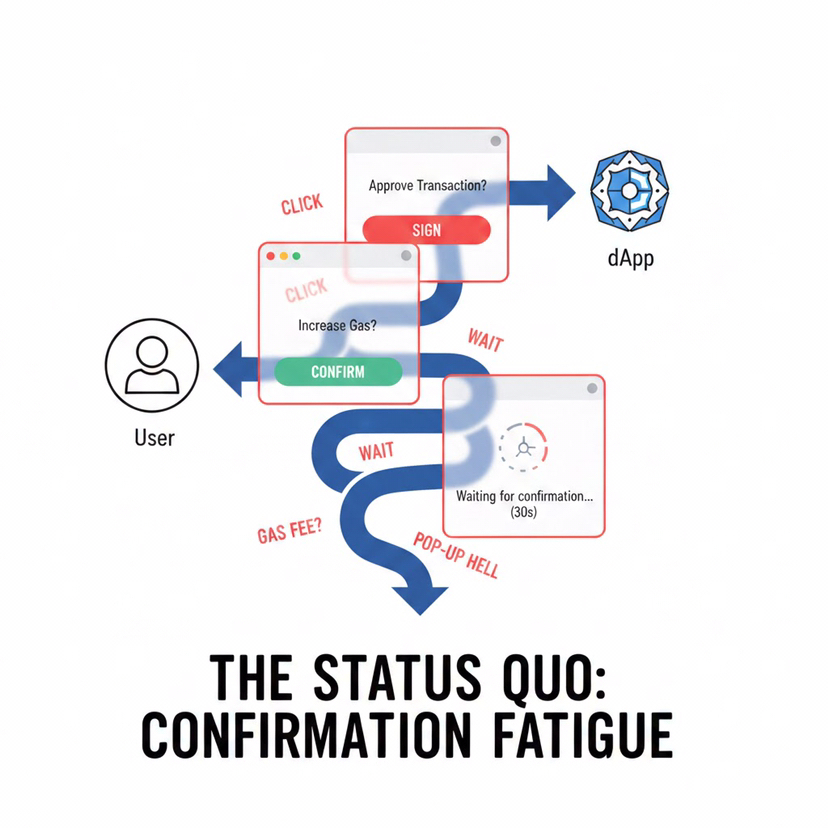
Fogo acts as the clinical antidote to that friction. Instead of fighting the blockchain, it uses Session Keys and a deep paymaster infrastructure to absorb the entire mess. When I start a session, I am signing a single Intent Message that sets the boundaries for the next few hours. Behind the scenes, Fogo runs a customized Solana Virtual Machine (SVM) on a pure Firedancer client—an extremely optimized version produced by Jump Crypto that squeezes every bit of performance out of the hardware. This allows the chain to hit 40ms block times, which is roughly 10 times faster than the standard Solana mainnet and 18 times faster than most other high-performance layers. Since the session key handles the signing and the built-in paymaster system covers the gas, the app just works without a single confirmation interruption.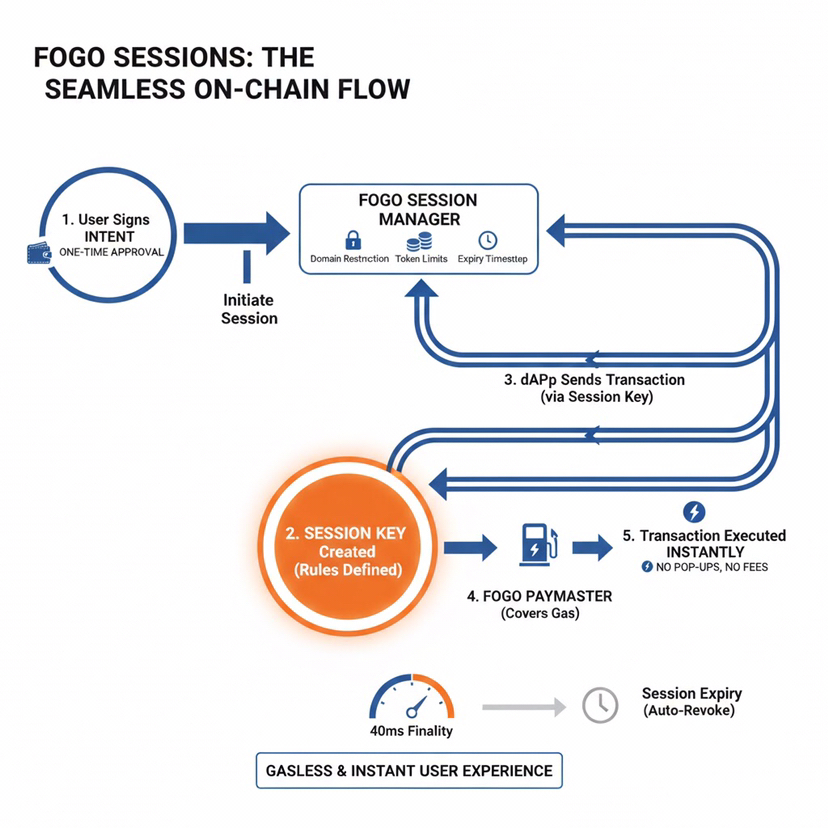
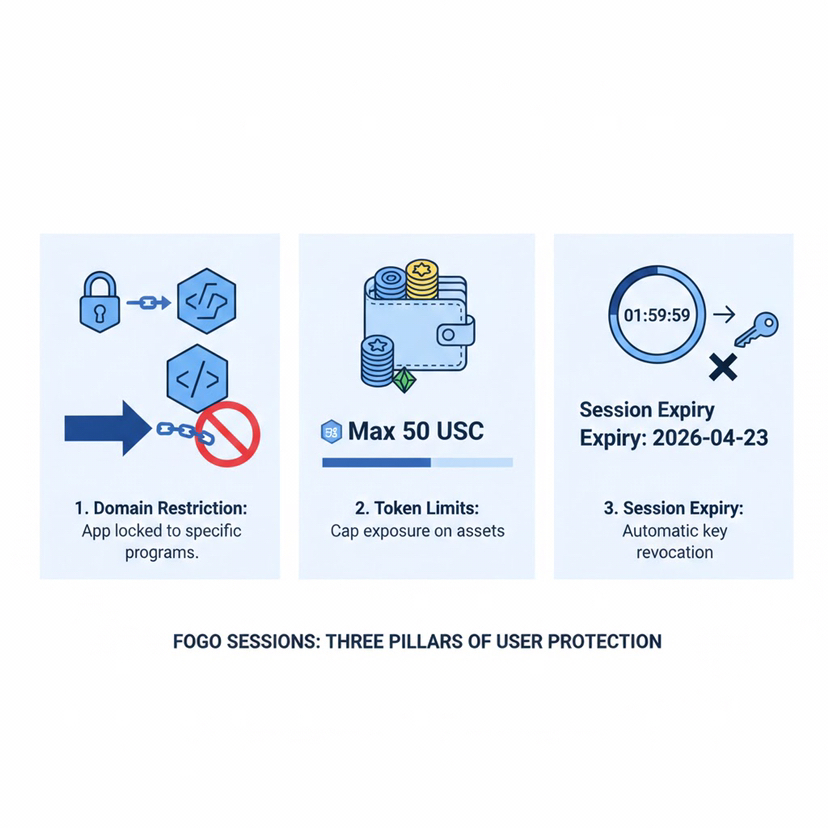
The three pillars of this protection are domain fields, token limits, and expiries. The domain field acts as a digital fence, locking the session to a specific on-chain program address so the app cannot reach outside its sandbox. I also set a strict limit on which tokens the app can touch and the maximum amount it can move. This means I do not have to create a burner wallet or fund it with gas just to test a new tool; I can use my main setup but cap my exposure at 50 USDC. Finally, the session has a hard expiry, so even if I walk away, the window for any potential exploit closes itself automatically.
The shift in how it feels to use is the real story here. After ten minutes on a dApp like Valiant or Pyron, I realized I totally forgot I was using a blockchain. I was focused on the actual trading strategy and price action rather than the plumbing. There were no pop-ups, no gas errors, and no waiting for a wheel to spin. It felt like using a centralized exchange or a regular fintech app. You move from dealing with the blockchain to actually using a product. By the time you realize you are on-chain, you have already finished your trade.
We have to stay grounded, though. This is still a very early experiment. The network is fast because it uses a multi-local consensus model that co-locates validators in specific geographic zones like Tokyo or London to minimize propagation delays. It is a calculated trade-off for that extreme speed. We are still in the phase where a network fluctuation could desynchronize session states, and if a dApp paymaster runs out of funds, you are back in signature purgatory. It is a high-performance engine that is still being tuned, and while the tech is impressive, the ecosystem is just starting to build its liquidity base.
But the data is hard to ignore. Since the mainnet launch on January 15, 2026, we have seen consistent 40ms finality and around 1.3-second settlement in real-world conditions. Protocols like Brasa for liquid staking and Ambient for perpetuals are proving the model works, with early peak daily volumes hitting over 115 million dollars. With Wormhole serving as the native bridge and a purpose-built RPC layer provided by FluxRPC, Fogo moves the conversation from how many users a chain can hold to how fast those users can actually interact. It is finally bringing the speed of an internal matching engine directly onto the ledger.
