
When I tried to make sense of Mira, I didn’t start with the polished promises. I looked for the mechanics. The unglamorous details. The parts that usually get skipped in a flashy presentation. If a system claims it can discipline something as unpredictable as AI, the proof has to live in how it handles the messy corners, not the headline.
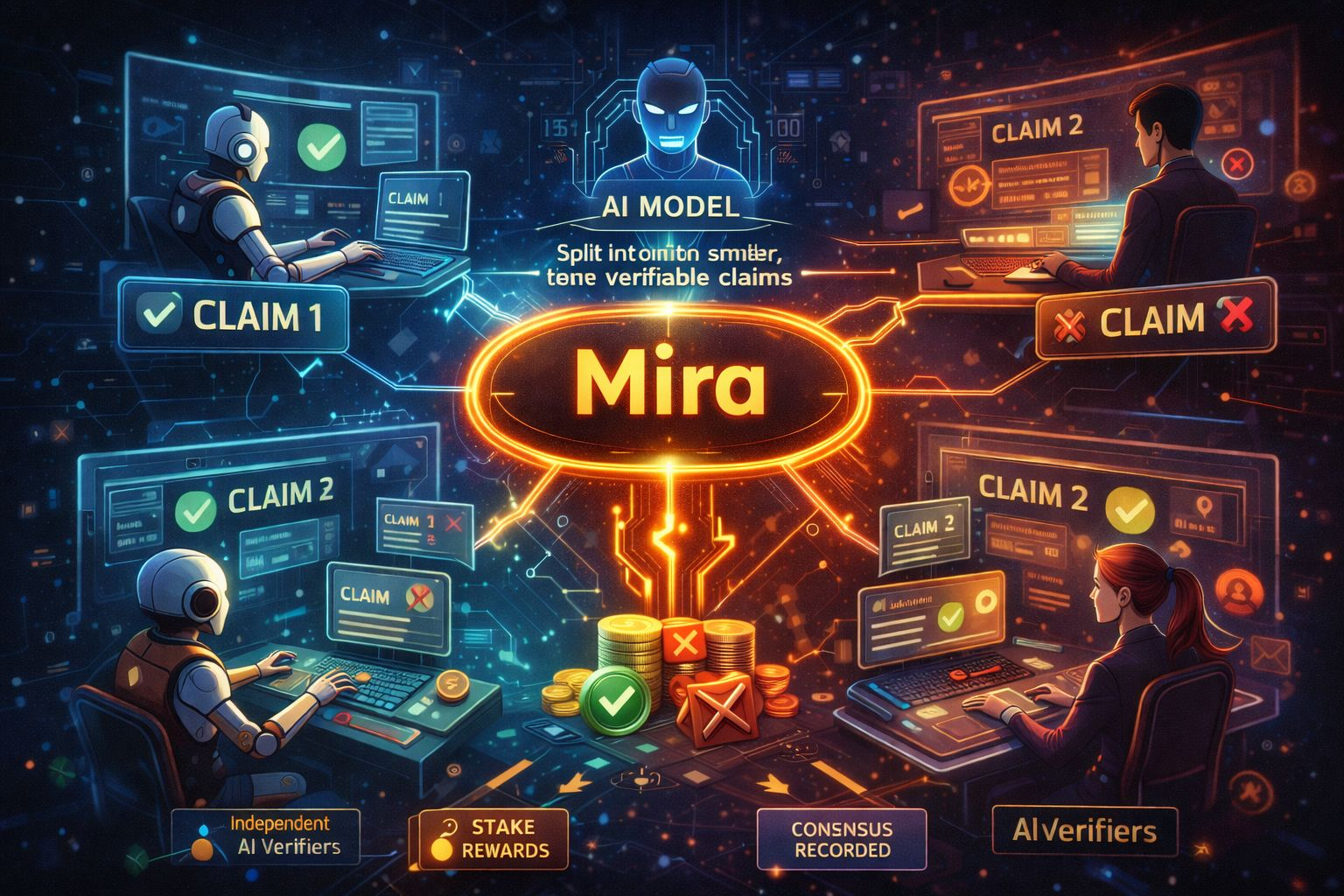
The issue Mira is addressing isn’t abstract. Anyone who relies on AI for real decisions has run into it. You get an answer that sounds thoughtful, structured, even authoritative. Then you pull on one small thread and it unravels. A number is slightly off. A source never existed. A detail feels accurate until you check it. What makes it unsettling isn’t just the mistake. It’s the certainty in the delivery. The tone doesn’t hesitate. It doesn’t signal doubt. It just moves forward, as if nothing could be wrong.
Most teams seem to reach for the same fixes. Add another layer. Plug in retrieval. Bring in a human to double check. Stack on more rules. Fine tune again. Slip “don’t hallucinate” into the prompt like the model just needs a stern reminder. Sometimes it improves things. Sometimes it barely moves the needle. But the core imbalance stays the same: producing text is easy and cheap. Verifying it is slow and costly.
Mira takes a different angle. Instead of asking one model to supervise itself, it breaks the original answer into smaller claims. Those pieces get sent to independent verifiers. The verifiers are rewarded for accuracy and penalized for careless checks. The outcome is recorded in a way that can be reviewed later. It’s a straightforward idea: don’t rely on a single voice. Build a system where scrutiny is distributed and accountable.
If you pause there, the framework sounds almost too neat. The real questions show up when you slow down and ask what each step actually requires outside a whitepaper.
The first hurdle is turning messy language into clean “claims.” On paper, that’s simple. Split a paragraph into statements that can be checked on their own. Basic examples behave nicely. “The Earth orbits the Sun.” Easy. You can verify it and move on.
But real answers are rarely that tidy. AI writes in shades of gray. It hedges. It implies. It blends fact with interpretation. It says things like “widely criticized” or “experts believe” or “results were significant.” Those aren’t crisp data points. They’re judgments dressed as statements. Verifying them forces you to define what “widely” means, which experts count, what qualifies as significant. If a system can’t handle that ambiguity, it risks stamping approval only on the safest, most obvious claims while the subtle ones slip through untouched.
Mira seems to respond by narrowing the task. Instead of open-ended checks, it leans toward constrained formats. Ask a specific question. Limit the possible answers. Make the verifier choose. That structure makes performance measurable. You can compare results. You can spot patterns. You can discourage vague, hand-wavy reviews. There’s a practical edge to this too. When choices are bounded, it’s harder to fake diligence. You can’t hide behind paragraphs. You have to commit.
Still, compression has a cost. Force a nuanced claim into a multiple-choice box and you risk sanding off the edges that matter. In the kinds of environments Mira talks about—corporate workflows, regulated sectors, places where accountability is not optional—nuance is often the point. Something can be technically correct and still misleading. A verifier might land on the “right” option while missing the spirit of the issue entirely.
Then there’s the incentive layer, which is where the system gains weight. If verification becomes a paid task, someone will eventually try to game it. Careful review consumes resources. Shortcuts are cheaper. Mira’s approach treats verification like a role that requires skin in the game. Participants stake value. If their judgments consistently drift from network consensus in suspicious ways, they face penalties. Over time, guessing your way through becomes statistically dangerous. One lucky call might slide by. A pattern of careless answers won’t.
But consensus has its own blind spot. Agreement is not the same thing as truth. Multiple models trained on similar data can inherit the same biases. In contested domains—politics, new research, disputed history—the majority view isn’t automatically the most accurate one. A protocol can decentralize the checking process, but it can’t erase deeper epistemic limits. It still has to define who qualifies as a verifier, what evidence counts, how disagreement is handled, and when uncertainty should be acknowledged instead of flattened into a tidy answer.
In the end, Mira feels less like a magic fix and more like an attempt to move doubt into a structured arena. It doesn’t promise perfect knowledge. It tries to make errors visible, distributed, and costly to ignore. Whether that’s enough depends not just on the models involved, but on how carefully the rules around them are built.
@Mira - Trust Layer of AI #Mira $MIRA
