
Fogo is no longer living in the comfort of anticipation. The network is live, the token is trading actively, and the market is reacting to it in real time. That shift changes how it should be evaluated. When a Layer 1 moves from roadmap slides to operational infrastructure, the conversation stops being about what it could do and starts being about what it actually delivers under pressure.
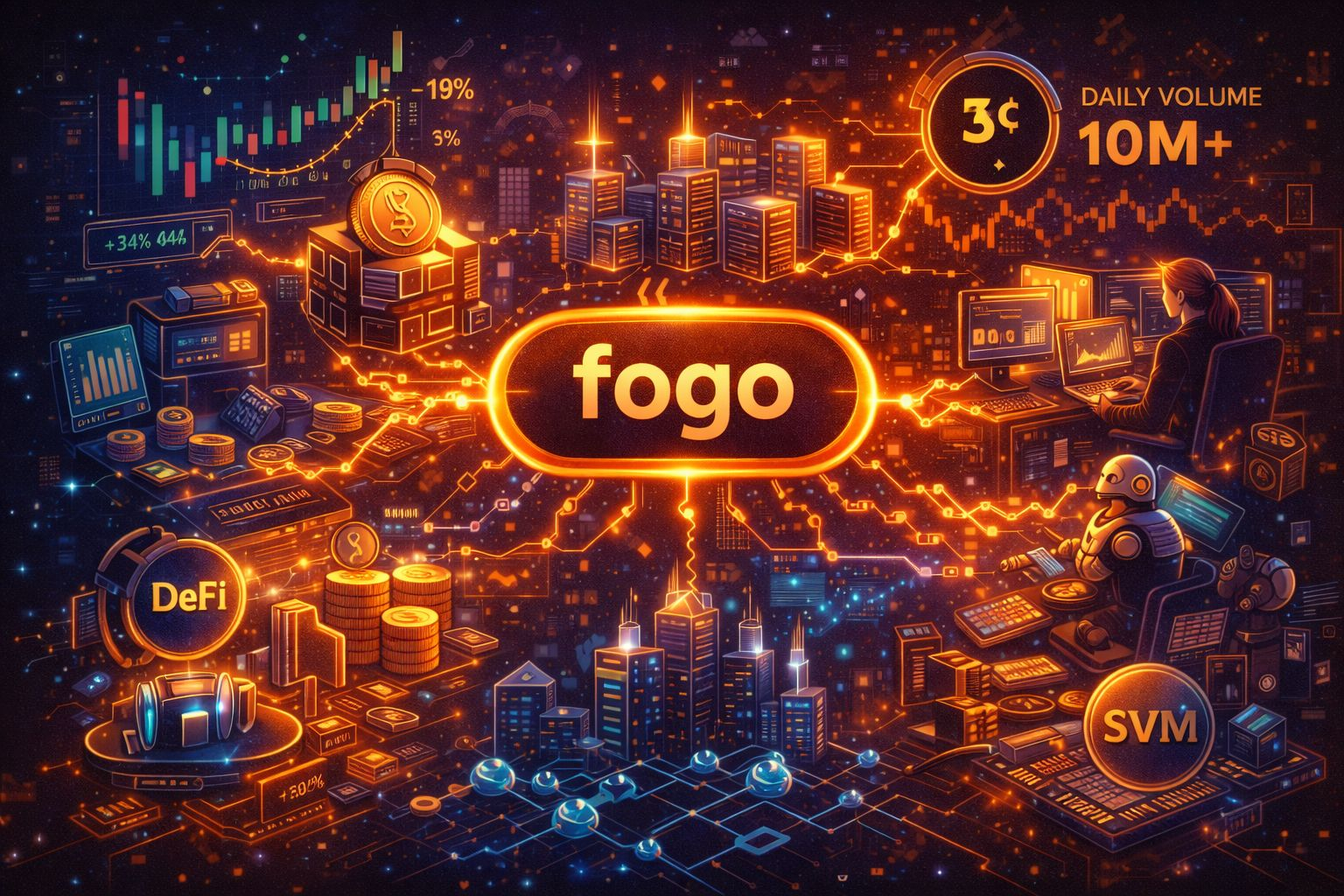
At the moment, fogo trades around the three-cent range, with daily volume that regularly climbs into the tens of millions. That is not empty activity. Liquidity is clearly present and traders are watching it closely. At the same time, the broader market environment remains cautious, and fogo’s weekly performance shows that conviction is still forming rather than fully established. Sharp upward moves are often followed by consolidation, which suggests interest exists but long-term positioning is still tentative.
Technically, fogo defines itself as a high-performance Layer 1 built on the Solana Virtual Machine. This is more than a branding decision. SVM compatibility lowers friction for developers already familiar with Solana’s parallel execution model and tooling. Instead of forcing teams to learn an entirely new stack, fogo allows them to deploy within a familiar execution framework while targeting improved performance characteristics. In theory, that accelerates ecosystem growth. In practice, it depends on whether there are compelling reasons to migrate or expand onto this network.
One of fogo’s most emphasized traits is latency. It aims for ultra-low block times and rapid finality, targeting performance that feels closer to centralized exchanges than traditional blockchains. This matters most in performance-sensitive environments such as decentralized trading, derivatives platforms, and order book systems. In those contexts, milliseconds are not cosmetic. They determine slippage, spread width, and how risk is priced during volatility.
However, performance metrics alone do not create gravity. Many chains advertise high throughput. What ultimately matters is whether real financial activity chooses to live on that infrastructure. fogo’s future depends on whether trading protocols, liquidity providers, and DeFi builders see tangible advantages in its architecture. If they do, the network can evolve into a specialized backbone for on-chain markets. If not, speed becomes just another checkbox in a crowded Layer 1 landscape.
Recent price action reflects this in-between stage. There have been meaningful daily gains that stand out even in cautious broader market conditions. At the same time, volatility remains elevated. This tells a familiar story for emerging infrastructure tokens. Traders are willing to engage, but deeper institutional conviction usually waits for sustained usage metrics. Exchange listings have improved accessibility and depth, helping fogo stay relevant in trading conversations. Yet exchange liquidity is only part of the picture. True validation comes from on-chain activity that is not purely speculative.
Another distinctive element in fogo’s early trajectory was its token distribution strategy. By pivoting away from a large presale and emphasizing broader community allocation, the project signaled a preference for decentralization and wider participation. That approach can foster stronger long-term alignment if holders feel genuinely invested in the ecosystem’s direction. At the same time, it removes the concentrated capital buffer that often funds aggressive ecosystem expansion. Over time, this distribution model will influence governance, staking behavior, and network incentives.
From a structural standpoint, fogo sits in a transitional tier. Its market capitalization is meaningful enough to attract attention but not yet large enough to be considered entrenched. Daily volume shows healthy engagement, yet price sensitivity indicates that speculative flows still dominate. This is typical for networks in their first operational year. The real shift occurs when usage data starts to anchor valuation more than sentiment cycles.
Competition adds pressure. High-performance chains are no longer rare. Throughput claims are common, and parallel execution is not unique. For fogo to stand apart, it will likely need to demonstrate advantages beyond raw speed. That could mean specialized tooling for order books, deeper integration with trading infrastructure, or a developer experience tailored specifically to performance-heavy financial applications. Differentiation in execution environments increasingly comes from ecosystem depth rather than hardware-style benchmarks.
Token economics will also shape fogo’s trajectory. As a Layer 1, its native token supports transaction fees, validator incentives, and staking. If application activity grows consistently, token demand tends to follow naturally. If network usage plateaus, price movement becomes more sentiment-driven. fogo is reaching the point where structural growth metrics will matter more than narrative.
The most important signals to monitor are practical. Are new decentralized exchanges launching on fogo? Is transaction volume growing because users are actively trading or interacting with applications? Are liquidity providers committing capital that remains deployed beyond short volatility spikes? These are the indicators that reveal whether infrastructure is becoming indispensable.
At present, fogo stands at a crossroads between potential and proof. It has a credible technical base, compatibility that reduces developer friction, and liquidity that keeps it visible in markets. It also operates in an environment where speed is expected and differentiation is earned. The coming months will test whether fogo can translate performance into repeated reliance.
Infrastructure is rarely judged by its launch week. It is judged by whether participants return because the system works better than alternatives. fogo has proven it can operate at scale and attract attention. The next phase will determine whether that attention converts into durable usage. If it does, fogo’s identity as a performance-driven trading backbone could solidify. If not, it risks becoming another technically impressive network still searching for a reason to exist.
