
The longer I’ve watched Fogo, the clearer it becomes that this isn’t really a debate about speed for the sake of it. It’s about edge.
In crypto, people often treat latency like some minor technical nuisance, something to blame when a trade slips. But in reality, timing is a filter. It quietly separates winners from losers. It decides whose order lands first, who gets picked off, who slips out before a liquidation wave, and who ends up providing liquidity for someone sharper.
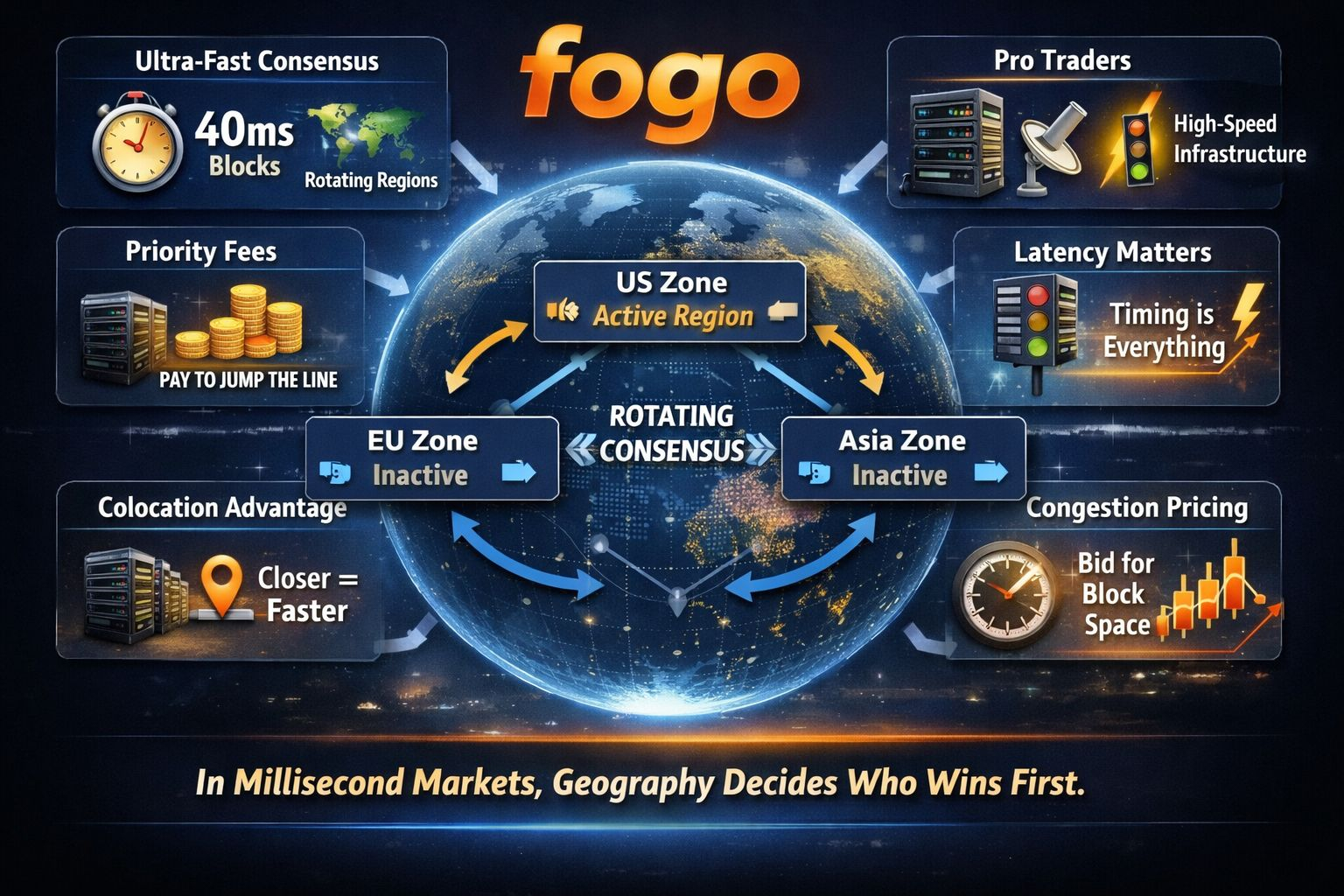
That’s where Fogo positions itself. Not with grand slogans or recycled explanations about how blockchains function. It starts from something more grounded. If you want a network to host real markets, you have to respect physics. The system only moves as fast as its slowest moments. Not the average case. The edge cases. The lag under pressure. That’s the pace everything else is forced to follow.
That’s the side of distributed systems people tend to gloss over because it doesn’t make for exciting headlines. A network can post impressive benchmark numbers and still drag when things get tense. When traffic spikes. When routes slow down. When a handful of validators fall behind. When everyone is racing to get in first. Fogo doesn’t frame those moments as rare exceptions. It treats them as the real test.
One point in the litepaper sounds simple at first, but it hits differently if you think like a trader. The internet doesn’t move at a uniform speed. There’s a hard limit to how fast data can travel through fiber. Paths aren’t perfectly straight. When information crosses continents, you’re not dealing with tiny fractions of a millisecond. You’re dealing with dozens, sometimes hundreds, depending on geography and routing. That gap isn’t just about smoother UX. It reshapes how a market behaves.
Fogo leans into an idea that most crypto projects prefer to avoid mentioning directly. It acknowledges that geography matters and builds around it instead of pretending it doesn’t.
The network organizes consensus into geographic zones. Validators are grouped by region, and at any given time only one zone is actively participating in consensus for that epoch. The others stay in sync, but they are not proposing or voting on blocks during that window. The goal is straightforward. Reduce the physical distance messages need to travel along the critical path so blocks can be created with more consistency and less delay. The litepaper even outlines rotation models, something like a follow the sun approach, where the active zone shifts over time. That way, the center of consensus is not permanently anchored to one region.
That design choice feels abstract until you bring it back to real people.
If consensus is concentrated in one region at a time, then distance still matters. Some participants will be physically closer to the active zone, others farther away. If the active region rotates, then in theory the advantage rotates with it. But markets are not theoretical. The traders who care about milliseconds do not sit back and accept where they land. They pay for proximity. They duplicate infrastructure. They position themselves near every major hub they can reach. Most everyday users do not have that luxury. Most builders do not either. They connect from wherever they happen to be.
So the deeper issue is not whether rotating zones is an elegant idea. It is whether it truly narrows the execution gap, or simply reshapes it into something predictable enough for the most prepared players to plan around and capitalize on.
This is where Fogo starts to feel more deliberate than flashy, because it doesn’t act like speed is some effortless upgrade. It openly leans into what it calls performance enforcement, which is really about tightening the spread between validators so a few slow operators don’t drag the whole system down. Stripped of the jargon, the idea is simple. If you want latency to stay consistent, you can’t let the network be defined by whoever shows up with the weakest hardware or the loosest setup. Consistency demands discipline.
But discipline always narrows the field. The moment you introduce higher standards, you introduce barriers. Clear requirements. Strict expectations. Less tolerance for sloppy operations. And that tends to tilt the table toward professional validators, the ones with serious infrastructure, clean routing, constant monitoring, and enough capital to maintain it properly.
This isn’t about pointing fingers. It’s just being honest about tradeoffs. A chain built for traders, one that genuinely prioritizes speed, will naturally start to resemble a professional marketplace. And professional marketplaces tend to concentrate power. Sometimes that concentration creates resilience and smoother execution. Other times it turns into quiet gatekeeping. Most of the time, it’s a mix of both, depending on who you are and where you sit.
The headline figure people latch onto, roughly 40 millisecond blocks with confirmations near a second, only has weight because of what it enables. No human reacts in 40 milliseconds. Machines do. And the market structures that rely on rapid feedback loops, things like order books, instant cancellations, liquidation systems that don’t feel random, survive or collapse based on that rhythm.
If you read between the lines of Fogo’s documentation, it’s clear what kind of activity the network is aiming to support. Not casual transfers. Not slow, passive interactions. It’s targeting use cases where a delay turns into a disadvantage. The phrase “millisecond markets” isn’t about someone tapping a screen faster. It’s about building an environment where timing is precise enough that strategies start to resemble traditional electronic trading. Constant quoting. Rapid repricing. Fighting to be first in line. Knowing when you’re last. Paying for priority when the system gets crowded.
And once you step into that world, another force comes into focus: congestion.
Fogo’s fee model includes a standard base fee and the option to add priority fees when demand surges. That part isn’t groundbreaking on its own. Most chains have some version of it. The important detail is what it implies. When the network is calm, inclusion feels routine. But when volatility spikes and everyone rushes to act at once, blockspace becomes scarce. Transactions compete. Being early isn’t just about speed anymore. It’s something you can bid for.
On a network designed for trading, the intense moments aren’t exceptions. They’re the real test. You don’t measure fairness when everything is calm and volumes are light. You measure it when volatility spikes and everyone is rushing to act at once. That’s when you see who gets through cleanly and who gets left behind.
There’s another detail in Fogo’s design that quietly signals how it expects people to interact with it: Sessions. The litepaper outlines a setup where a wallet can grant limited permissions to a session key, so users don’t have to approve every single action, and apps can even cover the fees. It sounds like a small usability tweak, but it changes the feel completely. Instead of constant pop-ups and pauses, the app behaves more like something you’d use every day—responsive, fluid, not asking for confirmation at every step.
That convenience comes with a quiet tradeoff. When the application is the one covering fees, it also sets the boundaries. It chooses what actions are worth subsidizing and which ones aren’t. It shapes the rails people move on. In a trading focused environment, that influence runs deep. The easier and smoother interaction becomes, the more rapid behavior turns into the norm. Quick adjustments. Constant repositioning. Always being in the flow.
For traders who thrive in that rhythm, it feels natural. For others, it can feel like the floor is shifting beneath their feet. The venue starts to reward speed as a default setting, and anyone operating at a slower pace may sense that the market isn’t waiting for them anymore.
The way Fogo handled its early funding and launch tells its own story. There was a seed round, then a broader community raise, and later a public phase tied to Binance during mainnet rollout. The specific numbers aren’t the main point. What stands out is the intent. This wasn’t designed to drift quietly into existence. It was structured to arrive with capital, distribution, and attention already lined up.
Because without real users, real liquidity, and real builders, the idea of millisecond markets stays theoretical. Speed only matters if there’s actual flow running through it.
When you step back, the result isn’t just another “fast blockchain” pitch. It’s a more layered attempt to engineer an environment where timing, infrastructure, and market design are tightly linked from day one.
Fogo is really wagering that crypto markets have matured enough to care about latency as a first principle, not an afterthought. Instead of treating speed as a bonus feature, it builds consensus around the idea that timing is the foundation. If that thesis holds, the experience can genuinely improve. Trades feel cleaner. Reactions feel sharper. Friction fades.
But there’s another side to that shift. When timing tightens, timing turns into an asset. And assets attract competition. The participants who can afford better infrastructure, better connectivity, smarter routing, and higher priority fees usually move first. Markets don’t ignore advantages like that. They amplify them.
So when someone asks whether Fogo is “good,” the only honest response is that it depends on what you value. If you value precision and performance, it may look like progress. If you worry about how advantages compound, you’ll see a different set of questions.
If by “better” you mean smoothing out the delay that makes on-chain trading feel awkward, then yes, the architecture seems built for that. But if you’re asking whether it removes the advantage of being closer, better wired, or better funded, it doesn’t. It reshapes where that advantage lives.
If you really want to understand how this plays out, ignore the polished messaging and study the stressful moments. Look at the spikes, the congestion, the hours when everyone rushes for the same exit. Notice who keeps getting clean fills and who keeps missing them. Notice when priority fees tip the balance. Notice whether rotating zones actually widen access or simply hand the most prepared players a timetable.
Because in the end, Fogo isn’t just constructing a quicker chain. It’s constructing a quicker arena.
