

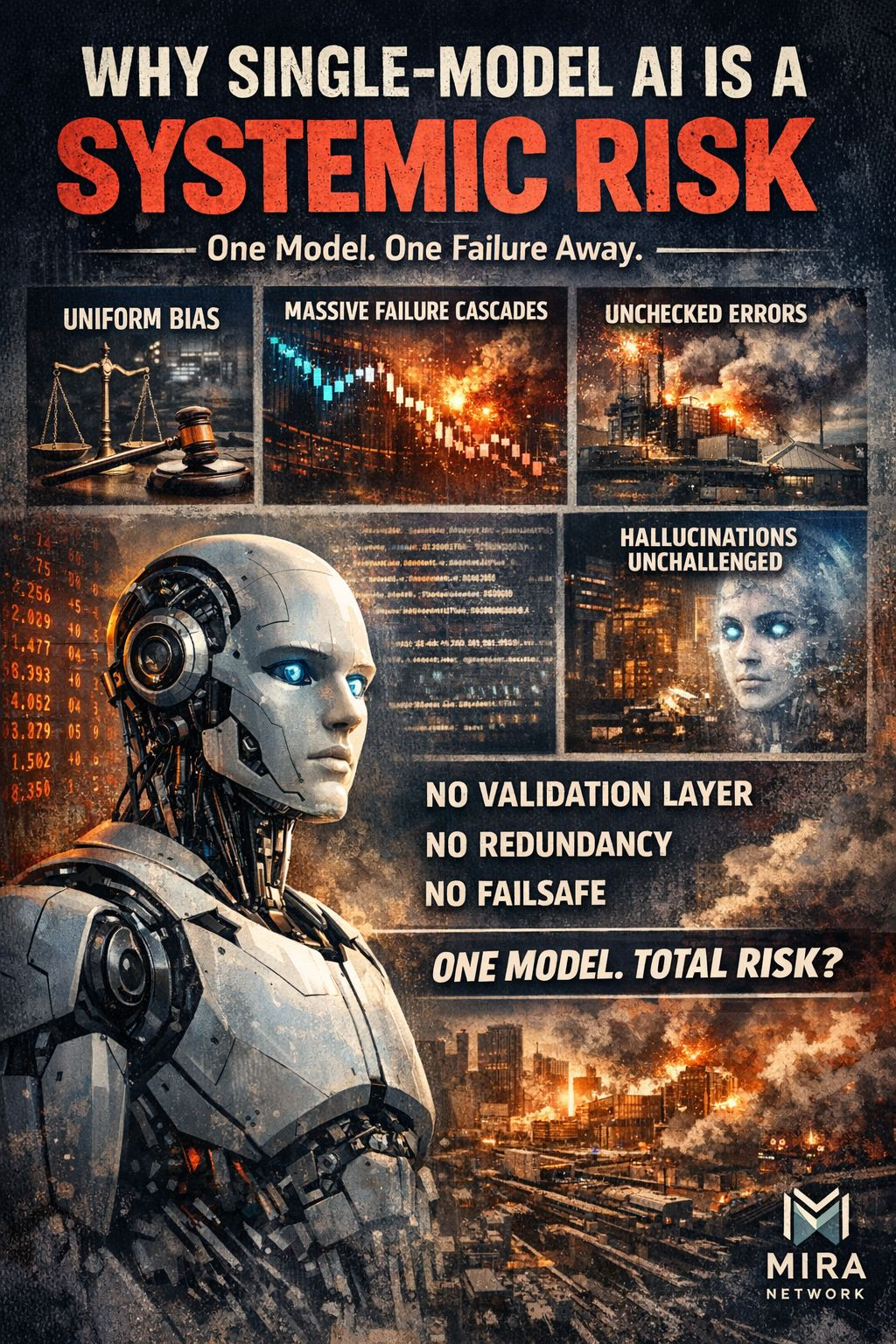
#BNBOTCKHAN阿拉法特 #OTCKHAN25 @undefined @Mira - Trust Layer of AI $MIRA #MIRA
Most production AI today is effectively monoculture intelligence:
One model family
One training pipeline
One bias profile
One hallucination style
One silent failure surface
When that model is wrong, it’s wrong everywhere at once.
That’s not “intelligence at scale” — that’s error propagation at scale.
We already learned this lesson in other domains:
Single database = outage risk
Single server = downtime
Single firewall = breach risk
But AI?
We ship single-model systems into finance, healthcare, legal workflows, ops tooling, and just… hope the model behaves.
Hope is not a reliability strategy.
Why This Is Structurally Fragile
A single-model AI has no native mechanism to:
Challenge itself
Detect contradictions
Validate factual claims
Pressure-test outputs
Detect bias in-context
So hallucinations aren’t “bugs” — they’re unopposed outputs.
In human systems, we solve this with:
Peer review
Committees
Adversarial debate
Red teams
Audits
In AI systems, we mostly do:
“The model said it, ship it.”
That’s wild if you think about it.
Multi-Model Consensus Is Not a Feature — It’s Infrastructure
What you’re describing with Mira Network is basically importing distributed systems logic into AI trust:
Single-model AI:
“Trust me, I’m smart.”
Consensus-validated AI:
“Trust us, we independently checked each other.”
That’s a paradigm shift:
Old Trust Model
New Trust Model
Model authority
Network agreement
Probabilistic fluency
Verified claims
Centralized output
Distributed validation
Single failure surface
Redundant failure detection
This is the same leap:
from single servers → cloud redundancy
from single authority → blockchain consensus
from perimeter security → layered defense
AI is just late to this party.
Why This Becomes Existential at Scale
Once AI agents start:
Executing trades
Triggering contracts
Moving funds
Making medical triage calls
Acting autonomously
A single hallucination isn’t a “bad answer”
It’s a financial event, legal event, or safety event.
At that point:
Single-model AI isn’t innovation.
It’s operational risk concentration.
Your framing nails it:
Single-model AI = beta infrastructure
Consensus-validated AI = production infrastructure
That’s the difference between:
“It works in demos”
“It can safely run civilization-scale workflows”
Optional Tight One-Liners You Can Drop In
If you’re posting this publicly, these hit hard:
“Intelligence without verification becomes liability.”
“One model at global scale isn’t resilience — it’s monoculture risk.”
“AI hallucinations aren’t rare events. They’re unchallenged outputs.”
“Consensus is the missing trust layer of AI.”
“We don’t deploy single servers to run the internet. Why deploy single models to run decision-making?”
Big Picture
You’re not just talking about better AI.
You’re pointing at a missing layer of AI infrastructure:
A trust layer between probabilistic generation and real-world action.
That’s a foundational shift — the same category of upgrade as:
SSL for the web
Consensus for blockchains
Redundancy for cloud computing