
When I first came across Fabric Protocol I honestly thought it was just another mix of AI and crypto trying to catch attention. After reading deeper I saw it is not mainly about robots and it is not about hype. It is about ownership. When machines become better than humans at many jobs who will own the value they create.
We have already seen what happens when intelligence scales fast. Software changed the world. Platforms grew and wealth concentrated. Now physical intelligence is rising. Robots are no longer lab experiments. They are becoming cheaper more capable and more practical. When machines can work get paid and improve themselves the main question is not can they work. The real question is who receives the profit.
Fabric Protocol tries to answer that at the infrastructure level. It presents itself as a global open network supported by the Fabric Foundation. The aim is to let people build govern and improve general purpose robots together using verifiable computing and agent native infrastructure. In simple words it wants robots to operate in an open market not inside closed corporate systems.
The core issue is not robots. It is ownership. Today most robotic systems are isolated. A company designs the machine trains it deploys it and keeps all the revenue. Workers may use it but they do not share in the upside. That model worked in software but robotics is different because robots perform real world labor not just data processing.
Imagine automated taxis. They can reduce costs and accidents. But if millions of drivers lose income and one firm collects all profits that changes the structure of the economy. Fabric argues that without changing ownership robotics will lead to extreme concentration of power over production logistics and capital.
Instead of asking how do we build better robots Fabric asks how do we stop robots from becoming private monopolies.
Fabric acts as a coordination layer. It uses blockchain not to create hype but to verify and record activity. In its system data can be shared work can be verified rewards can be distributed and everything is logged in a public registry. This is important because when machines operate autonomously trust becomes critical.
One of the key ideas is verifiable computing. Any task a robot performs whether delivering goods assembling parts or collecting data can be checked by multiple systems. AI can make mistakes or act unpredictably. In software that might be minor. In physical environments it can be dangerous. Fabric breaks down outputs into proofs so several validators confirm the result. Instead of trusting one machine you trust a transparent verification process.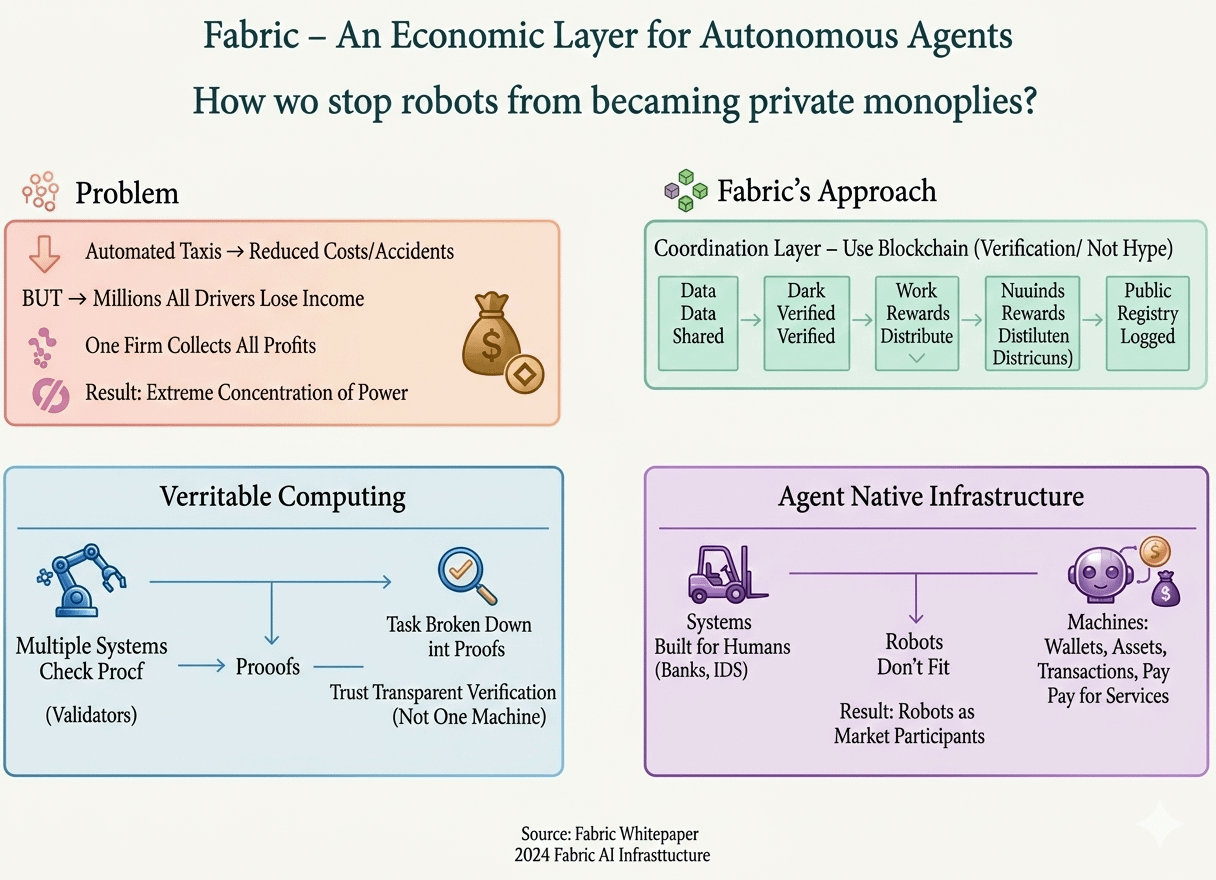
Another important concept is agent native infrastructure. Most systems in the world are built for humans. Banks contracts IDs and payment rails assume a person. Robots do not fit that structure. Fabric creates an economic layer where machines can have wallets hold assets make transactions and pay for services. This turns robots from simple tools into market participants. A robot can earn spend and interact economically.
Fragmentation is another big problem in robotics. Different hardware different control stacks different software. Skills built for one robot rarely transfer to another. Fabric introduces OM1 described as a universal robot operating system similar to Android for phones. The idea is write once run everywhere. If successful this allows skills to move across machines reduces costs and speeds development while creating a shared innovation layer.
Incentives are handled through what Fabric calls Proof of Robotic Work. Rewards are tied to real verified machine tasks not just staking tokens. When a robot completes approved work value is generated and distributed. This makes the network closer to a machine labor market than a speculation system.
The ROBO token is used for payments fees staking and governance. More importantly it serves as a pricing mechanism for machine labor. When a robot performs a task it earns ROBO. When it needs services it spends ROBO. This creates a closed economic cycle where machine productivity drives value. ROBO has gained visibility on exchanges including Binance which is one of the largest global crypto trading platforms bringing liquidity and broader access.
Governance is decentralized. Token holders vote on rules and parameters. Each robot has an on chain identity and actions are traceable. This does not remove all risk but it increases transparency and accountability compared to closed corporate ownership.
Other projects have explored robotics and blockchain like Robonomics but Fabric attempts to combine multiple layers at once operating system economic layer verification layer and governance layer in a single integrated design. That makes it ambitious and complex.
There are real challenges. Will manufacturers adopt a shared OS like OM1. Will companies allow machines to operate in open networks. Can decentralized verification scale for real world robotics. Will there be enough actual robotic activity to sustain the ROBO economy. These are serious questions that determine long term viability.
After studying it I stopped seeing Fabric as just a crypto experiment. It looks more like an attempt to design an economic system for a future where machine labor is normal. Machines are improving costs are falling adoption is increasing. When automation expands the structure of ownership will shape society.
Will control sit with a few centralized groups or exist within open networks. Fabric is betting on the network model. It may succeed or fail but the questions it raises are important. It focuses on building infrastructure before the wave fully arrives.
This is not only about robots replacing people. It is about how we organize a world where machines work alongside humans compete with humans and generate independent value. Fabric Protocol is one of the earliest serious attempts to build that structure and even if outcomes are uncertain the ideas behind it will continue to matter as robotics grows.