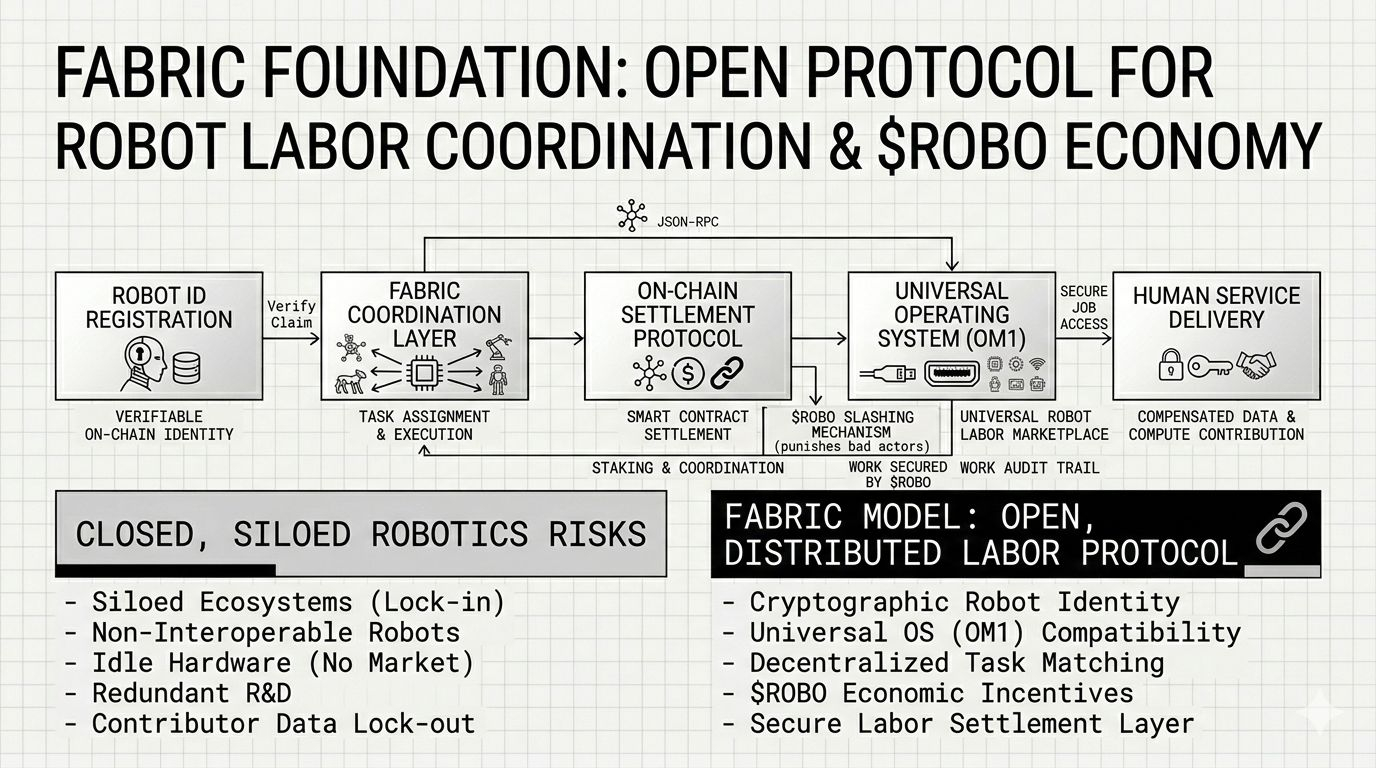
Here's a thought experiment. Imagine you own a robot. Not a Roomba — a real general-purpose humanoid that can perform physical tasks: warehouse sorting, elder care assistance, delivery logistics. Now imagine that robot sitting idle for 14 hours a day because there's no marketplace for its labor, no way to verify its work, and no mechanism to pay it for completed tasks without going through three different corporate intermediaries.
That's not a hypothetical. That's the current state of the robotics industry.
Every major robotics company today operates in a closed ecosystem. Boston Dynamics robots don't talk to Fourier robots. UBTech deployments don't share intelligence with AgiBot fleets. Each manufacturer builds walls around their hardware, their data, and their software — because in the old model, fragmentation was a competitive advantage. Lock-in meant revenue.
But here's the problem. The moment AI models became capable enough to issue commands to physical robots — which happened faster than almost anyone predicted — the siloed model became a liability, not an asset. Progress slowed. Redundant work multiplied. And the people contributing real-world data to train these systems? They got nothing.
@FabricFoundation looked at this landscape and made a different bet.
Instead of building another proprietary robot platform, they built an open protocol. One where any robot, from any manufacturer, can register a verifiable on-chain identity. One where tasks can be posted, matched, executed, and settled without a corporate gatekeeper in the middle. One where humans who contribute data, compute, or physical infrastructure get fairly compensated for what they actually provide.
The technical stack is genuinely impressive. OM1 — the universal robot operating system developed by OpenMind — strips away the hardware dependency entirely. Write once, run on a humanoid, a quadruped, or a robotic arm. Above that sits the FABRIC coordination layer: machine identity registries, skill-sharing protocols, on-chain task settlement, and a slashing mechanism that punishes bad actors without requiring a judge or jury.
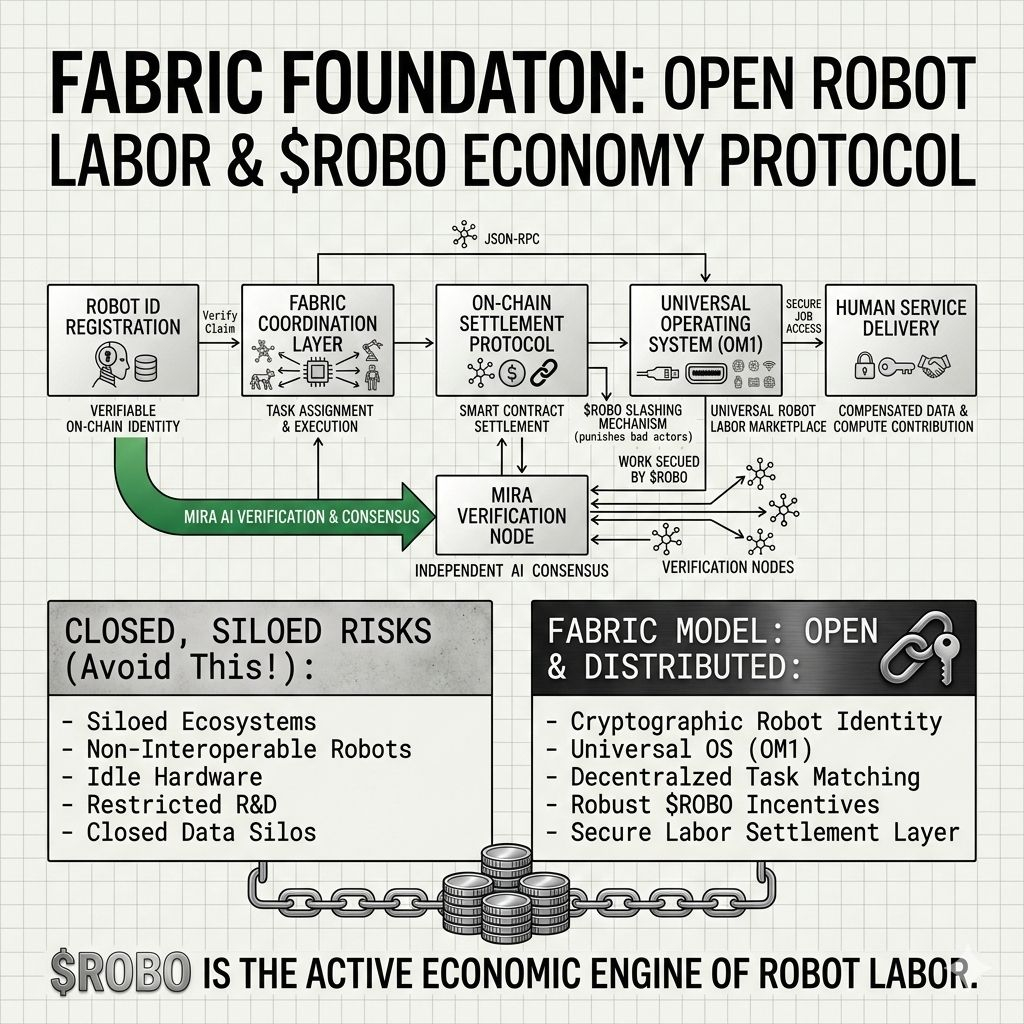
$ROBO is the token that makes all of it work. Not as a speculative asset sitting in a wallet — but as active economic infrastructure. Every identity registration costs $ROBO. Every task settlement flows through $ROBO. Operators stake it to join the network. Developers stake it to list applications. And a portion of every transaction gets used to buy $ROBO on the open market — creating structural demand that scales directly with network usage.
What's different here compared to the thousand other "AI + blockchain" projects that have come and gone is specificity. Fabric isn't promising to "decentralize AI." They're solving a narrow, concrete, urgent problem: how do machines from different manufacturers coordinate, verify, and settle work without trusting a middleman? The answer is a protocol. And protocols, historically, tend to capture enormous value once they reach critical adoption.
The robot economy is not ten years away. UBTech is already deployed. Fourier is shipping. The OM1 OS is live. The $ROBO token is trading. What's happening right now is the quiet, infrastructure-layer work that precedes every major technological wave — the part nobody writes headlines about until it's too late to get in early.
Pick your vantage point carefully. You can wait until robots are everywhere and the protocol is priced accordingly. Or you can understand what's being built right now, while most people are still debating whether humanoid robots are real.
The infrastructure moment for physical AI is here. @FabricFoundation is building it in the open. And ROBO is how you participate.
Do your own research. Understand the risks. But don't mistake quiet building for nothing happening.
#ROBO $ROBO @Fabric Foundation