
How Mira Protocol Could Become the Verification Layer of AI?
whenever people talk about artificial intelligence, the focus almost always lands on capability. Which model is smarter, which company trained the bigger system, which AI can reason better or automate more work. It’s an exciting race to watch, but after spending enough time actually using these tools, another issue quietly starts standing out.
AI doesn’t really struggle with producing answers anymore. It struggles with being trusted.
That might sound like a small distinction, but it changes how you look at the entire space. Most AI outputs today feel convincing by default. The language is smooth, explanations sound logical, and responses arrive instantly. Yet anyone relying on AI regularly knows there’s still a need to double-check things. Sometimes the mistake is small. Sometimes it’s subtle enough that you only notice later.
And once AI begins moving into serious environments finance, research, automation, decision-making constant verification by humans stops being scalable.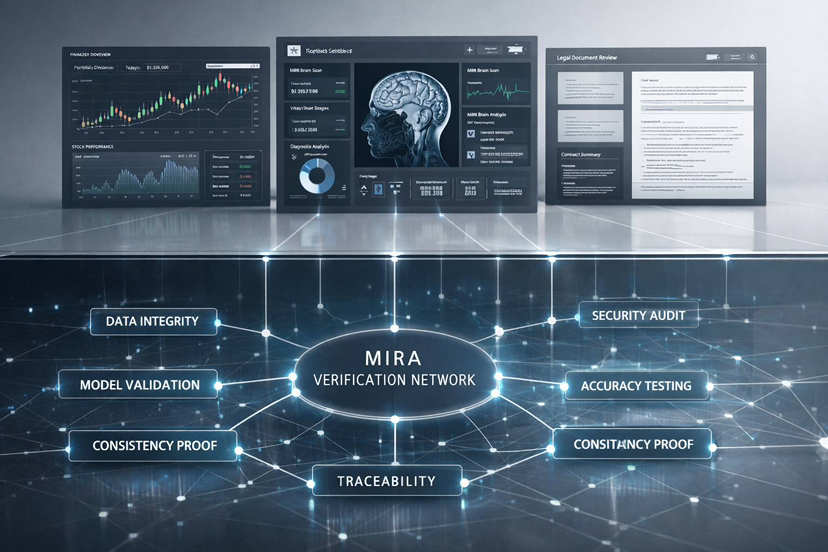
This is where Mira Protocol starts to feel relevant, not as another AI project competing for attention, but as something attempting to solve a problem sitting underneath the entire industry.
Instead of asking how to make AI smarter, Mira seems focused on a different question: how do we confirm that AI-generated information is actually reliable?
The idea behind the protocol is relatively straightforward when you step back from the technical explanations. Every AI output can be treated as a claim rather than a final truth. That claim can then be checked by multiple independent participants instead of relying on a single system’s authority.
In a way, it mirrors what blockchain originally did for digital transactions. Before decentralized networks, trust depended heavily on centralized institutions keeping records and confirming activity. Blockchain shifted verification into a distributed environment where consensus replaced blind trust.
Mira appears to be exploring whether the same concept can apply to intelligence itself.
What makes this interesting is how naturally the need for something like this is emerging. AI models are increasingly being used together agents calling other agents, applications combining multiple models, automated systems making decisions without direct human supervision. As that ecosystem grows, knowing which output is dependable becomes more important than simply generating more outputs.
Without verification. AI risks creating an internet filled with confident but uncertain information.
Miras proposed solution introduces a verification network where validators review and evaluate AI-generated claims. Participants stake value behind their assessments, meaning accuracy is not just encouraged philosophically it is economically enforced. Over time reliable validators gain reputation and incentives while incorrect verification carries consequences.
It’s not perfect, and it probably won’t be simple to scale, but the logic behind it feels practical.
One thing that stands out to me is that Mira doesn’t seem designed to sit in front of users. If anything, its success depends on remaining mostly invisible. Developers or AI platforms could integrate verification directly into workflows allowing outputs to be checked automatically before reaching end users.
That approach matters because history tends to reward infrastructure that fades into the background. Most people using cloud services, payment networks or internet protocols rarely think about the systems making everything function smoothly. Reliability becomes expected rather than noticed.
If Mira works as intended, verified intelligence could eventually feel the same way present but unseen.
There’s also a broader shift happening that makes this timing interesting. Early AI adoption was driven by curiosity and experimentation. People wanted to see what machines were capable of creating. Now the conversation is slowly moving toward responsibility. Companies and institutions can’t rely indefinitely on tools that occasionally fabricate details or misunderstand context.
At some point, AI systems need auditability.
They need a way to show not just what answer was produced, but why it can be trusted.
That is where Mira’s positioning as a verification layer becomes compelling. Instead of replacing existing AI ecosystems it complements them. Different models, platforms, or autonomous agents could theoretically rely on a shared verification network rather than building isolated trust systems from scratch.
In that sense, Mira isn’t competing with AI development it’s attempting to stabilize it.
Of course, there are real challenges ahead. Verifying factual claims is one thing; verifying reasoning, interpretation, or subjective analysis is much harder. Consensus mechanisms that work well for transactions may behave differently when applied to knowledge. Adoption will also depend heavily on whether developers see verification as necessary infrastructure rather than added complexity.
Still the direction feels aligned with where technology is heading.
As AI becomes more embedded in everyday systems, trust will likely become one of the defining bottlenecks. Faster intelligence alone doesn’t solve uncertainty. In many cases, it amplifies it. The more information machines generate, the harder it becomes to separate reliable outputs from plausible mistakes.
A verification layer begins to look less like an optional upgrade and more like missing infrastructure.
Stepping back, Mira Protocol represents an interesting possibility: that the next phase of AI growth may not come from building larger models, but from building systems that make intelligence dependable at scale.
If that happens, success probably won’t look dramatic. There won’t necessarily be a single breakthrough moment people point to. Instead AI tools may simply start feeling safer to rely on. Decisions supported by machines may require less second-guessing. Automation may feel less risky.
And users might never realize a verification network is operating underneath those experiences.
Sometimes technological progress isn’t about creating something entirely new. It’s about strengthening the layer people didn’t realize was missing.
If AI becomes one of the defining technologies of this era, then verification not generation might quietly become its most important foundation. Mira Protocol is essentially betting on that future.