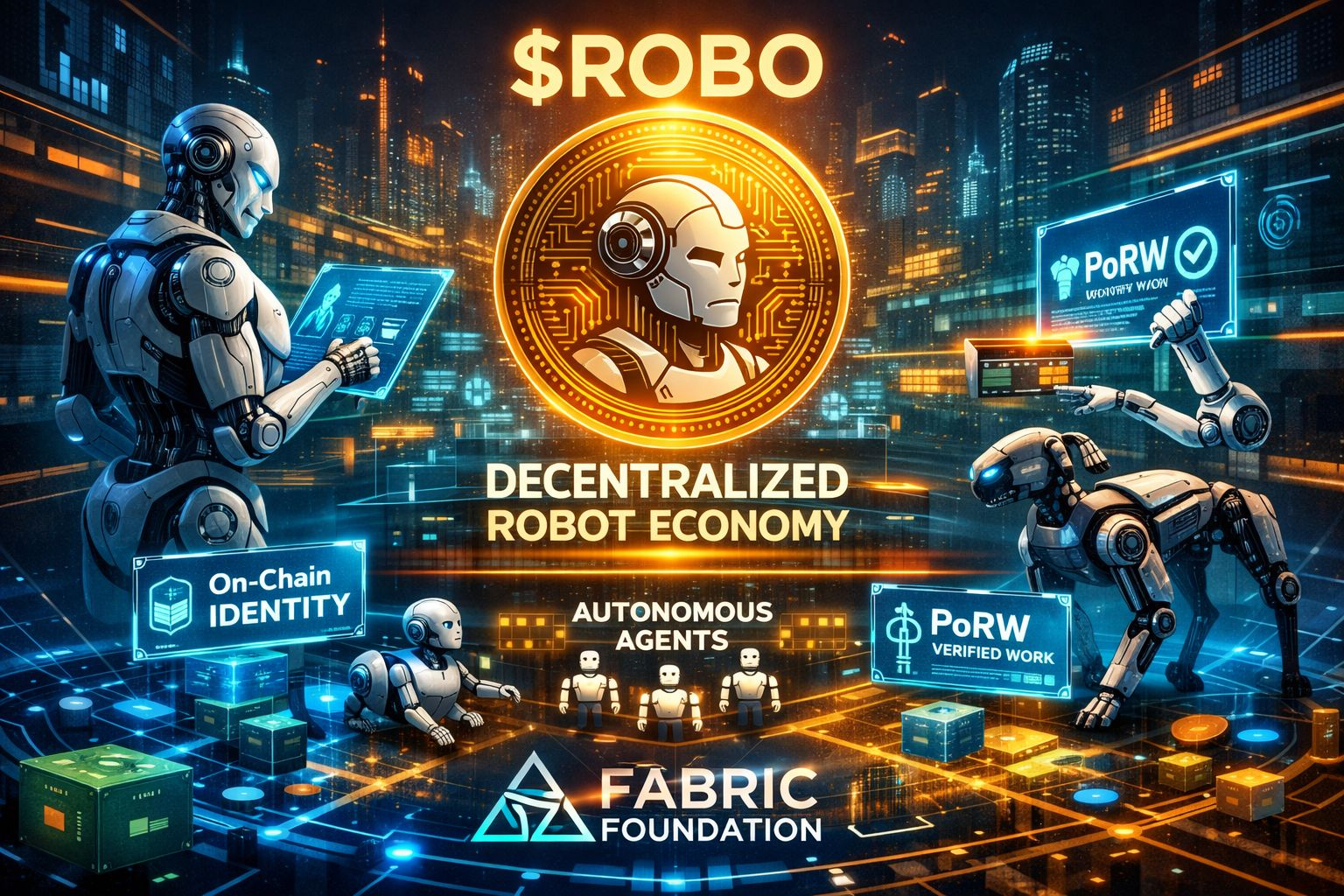
ROBO Overview:
$ROBO is the native utility and governance token of the @Fabric Foundation a non-profit initiative focused on building infrastructure for a future where AI agents and robots participate directly in the global economy.
Unlike typical AI tokens centered only on computation or data, Fabric targets something more ambitious: creating a decentralized “robot economy” where machines can own wallets, perform work, receive payments, and operate under transparent governance rules.
The thesis is simple but bold:
If autonomous machines become economic actors, they will need financial and identity infrastructure — and Fabric aims to provide that layer.
•Core Technology & Use Case:
Fabric Protocol attempts to solve a future problem before it fully arrives: how autonomous systems interact economically with humans.
•Key components include:
1. On-chain Robot Identity
Robots cannot legally open bank accounts or own identities. Fabric introduces blockchain-based identities allowing machines to:
✓receive payments
✓verify tasks
✓maintain operational history
All network interactions use @Fabric Foundation ROBO for fees and verification.
2. Machine-to-Machine Economy:
The protocol enables:
✓autonomous payments
✓decentralized task allocation
✓AI human coordination infrastructure
This creates a marketplace for automated labor and services.
3. Proof of Robotic Work (PoRW):
Instead of rewarding passive staking, token emission links to real robotic activity and verified work, aligning token value with real-world output rather than speculation.
This model differentiates $ROBO from many AI narrative tokens.
•Token Fundamentals
✓Token Utility
1.Network transaction fees
2.Governance voting
3.Identity verification
4.Staking & coordination incentives
✓Supply
✓Fixed supply: 10 billion $ROBO tokens
✓Economic Design Insight: The long-term value depends less on trading hype and more on:
✓adoption of robotic infrastructure
✓AI agent deployment
✓machine economic activity
Major Developments 2026:
•Exchange Listings & Market Launch
ROBO officially entered open trading markets in February 2026, launching across major exchanges including Coinbase-linked platforms and Binance Alpha campaigns.
This provided:
liquidity
institutional visibility
broader investor access
Shortly after listing, strong demand pushed significant price volatility — typical for early-stage infrastructure tokens.
•Airdrop & Ecosystem Expansion
@Fabric Foundation Fabric launched a large airdrop program to decentralize ownership and onboard early participants into the ecosystem.
The strategy signals:
1.community-first distribution
2.long-term governance participation
early network effects
3.AI + Robotics Partnerships
Fabric collaborates within the OpenMind ecosystem to build human–AI collaboration infrastructure, positioning ROBO as coordination middleware between intelligent systems.
✓Roadmap Vision:
Based on official documentation and ecosystem updates:
1. Phase 1 — Base Layer Deployment (Current)
Launch on Base L2
Token generation & listings
Identity + payment primitives.
2. Phase 2 — Ecosystem Growth
Developer onboarding
robotic work verification
decentralized governance activation
3. Phase 3 — Dedicated Layer-1 Blockchain
Fabric plans migration into its own L1 chain, optimized for high-frequency machine transactions and robotic coordination.
4. Phase 4 — Robot Economy Scaling (Long-Term)
autonomous agent marketplaces
machine-owned wallets
real-world robotic labor markets
✓Strengths (Fundamental Bull Case):
✅ Unique Narrative: AI + Robotics + Blockchain (rare intersection)
✅ Real-world thesis: Machines becoming economic actors
✅ Utility-driven token design (not purely governance)
✅ Early institutional visibility through major listings
✅ Work-based emission model (PoRW)