
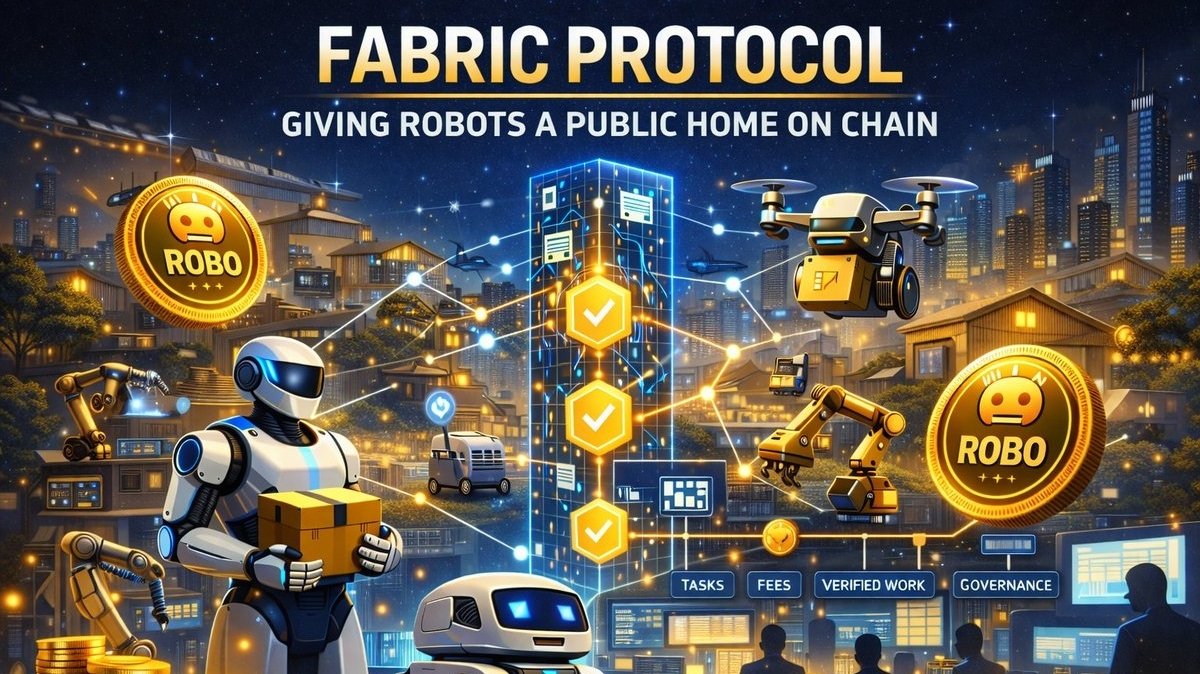
When I first came across Fabric Protocol, my reaction was not excitement. It was exhaustion. Over the past few years, I have watched countless projects try to combine artificial intelligence, robotics, and blockchain. Most of them sounded impressive at first, but the deeper I looked, the more familiar the pattern became. Complex technologies wrapped in big promises, often without a clear understanding of the real world systems they claimed to improve.
Robotics is not a simple digital experiment. Machines move in physical spaces. They interact with people, infrastructure, and environments where mistakes can cause real harm. Because of that, reliability, accountability, and governance matter far more than hype. Too many projects ignored that reality. Instead of solving meaningful coordination problems, they forced tokens and decentralized narratives into systems that did not need them.
So when I saw Fabric Protocol described as an open network for robotics and intelligent agents, my first instinct was to dismiss it. I assumed it would be another attempt to push blockchain into a space where engineering discipline matters more than digital enthusiasm. I expected big language about the future and very little substance about how machines and humans would actually work together.
But curiosity has a way of pulling you back. After spending more time studying the architecture and thinking about the deeper intent behind the protocol, something started to feel different. Slowly, the noise faded and a more serious idea began to appear underneath.
What Fabric is trying to address is not simply robotics. It is the invisible coordination layer that robotics will eventually need.
Today, most robots exist inside controlled ecosystems. A company designs the hardware, writes the software, manages the updates, and controls the entire operating environment. This centralized structure works because responsibility is clear. If something goes wrong, there is a clear owner of the system.
But the world we are moving toward will not look like that forever.
As robotics and artificial intelligence continue to advance, machines will begin to interact across organizations and environments. Autonomous delivery systems moving through cities. Intelligent machines operating across supply chains. AI driven agents negotiating tasks and resources between companies. In that future, machines will not live inside isolated platforms. They will operate inside shared environments where trust cannot depend on a single authority.
That realization is where my perspective began to shift.
Fabric Protocol does not focus only on building better machines. It focuses on building the infrastructure that allows machines, developers, organizations, and communities to coordinate around those machines. Instead of treating robots as isolated tools, the protocol treats them as participants in a broader network where actions must be verified and decisions must be transparent.
One idea at the center of this design is verifiable computing. In simple terms, it means that certain processes within the system can be validated rather than blindly trusted. Instead of relying entirely on the claims of a manufacturer or platform, parts of the network can confirm that computations, updates, or rules were executed correctly.
This does not mean every movement of a robot is recorded somewhere. That would be unrealistic and unnecessary. What matters is that the critical decisions shaping how these machines behave can be verified through a shared infrastructure. Software upgrades, operational policies, and validation processes can be recorded in ways that allow independent participants to confirm their integrity.
What surprised me most is how this changes the role of decentralized systems.
In many projects, distributed ledgers are treated like decorative technology. They exist because they sound innovative. In the context of Fabric, the ledger begins to look more like a coordination memory. A place where important events and decisions in the machine network can be tracked and verified over time.
There is also a deeper philosophical shift in how the system views artificial intelligence.
As AI becomes more capable, it starts behaving less like software and more like an agent interacting with its environment. These agents request resources, perform tasks, and make decisions that affect real world outcomes. In that kind of ecosystem, identity becomes essential.
Fabric introduces the idea that machines and intelligent agents should have verifiable identities within the network. When a system acts, its origin and permissions can be traced. This may sound technical, but the emotional reality behind it is trust. If autonomous machines are going to operate around us, people need confidence that those systems are accountable to something larger than their creators.
Governance is another layer that reveals the seriousness of the design.
In traditional robotics companies, governance happens behind closed doors. Engineers decide what rules exist and executives approve them. But in an open network where multiple builders and operators participate, governance must evolve into something more collaborative.
Fabric proposes a system where participants in the network can contribute to how the infrastructure evolves. Developers, validators, and operators share responsibility for maintaining the rules and integrity of the system. It is not a perfect solution, and decentralized governance has many challenges, but it reflects an honest attempt to confront the coordination problem rather than ignore it.
If the protocol includes a token, its role becomes easier to understand through this lens. The token is not meant to be decoration or speculation. Instead, it works as coordination logic. Participants who verify computations, contribute infrastructure, or help govern the network need incentives to stay aligned with the system. The token helps connect these roles into a shared economic structure.
Still, it would be unrealistic to pretend that a system like this will succeed easily.
Robotics is heavily shaped by regulation and safety standards. Governments and institutions will demand clear accountability when machines interact with public environments. Any decentralized infrastructure must operate within those legal frameworks.
The engineering challenges are also enormous. Combining robotics, artificial intelligence, and verifiable distributed systems requires patience, discipline, and years of experimentation. Adoption will likely be slow because industries that depend on physical systems tend to move carefully.
But perhaps that is exactly why the thinking behind Fabric feels important.
Instead of promising immediate disruption, the project quietly focuses on a problem that will eventually become unavoidable. As machines grow more autonomous and more connected, the systems coordinating them must also become more transparent, verifiable, and trustworthy.
In many ways, the most powerful technologies are not the ones that attract attention today. They are the quiet infrastructures that make future systems possible.
Fabric Protocol may not deliver dramatic change overnight. What it offers instead is something more subtle and more enduring. A thoughtful attempt to design the foundations of a world where humans and intelligent machines must learn to operate together with accountability and trust.
@Fabric Foundation #robo $ROBO
