
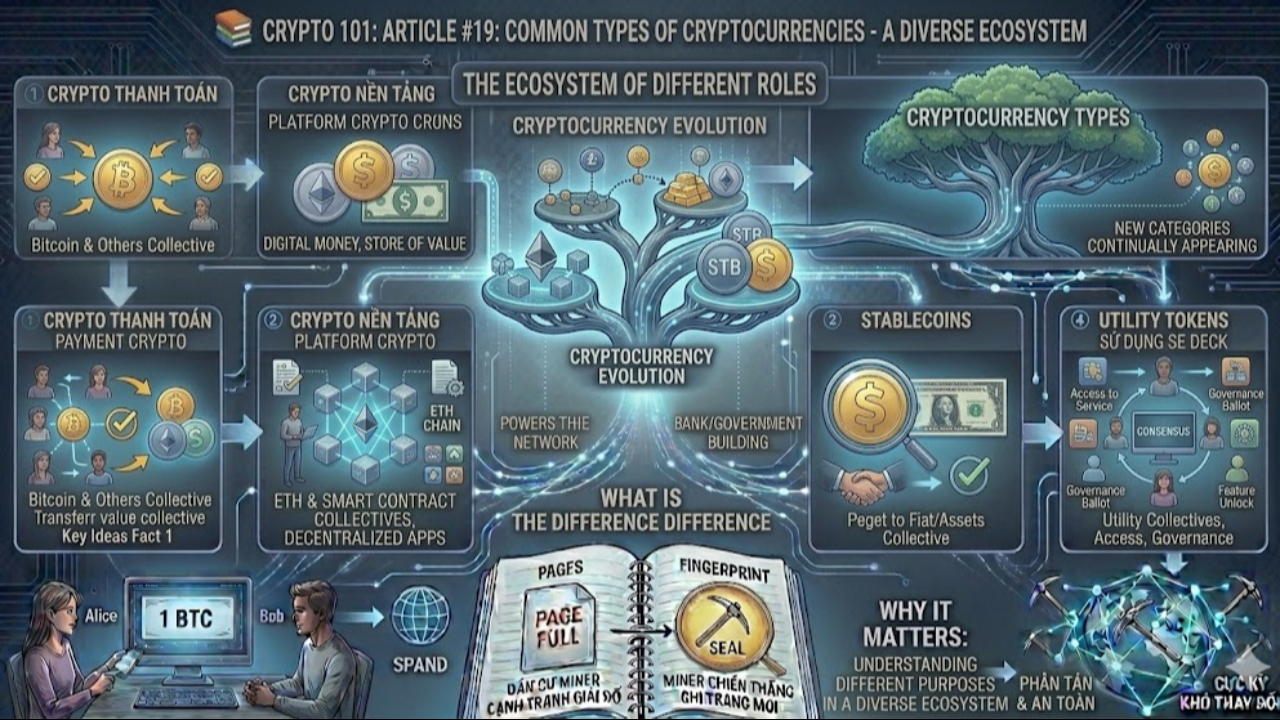
📚 As the crypto industry has grown, thousands of different cryptocurrencies have been created.
However, not all cryptocurrencies serve the same purpose.
Some are designed to be used as digital money, while others support applications, payments, or decentralized systems.
Understanding the main categories of cryptocurrencies can make the crypto world much easier to navigate.
Instead of thinking of crypto as one single type of asset, it is better to see it as an ecosystem with different roles.
Here are some of the most common types of cryptocurrencies.
1️⃣ Payment cryptocurrencies
These are designed mainly to transfer value between users. Bitcoin is the most well-known example and is often used as digital money.
2️⃣ Platform cryptocurrencies
Some cryptocurrencies power blockchain platforms that allow developers to build applications. These networks often support smart contracts and decentralized apps.
3️⃣ Stablecoins
Stablecoins are cryptocurrencies designed to maintain a stable price, usually by tracking the value of a fiat currency like the US dollar.
4️⃣ Utility tokens
These tokens are used within specific platforms or applications. They may provide access to services, features, or governance in a project.
A simple example can help explain these differences.
Imagine the crypto ecosystem as a digital economy.
Some cryptocurrencies act like money used for payments.
Others function like infrastructure that allows developers to build new services.
And some are designed to stay stable so users can avoid price volatility when trading or storing funds.
Because the crypto industry is still evolving, new categories of cryptocurrencies continue to appear over time.
But most projects usually fall into one of these basic groups.
Learning these categories helps beginners understand what different cryptocurrencies are actually designed to do.
Instead of looking only at price, it becomes easier to understand the purpose of a project.
📌 In the next article, we’ll explore:
What smart contracts are and how they allow programs to run directly on blockchain networks.
If you’re just starting to learn about crypto, follow the Crypto 101 series as we build the foundation step by step. 🚀
#CryptoSeries
