
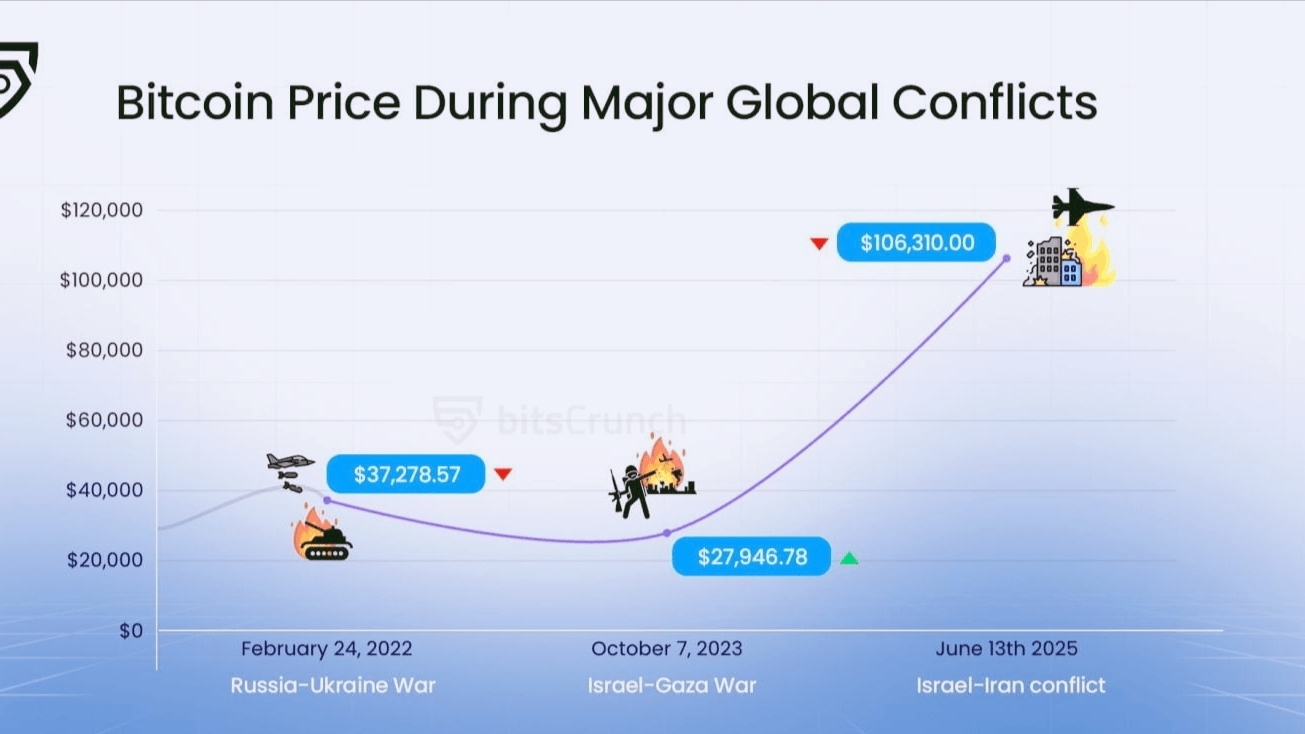
Global conflicts and wars have always had a strong impact on financial markets. In recent years, cryptocurrency has become an important part of the global financial system. When geopolitical tensions rise, investors often react quickly, moving their money between different assets. Because of this, wars can significantly influence the prices of major cryptocurrencies such as Bitcoin (BTC), Ethereum (ETH), and Solana (SOL).
How War Affects the Crypto Market
When a war begins or tensions increase between countries, traditional financial markets often become unstable. Stock markets may fall due to uncertainty, and investors start looking for alternative assets to protect their wealth. In some situations, cryptocurrencies benefit from this uncertainty because they are decentralized and not controlled by any government or central bank.
For example, during major geopolitical conflicts, some investors treat Bitcoin as a “digital gold.” They move their money into #BTC because it can be transferred globally and is not easily restricted by banks or governments. This increased demand can push the price higher.
However, the crypto market does not always move upward during war. In the early stages of a conflict, panic selling can occur. Investors might sell risky assets, including cryptocurrencies, to move into safer options such as cash, gold, or government bonds. This can cause a temporary drop in crypto prices before the market stabilizes.
Bitcoin’s Potential Movement During Global Conflict
Bitcoin is considered the strongest and most established cryptocurrency in the market. Because of its limited supply of 21 million coins and strong global adoption, BTC often reacts differently compared to smaller cryptocurrencies.
If a global conflict causes economic instability, more investors could turn to Bitcoin as a hedge against inflation and currency devaluation. In such a scenario, BTC could potentially rise toward new highs. Some analysts believe that in a strong bullish environment fueled by global uncertainty, Bitcoin could reach price levels between $100,000 and $150,000 in the long term.
On the other hand, if the war severely damages global liquidity and investors need cash, Bitcoin could experience short-term corrections before continuing its upward trend.
Ethereum’s Outlook in Times of War
Ethereum is the second-largest cryptocurrency and powers a large ecosystem of decentralized finance (DeFi), NFTs, and blockchain applications. Because of this, #ETH is influenced not only by macroeconomic events but also by technological development and network usage.
During times of global uncertainty, if crypto adoption continues to grow, Ethereum could benefit significantly. Increased demand for decentralized financial systems could push ETH prices higher. In a strong bullish cycle influenced by global instability and crypto adoption, Ethereum could potentially move toward the $6,000 to $10,000 range.
However, Ethereum can also experience volatility because it is more closely connected to the broader crypto ecosystem than Bitcoin.
Solana’s Potential Growth
Solana is known for its high-speed blockchain and low transaction costs, which make it popular for decentralized applications and trading platforms. Compared to BTC and ETH, Solana is more volatile but also has higher growth potential.
If the crypto market enters a strong bullish phase triggered by global financial uncertainty, Solana could see significant growth. Increased adoption of decentralized applications and faster blockchain networks may drive demand for SOL. In a strong market cycle, #solana could potentially reach the $300 to $500 range.
However, because it is a younger ecosystem, Solana may also experience stronger corrections during periods of panic in the market.
The Role of Investor Psychology
One of the biggest factors during wartime is investor psychology. Fear and uncertainty can cause sudden price swings. Some investors rush to sell assets, while others see an opportunity to accumulate cryptocurrencies at lower prices.
In many historical situations, markets initially drop when war news appears, but later recover once investors adapt to the new environment. The same pattern can occur in the crypto market.
Conclusion
War and geopolitical conflicts create uncertainty in global financial systems. While traditional markets often react negatively, cryptocurrencies can sometimes benefit due to their decentralized nature and global accessibility. Bitcoin may act as digital gold, Ethereum could grow through its expanding ecosystem, and Solana might experience high-growth opportunities if adoption continues.


