I’ve been burned enough by fresh listings that I don’t really get impressed by a clean narrative anymore.For decades, robotics development advanced through fragmented innovation. Laboratories, private companies, and research institutions built increasingly capable machines, yet most of these systems existed within closed environments where knowledge, data, and operational frameworks rarely extended beyond institutional boundaries. The result was technological progress without a shared infrastructure capable of coordinating machines, data, and human oversight on a global scale. Fabric Protocol emerges within this context as an attempt to redefine how robotics ecosystems are organized, proposing an open network where the construction, operation, and governance of general-purpose robots can evolve collectively rather than in isolation.

Supported by the non-profit Fabric Foundation, the protocol introduces a structural framework that treats robotics not simply as hardware engineering but as a distributed digital environment where machines function as network participants. This approach places emphasis on the integration of robotic systems with agent-native infrastructure, allowing machines and software agents to interact within a coordinated computational layer. Instead of relying on opaque execution processes, Fabric incorporates verifiable computing into its core architecture, ensuring that every computational action performed within the system can be cryptographically validated. Such mechanisms transform robotic operation from a trust-based model into one built on verifiable evidence, where the behavior of machines can be examined, audited, and confirmed by any participant within the network.
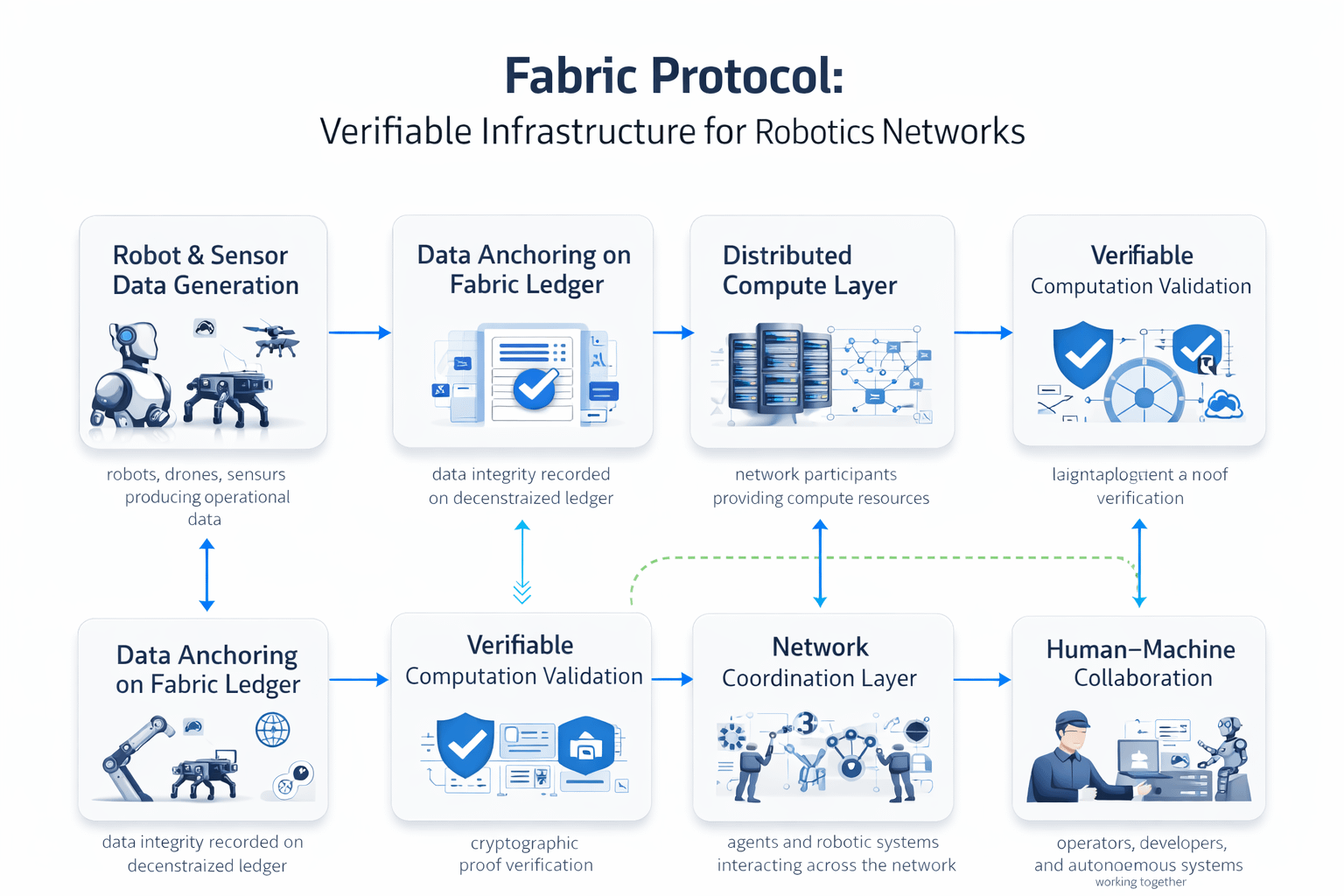
Central to the protocol’s design is the coordination of three critical components that define modern robotic ecosystems: data generation, computational processing, and governance oversight. Fabric organizes these elements through a public ledger that records interactions and operational activity across the network. Data produced by robotic systems, sensors, and environments can be anchored within this ledger, creating a shared record that preserves integrity while enabling controlled accessibility. Computational workloads, often intensive within robotics and artificial intelligence systems, can be distributed across participants who contribute processing capacity, effectively transforming the network into a collaborative computational infrastructure. Governance mechanisms embedded in the protocol allow stakeholders to collectively determine how the system evolves, introducing a framework where safety standards, regulatory alignment, and operational permissions are defined through transparent coordination rather than centralized authority.
What distinguishes Fabric Protocol is its modular architectural philosophy. Instead of imposing rigid technological standards that force developers to abandon existing platforms, the protocol allows different layers of infrastructure to integrate with varying robotic systems and software environments. This design principle recognizes that robotics development spans diverse industries, from industrial automation to research laboratories and emerging AI-driven service robotics. By enabling interoperability rather than replacement, Fabric seeks to provide a coordination layer capable of supporting experimentation, incremental adoption, and cross-industry participation without disrupting established technological ecosystems.
As the network expands, the protocol begins to function less as a singular technological project and more as foundational infrastructure for the robotic era. Within this framework, machines are no longer isolated tools but active participants in a broader computational environment where their actions, data exchanges, and operational decisions remain transparent and verifiable. The resulting system aims to foster a form of human-machine collaboration grounded in accountability, where technological advancement occurs alongside mechanisms that ensure safety, governance, and collective oversight.
In this sense, Fabric Protocol represents an effort to construct the institutional and technological scaffolding required for a future in which robotics becomes deeply embedded within everyday systems. Rather than focusing solely on the capabilities of individual machines, the protocol addresses the broader challenge of coordination—how billions of devices, intelligent agents, and human participants might operate within a shared digital framework. Through its emphasis on verifiable computation, open governance, and modular infrastructure, Fabric outlines a model in which the evolution of robotics is guided not by isolated innovation but by a globally coordinated network designed to support collaboration between human intelligence and autonomous machines.
@Fabric Foundation #ROBO $ROBO