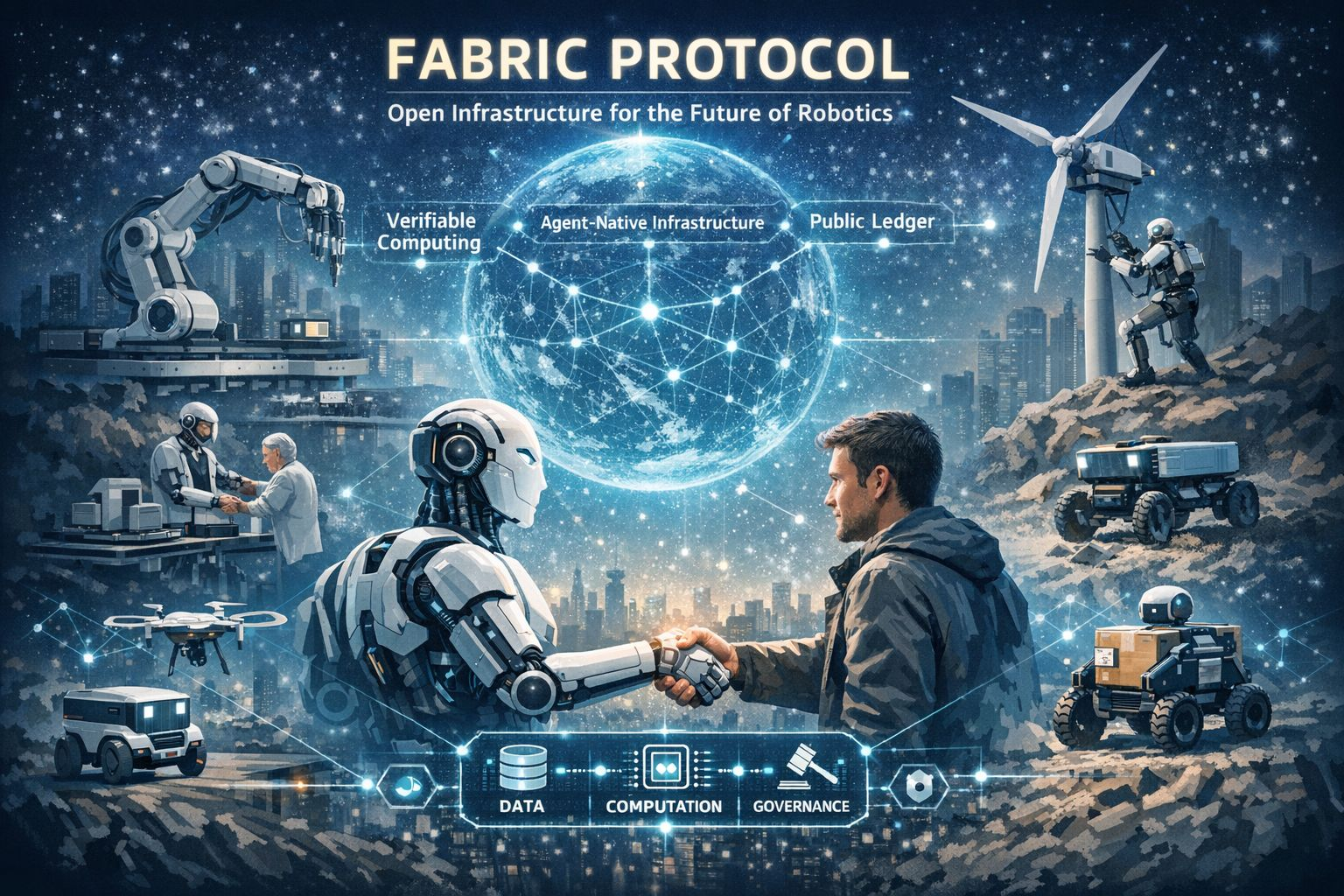
The next technological revolution will not just be about software—it will be about intelligent machines that can operate safely alongside humans. As robotics and artificial intelligence rapidly evolve, the need for a transparent, collaborative, and secure infrastructure becomes essential. Fabric Protocol emerges as a powerful solution designed to support the construction, governance, and continuous evolution of general-purpose robots through an open global network.
The Vision Behind Fabric Protocol
Fabric Protocol is supported by the Fabric Foundation, a non-profit organization dedicated to advancing open technological ecosystems. Its mission is to create a shared digital infrastructure where robots, developers, organizations, and communities can collaborate in a secure and verifiable environment.
Instead of robotics systems being controlled by isolated companies or closed platforms, Fabric Protocol promotes an open, decentralized framework where innovation can be built collectively. This approach ensures transparency, trust, and long-term sustainability in the development of robotic technologies.
Verifiable Computing: Trust in Machine Intelligence
One of the key pillars of Fabric Protocol is verifiable computing. In a world where autonomous machines perform critical tasks—from manufacturing to healthcare—trust becomes a fundamental requirement.
Verifiable computing allows every computation performed by a robot or AI agent to be cryptographically proven and validated. This means that actions taken by machines can be audited, verified, and trusted by humans, organizations, and regulators.
This technology helps ensure that robotic systems operate according to defined rules and ethical frameworks, reducing risks associated with autonomous decision-making.
Agent-Native Infrastructure
Fabric Protocol introduces the concept of agent-native infrastructure, designed specifically for intelligent agents and robotic systems. Unlike traditional internet architecture built for human interaction, this infrastructure enables machines to interact, collaborate, and coordinate seamlessly.
Robotic agents can share data, request computational resources, and communicate with other machines in a structured environment. This creates a dynamic ecosystem where machines are not just tools but participants in a collaborative network.
Coordination Through a Public Ledger
At the core of Fabric Protocol lies a public ledger that coordinates data, computation, and governance across the network. This ledger functions as a transparent system of record that tracks machine activity, data flows, and protocol governance.
Through this decentralized ledger:
Robot behaviors can be verified
Data ownership can be managed securely
Computational tasks can be distributed efficiently
Governance decisions can be recorded transparently
The use of a public ledger also reduces the need for centralized intermediaries, enabling a more open and resilient system.
Modular Infrastructure for Innovation
Another defining feature of Fabric Protocol is its modular infrastructure. Instead of forcing developers into rigid frameworks, the protocol allows components to be built and integrated as independent modules.
Developers can design specialized tools, robotic capabilities, data pipelines, or governance models that plug into the network. This modularity encourages rapid innovation and makes it easier for organizations to adopt the technology according to their specific needs.
Enabling Safe Human-Machine Collaboration
Perhaps the most important goal of Fabric Protocol is enabling safe and productive collaboration between humans and machines. By combining verifiable computing, decentralized coordination, and agent-native infrastructure, the protocol creates a trustworthy environment where robots can operate responsibly.
This opens the door to numerous applications, including:
Smart manufacturing systems
Autonomous logistics networks
Healthcare robotics
Infrastructure maintenance robots
Disaster response systems
In each of these fields, transparency and accountability are critical, and Fabric Protocol provides the technological foundation to achieve both.
A Step Toward the Robotic Internet
Fabric Protocol represents more than just another blockchain or robotics platform. It is an ambitious attempt to build the “internet of robots”—a global network where machines, developers, and organizations collaborate openly to accelerate technological progress.
By combining decentralized governance, cryptographic verification, and modular design, Fabric Protocol could redefine how robotic systems are built, governed, and trusted.
Conclusion
As robots become increasingly integrated into everyday life, the systems that control and coordinate them must be transparent, secure, and collaborative. Fabric Protocol offers a bold vision for the future—an open infrastructure where humans and machines can work together safely and efficiently.
If successful, Fabric Protocol could become a foundational layer for the next generation of intelligent machines, shaping a world where robotics innovation is not limited by centralized control but powered by global collaboration. 🚀
@Fabric Foundation #ROBO $ROBO