
The artificial intelligence sector is heavily saturated with empty promises and shiny presentations. Everyone talks endlessly about smart robots and autonomous agents taking over complex tasks, but very few developers focus on the actual plumbing required to make this future a reality. When a robot leaves the safety of the factory and steps into the open real world, it immediately faces a massive crisis of trust. How do we precisely know what a machine is doing? How can a robot autonomously pay for critical data or receive instant compensation for its work? The current closed corporate systems simply cannot answer these fundamental questions.
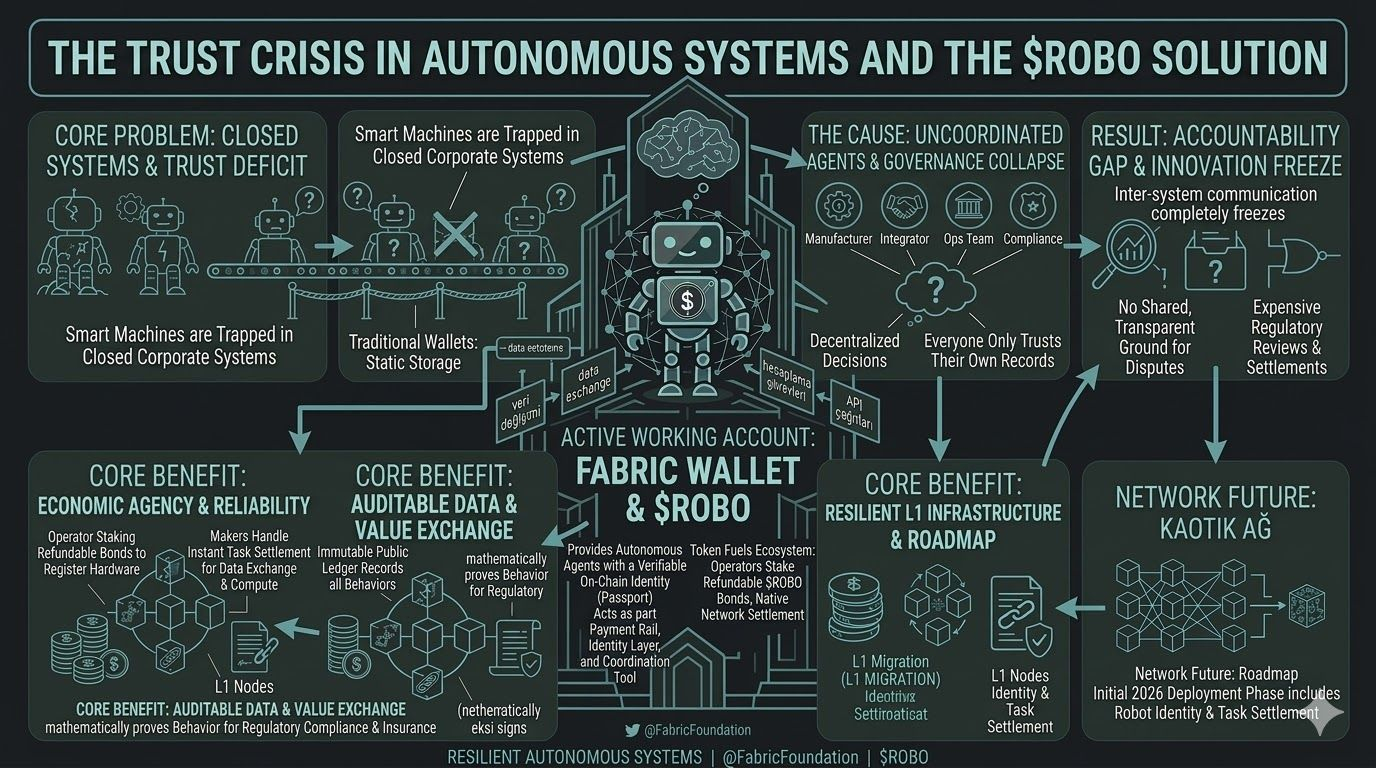
This is exactly why @Fabric Foundation is completely different from the standard hype driven projects in the market. Instead of painting unrealistic science fiction scenarios, Fabric is doing the incredibly hard and unglamorous work of giving machines verifiable on chain identities. In this new autonomous ecosystem, a wallet is not just a static place to store digital tokens. For an autonomous agent, a Web3 wallet acts as a primary working account and a digital passport. Since robots absolutely cannot open traditional bank accounts, this decentralized identity is their only secure way to prove their work, verify their data sources, and operate seamlessly in systems that people and corporations can actually trust.
At the absolute center of this massive technological shift is the $ROBO token. Fabric treats machines as active network participants, not just simple disposable tools. Human operators are required to use $ROBO to post refundable operational bonds, ensuring that machines have real financial skin in the game. When an AI agent buys a dataset or a physical drone completes a delivery, the network natively handles the instant settlement securely. Every single action and data processing task is permanently recorded on an immutable public ledger. This architecture creates absolute transparency and directly solves the accountability gap that has severely frozen innovation in global robotics.
As @Fabric Foundation aggressively rolls out its institutional grade L1 network, it prioritizes maximum security and advanced validator nodes to handle the enormous transaction volume of the upcoming machine economy. This is clearly not just an idea on paper; it is the resilient and unbreakable infrastructure being built right now to support real coordination, verified network contributions, and true economic agency for machines.
#robo