
I closed my last position around midnight, poured coffee, and opened the explorer out of habit. Fabric Foundation’s ROBO Public-Ledger Oversight in Fabric’s decentralized architecture isn’t hype — it’s already running. The ROBO contract hit Ethereum at 0x32b4d049fe4c888d2b92eecaf729f44df6b1f36e on February 27, 2026.
That single deployment quietly turned every robot action into something you can actually audit. No more black-box fleets.
Two actionable things I started doing immediately: lock ROBO for veROBO to get real voting weight, and watch large transfers for early contribution signals. Both beat guessing.
the moment my small lock actually showed up
Back in the first week of March I tossed a test bag into the lock — nothing huge, just enough to feel the mechanism. Waited the full period. When the dashboard finally refreshed, my voting power ticked up exactly as promised. Nothing flashy. Just quiet confirmation that the public ledger really does weight commitment over noise.
Felt oddly grounding. Like the first time you see a transaction settle without a middleman.
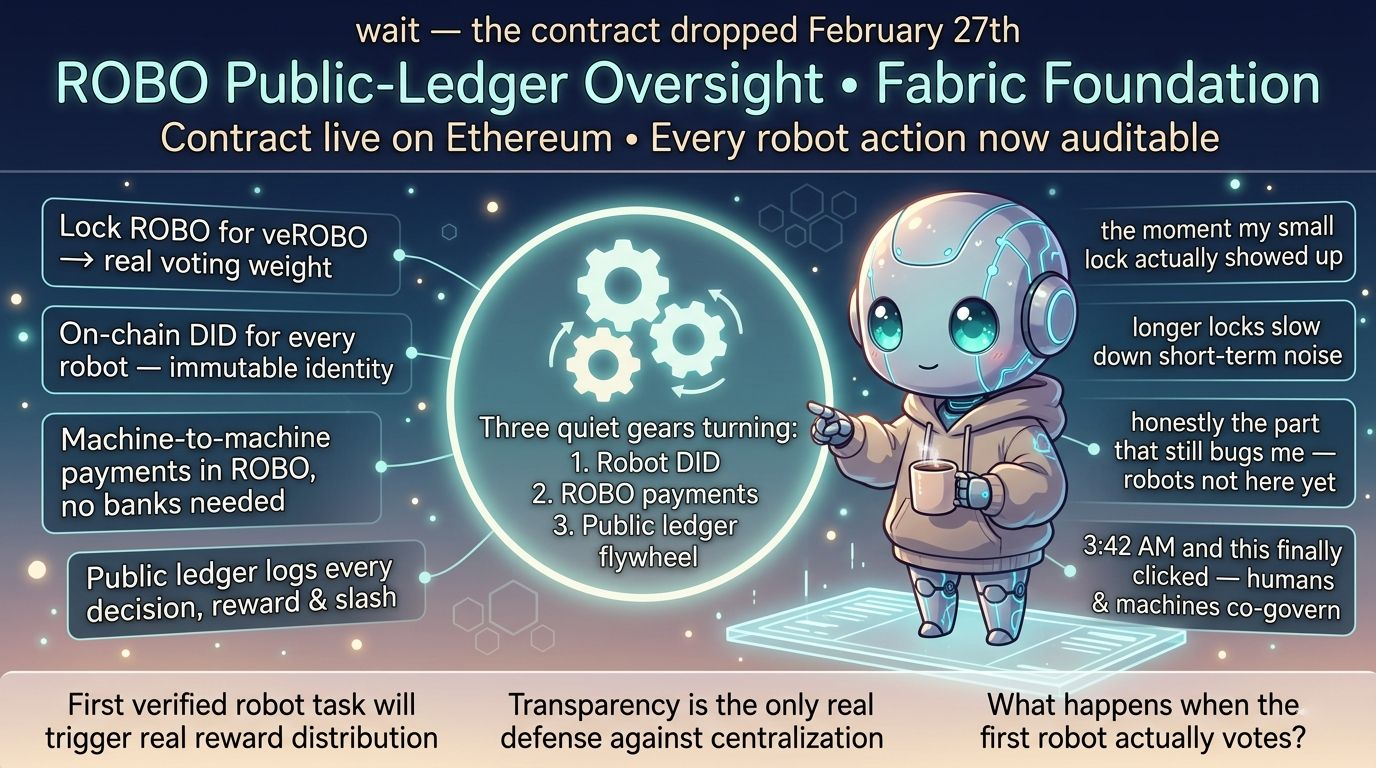
That’s the first intuitive behavior: longer locks don’t just earn more voice — they slow down short-term noise. The chain rewards patience in a way spreadsheets never could.
three quiet gears turning
Fabric runs on three simple gears nobody talks about enough. First, every robot gets an on-chain DID — immutable identity. Second, payments flow machine-to-machine in ROBO, no bank account required. Third, the public ledger logs every decision, every reward, every slash.
Turn one and the others move. That silent flywheel is why the architecture feels different. Not flashy DeFi loops. Just steady coordination that scales with real hardware.
Second intuitive behavior I keep noticing: when a contribution hits the ledger, the reward parameter adjusts automatically. No committee meeting. The contract just settles it. You see it in the transfer logs if you know where to look.
honestly the part that still bugs me
Binance opened spot trading March 5th. Kraken followed right after. Volume jumped, sure. But on-chain? Mostly people moving tokens between wallets. Not robots yet.
Hmm… that gap still makes me pause. The oversight layer is live, the contract is there, yet the actual robot economy feels one step away. Makes me wonder if we’re watching infrastructure before the machines show up in force.
3:42 AM and this finally clicked
Sat here staring at the explorer again. Realized the whole thing is built so humans and machines can co-govern without one side dominating. Lock ROBO, vote on fees or safety thresholds, and the ledger records it forever.
No CEO can flip a switch. No single lab owns the rules. That’s the part that keeps me up — not the price action, but the quiet shift in power.
Feels heavy in the best way.
where this heads next
Strategically, the real test comes when the first verified robot task settles on-chain and triggers an actual reward distribution. Watch how the emission engine adapts — that’s the signal.
Longer term, expect the protocol to migrate to its own L1 once robot density grows. The public-ledger oversight stays the same; only the base layer changes. Builders who start experimenting with robot identity modules now will have the edge.
Also worth thinking about: what happens when machines themselves start locking tokens? The governance math gets interesting fast.
One more reflection — this setup forces alignment early. Every incentive is visible. Every decision traceable. That transparency might be the only real defense against the usual centralization creep.
If you’re watching the same explorer windows I am, drop a note. Curious who else is testing the locks this quiet.
What happens when the first robot actually votes?
@Fabric Foundation #Robo $ROBO