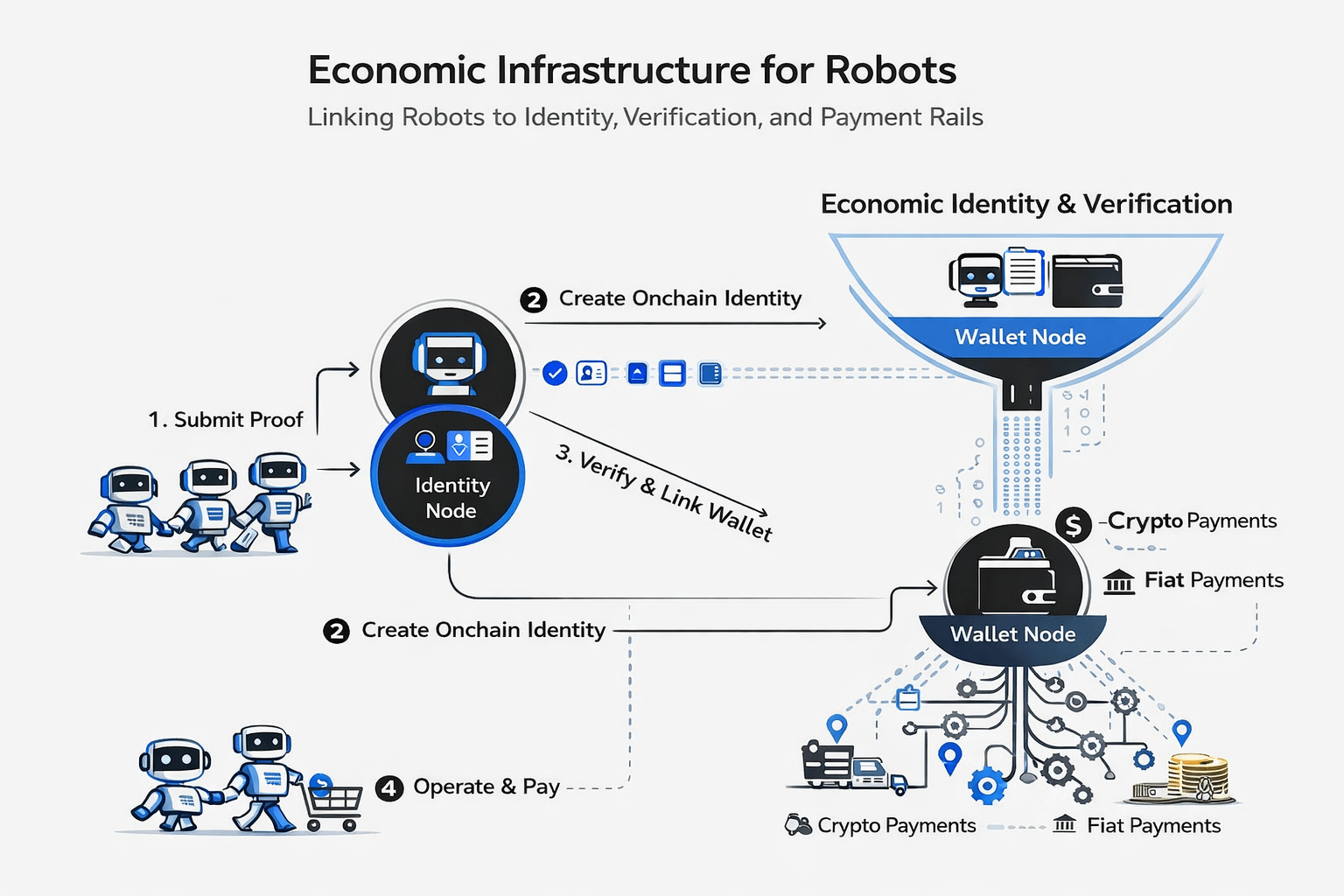
At first, I thought Fabric was just another robotics narrative. But the more I studied it, the more I felt the real idea was much bigger. The real bet here is not simply on smarter robots. It is on whether robots can become real economic participants in a world whose systems were built only for humans. That is the part that changed how I look at $ROBO. Fabric Foundation describes itself as a non-profit focused on open robotics and AGI, with a mission to build the governance, economic, and coordination infrastructure that helps humans and intelligent machines work together safely and productively.
What stood out to me most is Fabric’s basic argument: today’s financial and institutional rails were designed for people, not machines. Humans can open bank accounts, carry identity documents, sign contracts, and get paid through systems that already exist. Robots cannot do that in the same way. Fabric’s official thesis is that if machines are going to do useful work in the real world, they will need persistent identity, wallets, payment rails, and transparent coordination systems. That is why the project keeps framing the opportunity around the “robot economy,” not just around robotics as a theme.
That is also where ROBO starts to look more meaningful to me. Fabric says $ROBO is the network’s core utility and governance asset. According to its official token introduction, it is meant to be used for payments, identity, verification, staking and participation, builder ecosystem access, and governance. Fabric also says the network will launch on Base first and may later migrate into its own L1 as adoption grows. When I put those details together, I do not see a token that exists only for launch attention. I see a token that is being placed inside a bigger infrastructure thesis.
What makes this interesting from my perspective is that it shifts the whole question. Instead of asking only whether robots will become smarter, I start asking whether they can become economically usable. A robot can be intelligent and still remain trapped inside a closed system if it cannot be identified, verified, paid, or coordinated across an open network. Fabric’s thesis is that this missing layer matters just as much as the intelligence itself. And honestly, I think that is a much more original bet than the market is giving it credit for right now.
Of course, the idea is still early. Fabric itself says scaled robotic fleets will still require partnerships, operational maturity, insurance frameworks, and reliable service models before this vision becomes real. But that honesty is exactly why I find the project worth watching. The challenge is not small, and neither is the upside if the thesis works. That is why I’m not only looking at ROBO as a token. I’m watching whether Fabric can actually build the rails that make machine participation real.