
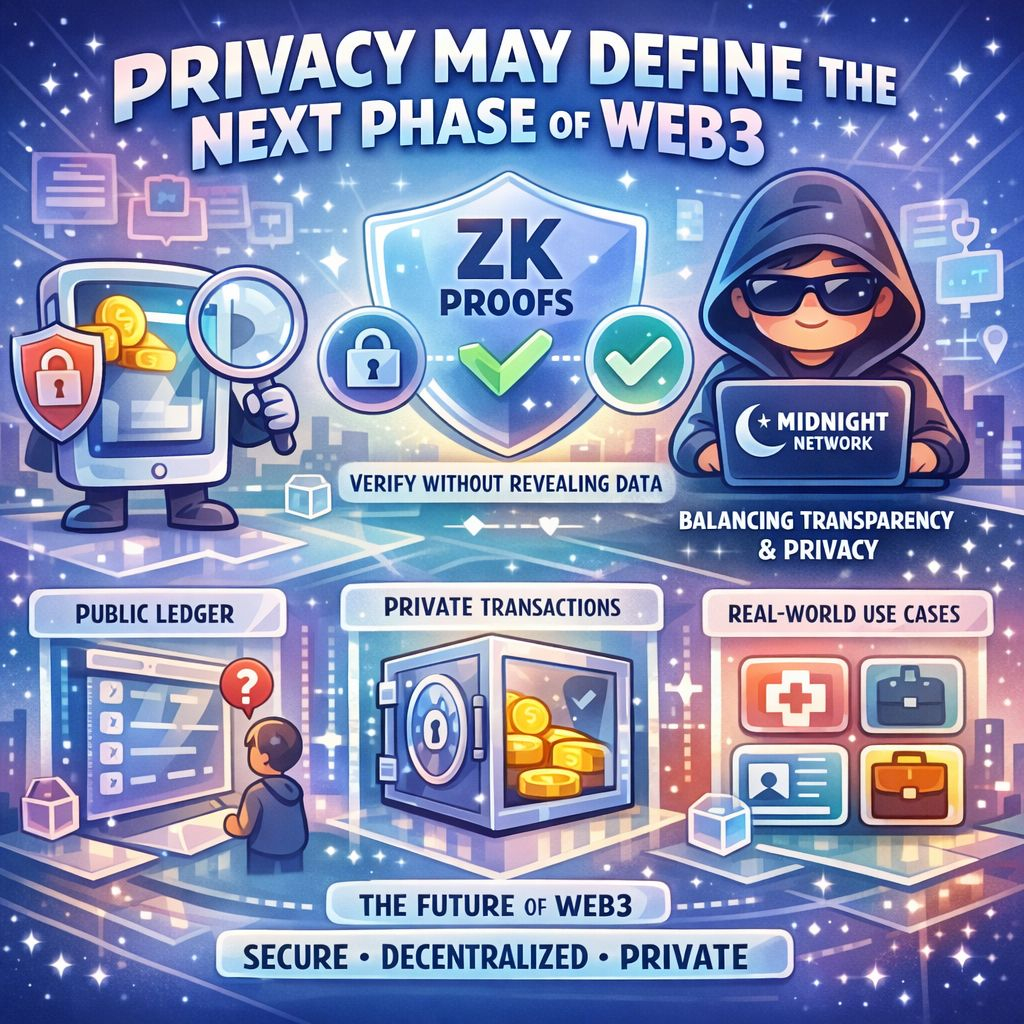
 PRIVACY MAY DEFINE THE NEXT PHASE OF WEB3
For most of crypto’s history, transparency has been treated as one of blockchain’s greatest strengths. Public ledgers allow anyone to see transactions, track movements of funds, and verify activity without relying on a central authority. This openness builds trust. But as blockchain technology expands beyond simple payments and into real-world applications, that same transparency is starting to reveal its limitations.
Every transaction recorded on a public chain leaves a permanent trail. Wallet interactions, trading behavior, and financial patterns can all become visible to anyone willing to analyze the data. For developers and regulators, this transparency can be helpful. For everyday users, it can feel intrusive. As adoption grows, the conversation is slowly shifting from pure transparency to something more balanced: transparency where necessary, and privacy where appropriate.
This is the space where Midnight Network is trying to position itself.
The core idea behind the project revolves around zero-knowledge proof technology. At first glance, the concept sounds complex. In reality, the principle is surprisingly straightforward. A zero-knowledge proof allows one party to prove that a statement is true without revealing the underlying information behind that statement.
In practical terms, this means that a transaction or piece of data can be validated by the network without exposing sensitive details to the public ledger. The blockchain still verifies that rules are being followed, but the personal information behind the activity remains protected.
This approach could change how people think about blockchain privacy.
Consider a simple scenario many crypto users experience. A wallet address is shared publicly for a transaction, a trade, or participation in a decentralized application. From that moment forward, anyone can examine the full transaction history connected to that address. Tools designed for blockchain analytics make it easier than ever to map financial behavior and track activity across multiple platforms.
For professional traders or institutions, this kind of exposure can create strategic disadvantages. For regular users, it raises questions about financial privacy. Even small actions on-chain can reveal patterns about spending habits, holdings, or personal activity.
The challenge is that privacy and security must coexist. A system that hides everything can weaken trust. A system that reveals everything can compromise user autonomy.
Midnight Network attempts to balance those two forces.
Instead of abandoning transparency completely, the architecture focuses on selective disclosure. Developers can build decentralized applications where certain data remains private while the validity of the transaction is still verified on-chain. In other words, the network confirms that rules were followed without exposing every detail to the public.
This balance could become increasingly important as blockchain moves into sectors beyond trading and decentralized finance.
Imagine applications in healthcare, digital identity, or enterprise data systems. In those environments, raw transparency is often not acceptable. Sensitive information must remain confidential, yet the systems still need to maintain verifiable integrity. Privacy-preserving infrastructure allows both conditions to exist simultaneously.
That is one of the long-term arguments behind privacy-focused blockchain design.
Developers are also paying attention to the usability side of the equation. Privacy solutions in earlier blockchain experiments often required complicated tools or external layers. For wider adoption, privacy must be integrated directly into the network architecture while still allowing developers to build applications in familiar ways.
Midnight Network aims to support decentralized applications and digital services while embedding privacy features directly into the protocol. The goal is not to replace the existing Web3 ecosystem, but to expand its capabilities.
If successful, this type of infrastructure could open new possibilities. Businesses may feel more comfortable building blockchain-based platforms when confidential information can remain protected. Individuals may adopt decentralized tools more freely when their financial activity is not permanently exposed to public scrutiny.
Of course, privacy in blockchain also raises broader discussions.
Regulators often worry that privacy technologies could be misused for illicit activity. Developers counter that privacy is not inherently suspicious. In traditional finance, individuals expect a level of confidentiality when managing their assets. The debate is not about whether privacy should exist, but how it should be implemented responsibly.
Technologies like zero-knowledge proofs attempt to navigate that middle ground. They allow verification without exposure, compliance without total surveillance.
In many ways, this reflects the natural evolution of blockchain itself. The first generation focused on decentralization. The second generation expanded into smart contracts and decentralized applications. The next stage may revolve around data control and privacy protection.
Users increasingly want ownership of their digital identity and personal information. They want the benefits of decentralized systems without sacrificing their autonomy. Privacy-preserving networks attempt to deliver exactly that combination.
Whether Midnight Network ultimately becomes a major part of that future remains to be seen. The Web3 landscape is constantly evolving, and many projects are exploring similar ideas from different angles. But the broader trend is difficult to ignore.
As blockchain technology matures, transparency alone may not be enough.
The next era of Web3 could depend on systems that are not only decentralized and secure, but also capable of respecting the privacy of the people who use them.