
I was staring at the Midnight Explorer around 3 AM my time, coffee gone cold, when block 600115 landed. Nothing dramatic — just another regular transaction, hash 0x00c9ad38bf27ff2be91ff13a7949208c17ed46bbb78850869d3c442d46c1b32d, confirmed in seconds. Preprod network, epoch 985,187, slot ticking forward every six seconds. Yet something about that quiet settlement stuck. This wasn’t hype. This was the Midnight Network actually breathing.
the moment the dashboard refreshed
You hold $NIGHT — unshielded, public, governance token — and it quietly mints DUST. That DUST pays for shielded interactions where the world sees nothing unless you choose to reveal it. Rational privacy, they call it. Not hiding for the sake of hiding. Hiding what needs hiding while proving the rest. I’ve watched similar mechanics on other chains fall apart under real load. Here, the dual-token flywheel feels… intentional. One public lever for alignment, one private resource for execution. Three quiet gears: NIGHT secures the chain and votes on upgrades, DUST fuels the shielded work, zero-knowledge circuits let you disclose only what matters.
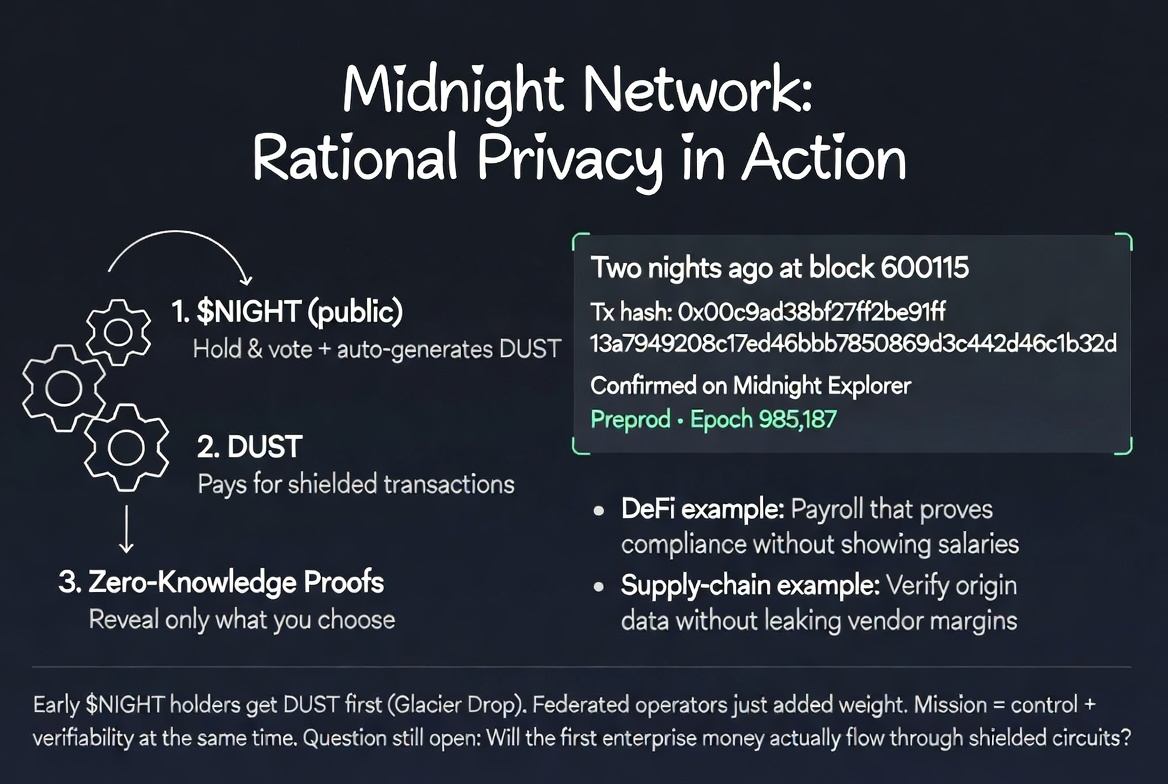
Last week the federated operators — Google Cloud, Blockdaemon, Shielded Technologies — added more weight ahead of the late-March mainnet push. You could feel the network hum a little steadier. Two timely examples hit different: one DeFi team quietly testing payroll logic that proves compliance without exposing salaries; another supply-chain pilot verifying origin data without leaking vendor margins. Both ran on the same preview chain I was watching. Both stayed private until the moment proof was needed.
honestly the part that still bugs me
Hmm… I keep circling back to the distribution. Over 4.5 billion $NIGHT already claimed through Glacier Drop and Scavenger Mine phases. Early holders generate DUST first. That’s fine — skin in the game matters. But it does mean the privacy tools open widest for those who showed up earliest. Wait — actually, that’s not a flaw. That’s how incentives have to work if you want the network to survive its first year. Still, I catch myself wondering how the late arrivals will feel when mainnet flips live and the resource model is already humming.
I closed a position earlier that night, nothing to do with NIGHT, just routine. Poured another coffee and kept scrolling blocks. The explorer showed 90–120 transactions rolling through the last 24 hours, steady, unremarkable. No fanfare. No viral moment. Just the chain doing its job in the background while the rest of crypto chases the next narrative.
3:42 AM and this finally clicked
Here’s the part that lands different at this hour. Midnight isn’t selling anonymity. It’s selling control. You decide what stays hidden and what gets proven — to regulators, to counterparties, to your own team. That selective disclosure changes the risk equation entirely. Institutions that walked away from crypto because of exposure might actually lean in. Developers who gave up on privacy coins because they couldn’t audit anything might finally build.
I’m not convinced every regulator will get it right away. Some will still see “privacy” and hit the brakes. Others might notice the auditable NIGHT layer and the programmable proofs and pause long enough to test it. Either way, the on-chain behavior I watched two nights ago already answers the question most chains never ask: can you be private and verifiable at the same time, at scale, without asking users to trust a black box?
The federated phase ends soon. Community block production follows. Governance moves on-chain. The mission — rational privacy as infrastructure, not gimmick — either proves itself or it doesn’t.
What happens when the first enterprise DApp ships real money through those shielded circuits and regulators actually approve the disclosure model instead of fighting it? That’s the question I can’t stop turning over.
@MidnightNetwork #night