
@Fabric Foundation When I first looked at the idea of ROBO Coin connecting physical robots to blockchain systems, my instinct was to treat it like another crypto narrative trying to ride the automation wave. The surface explanation sounded familiar. Robots do work, a token records the result, and everything becomes decentralized. But that framing felt too clean. What struck me after thinking about it longer is that the real issue is not robots or tokens. It is coordination.
A common misconception sits right at the center of the conversation. People assume the purpose of connecting robots to blockchains is efficiency. Faster machines, faster records, faster automation. The deeper question is different. The real challenge is how independent machines operated by different organizations verify each other's actions without relying on a single authority.
To understand the structure, it helps to start with how robots currently operate. Industrial automation is already widespread. The International Federation of Robotics estimates that more than 4 million industrial robots are active globally, most working inside manufacturing, logistics, and warehousing systems. Each one constantly produces data. A robot moving a container inside a warehouse can generate dozens of sensor readings and status confirmations within seconds.
On the surface, that activity appears organized. Underneath, those records almost always live in isolated systems. One company owns the robot, another owns the logistics platform, another operates the warehouse infrastructure. Each participant maintains its own internal logs. When something goes wrong, everyone trusts their own data first.
That fragmentation becomes a structural problem when machines begin interacting across organizational boundaries. A delivery robot may start a task inside one company's warehouse, pass through a logistics network managed by another firm, and complete a final step at a retail distribution center owned by a third. Each stage produces information about location, timing, and task completion.
What appears to happen is a simple chain of robotic actions. Underneath, the truth becomes harder to verify. Each organization has its own database and its own version of events. When disputes arise, there is no neutral record to settle the question.
This is where the idea of connecting robots to a blockchain ledger starts to make sense. On the surface, a robot finishes a task and a small record is written to the chain. Underneath, something more structural occurs. A shared ledger creates a timestamped event that multiple parties can verify independently.
That simple mechanism enables something important. Machines operating across different companies can coordinate around a record that no single organization controls. In practical terms, a logistics company could verify that a warehouse robot actually completed a loading task before dispatching the next machine in the chain.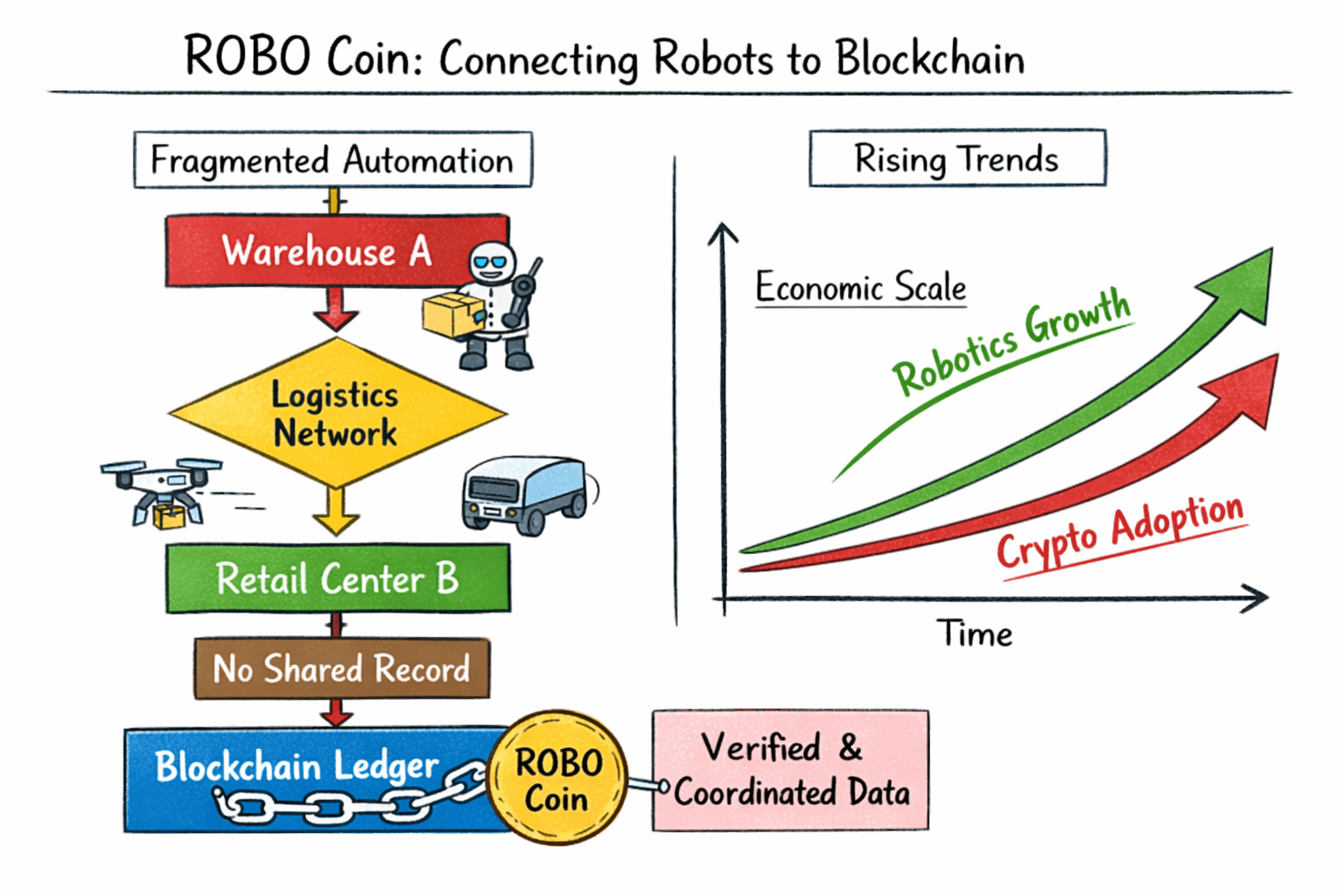
Understanding that mechanism also helps explain why ROBO Coin exists inside the architecture. Surface level, the token appears to function like a normal crypto asset. It moves between addresses and has a market price. Underneath, it anchors economic incentives inside the network.
Blockchains require participants to maintain the system. Validators, which are the computers responsible for confirming transactions, must be rewarded for processing and verifying data. Tokens provide that reward structure. Without them, the ledger would rely on centralized infrastructure.
The scale of this coordination problem becomes clearer when looking at current automation trends. Global spending on robotics and intelligent automation exceeded roughly 200 billion dollars last year. That figure reflects the rapid expansion of autonomous systems across industries ranging from manufacturing to agriculture.
Meanwhile the crypto market itself is operating at a different scale. Daily digital asset trading volume often fluctuates between 60 and 90 billion dollars depending on liquidity conditions. Those numbers reveal something interesting. Both robotics and crypto infrastructure now operate at meaningful economic scale, yet they rarely intersect.
That gap is where ideas like ROBO Coin begin to position themselves. Not as a consumer-facing payment system, but as a quiet coordination layer connecting physical machines to digital ledgers.
Meanwhile the broader crypto environment has shifted significantly over the past year. Institutional flows have begun entering the market through spot Bitcoin exchange traded funds. Those funds accumulated tens of billions of dollars in assets within months of launching. That inflow signals growing institutional comfort with blockchain infrastructure.
At the same time, artificial intelligence narratives are dominating technology markets. Investors increasingly talk about autonomous agents, machine decision systems, and AI-driven workflows. Yet most of those discussions overlook the infrastructure needed for machines to coordinate with each other.
A robot completing a task is one thing. A robot proving that the task happened in a way other systems can trust is something else entirely.
That distinction introduces technical constraints. A single industrial robot can generate thousands of events per day. A fleet of 10,000 machines operating inside a logistics network could easily produce millions of data points within hours. Writing every sensor reading directly to a blockchain would overwhelm most networks.
So the architecture tends to work differently. Surface level, observers see a robot interacting with a blockchain. Underneath, only key events are recorded. The ledger captures confirmations that a task occurred, not the entire stream of sensor data behind it.
That design choice enables scalability. The blockchain records only the moments that matter for coordination. Meanwhile the raw machine data remains in off-chain storage systems.
But that structure introduces tradeoffs. If off-chain systems fail or become compromised, reconstructing the full context behind an event may become difficult. The ledger proves that something happened, but not necessarily every detail surrounding it.
Another challenge appears in privacy. Industrial operations often contain sensitive information. Companies rarely want their entire production flow visible on a public ledger. That tension forces designers to balance transparency with confidentiality.
Some networks address this by recording proofs rather than raw information. A proof is a cryptographic confirmation that a process followed certain rules without revealing the data itself. Surface level, a robot confirms a task completion. Underneath, the system proves the event happened without exposing operational details.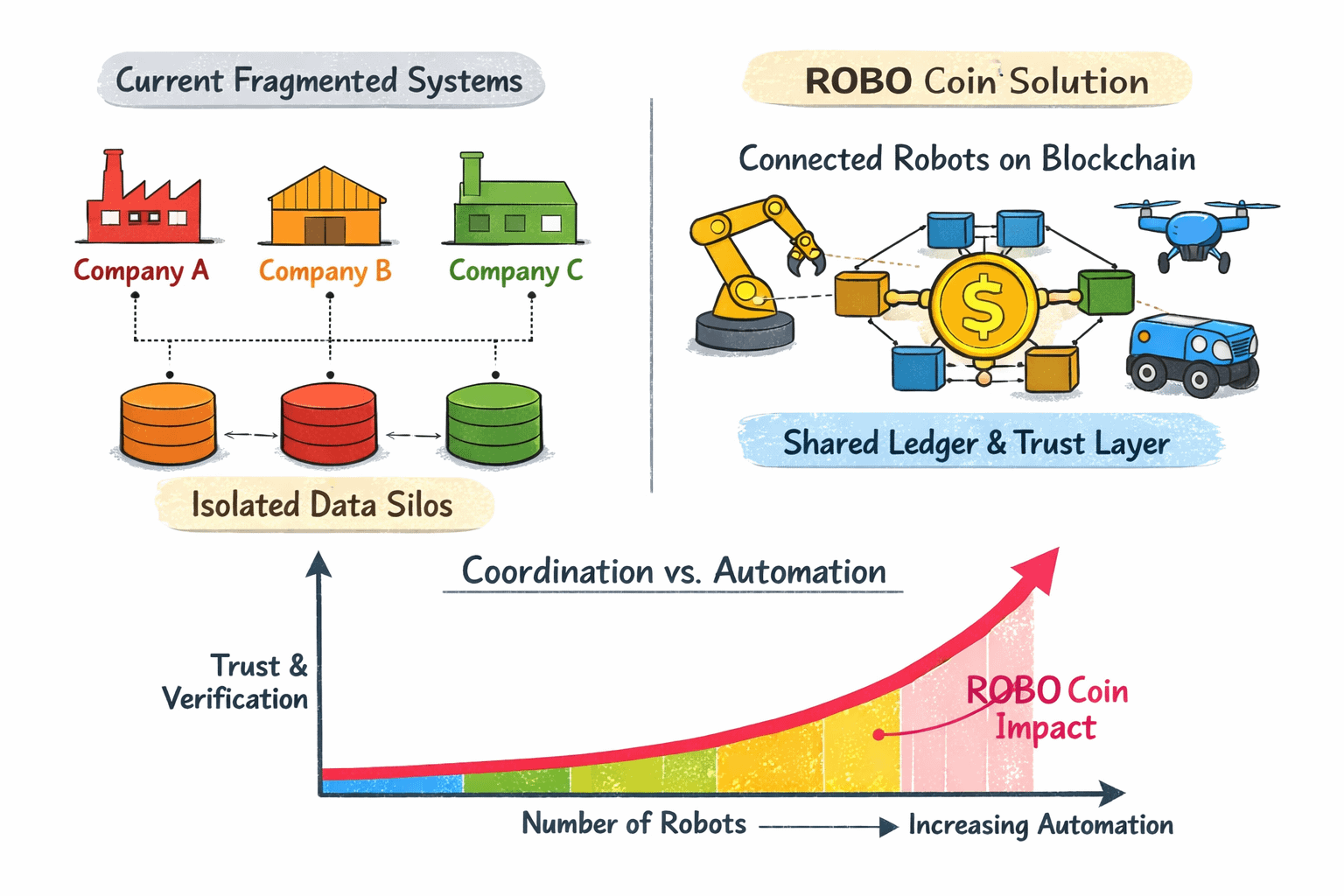
Understanding that layered architecture helps explain why connecting robots to blockchains is less about automation and more about trust infrastructure.
Meanwhile market behavior adds another dimension. Traders often view tokens through the lens of speculation. Liquidity depth, exchange listings, and price volatility dominate conversation. But infrastructure tokens tend to follow different adoption curves.
They gain relevance only when external systems begin depending on the coordination layer they provide. In the case of ROBO Coin, the external system is the robotic economy itself.
If large-scale automation continues expanding, the question becomes less about how robots perform tasks and more about how different robotic systems verify each other's behavior.
That shift moves the conversation away from product features and toward structural incentives. Companies cooperate more easily when shared infrastructure reduces the cost of trust.
Still, none of this guarantees success. Hardware ecosystems evolve slowly. Robotics companies tend to prioritize reliability and safety over experimental infrastructure. Integrating blockchain verification into real-world machine workflows introduces operational complexity.
Remains to be seen how quickly industries adopt such systems, if at all. Early signs suggest experimentation rather than widespread deployment.
Yet the broader pattern is difficult to ignore. Machines are becoming economic participants. AI systems make decisions. Autonomous vehicles move goods. Robots complete physical tasks without human supervision.
As that trend continues, the systems verifying machine activity may become as important as the machines themselves.
Seen from that angle, ROBO Coin is not primarily about trading tokens. It represents an attempt to build a neutral coordination layer between physical automation and digital verification systems.
And that idea sits quietly underneath the conversation.
The more machines begin interacting across organizations, the more valuable shared records of machine behavior may become.#robo #ROBO $ROBO