
Here I researched some information about fabric foundation. The Fabric Foundation is building an open robotics economy, and its native token, ROBO, is the key to unlocking this ecosystem. ROBO is designed to coordinate economic relationships among robots, developers, and ecosystem participants, enabling machines to pay fees, verify identity, and participate in network coordination .
But I kept reading. And then I couldn't stop.
And today, I'm writing this because I genuinely believe — not as financial advice, but as someone who has spent real time going deep on this — that Fabric Foundation is one of the most important infrastructure plays I've seen in a long time.
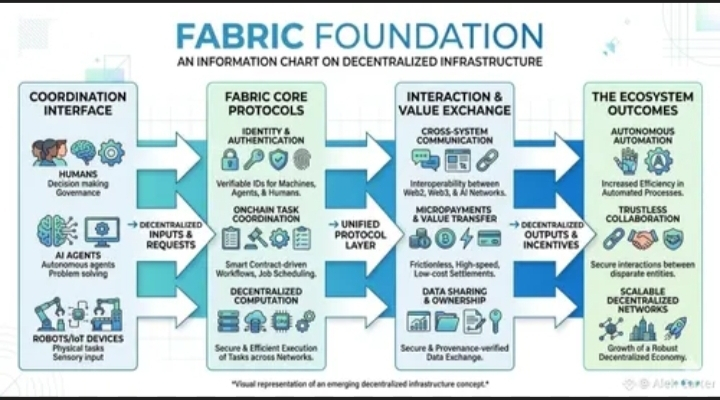
I've read a lot of whitepapers. Most of them describe a future so vague it could mean anything. Fabric's whitepaper, published in December 2025, is different. It's specific. It's technical. And it carries an urgency that doesn't feel manufactured.
The architecture has three interconnected layers that build on each other .
OM1, the Android for Robotics. OM1 is that universal operating system for robots. Hardware-agnostic. Deployable across humanoids, quadrupeds, robotic arms, any form factor. When a robot runs OM1, it can run any application built on the Fabric ecosystem, regardless of who manufactured the physical body.
Backing and Development
Institutional Interest: The project is supported by major industry players, with OpenMind (the core team) having raised funds from investors including Pantera Capital, Coinbase Ventures, and Digital Currency Group.
Launch Strategy: The Fabric Protocol is built on the Base network .
Robot Crafter and the Skills Marketplace:
The third layer is where the ecosystem compounds over time. Developers publish skills and tasks to a marketplace. The network grows its own collective intelligence as more skills get contributed, verified, and distributed across thousands of machines.
Over time, the robots running on Fabric become more capable not because any single team built everything, but because the network itself accumulates knowledge.
.The $ROBO Token
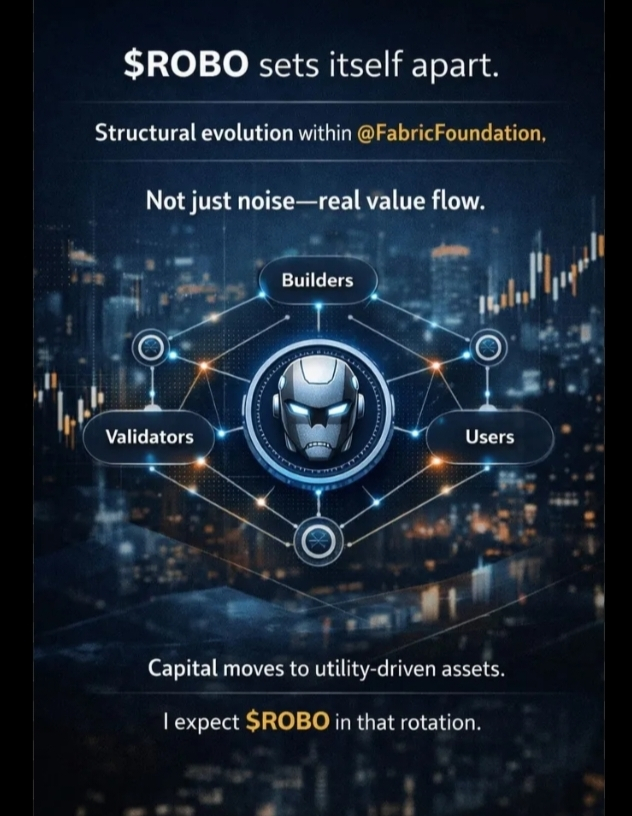
$ROBO is the native utility and governance token powering the Fabric ecosystem.
Real-World Utility: it is used for registering robot identities (staking bonds).
What ROBO Actually Does
Every transaction on the Fabric network is denominated in ROBO. That's not a marketing claim. It's the functional reality of how the protocol operates.This is not casino money.
But here's what nobody is talking about it. These robots have no financial identity.
A robot cannot open a bank account. It cannot hold a passport. It cannot independently pay for the electricity it needs to recharge, or the cloud compute it needs to process a task. Every single payment, every transaction, every coordination signal has to go through a human intermediary.
Conclusion: Should You Invest in Fabric Protocol ROBO Token?
The Fabric Foundation represents a significant shift in the robotics sector, moving from closed-loop hardware toward an open, Robot Economy. By integrating a universal operating system (OM1) with a blockchain-native coordination layer, the protocol addresses the critical scaling bottlenecks of machine identity and autonomous payments.Fabric Foundation is not just a trend; it is a response to a pressing technological necessity.
Risk : Cryptocurrency investments in the AI and robotics sectors carry extreme market risk and volatility. The $ROBO token is subject to supply inflation through scheduled unlocks and the inherent technical risks of migrating to a native blockchain. Always do your own research and never invest more than you can bear to lose.
#ROBO $ROBO
#FabricFND @Fabric Foundation