
 Every new blockchain claims to fix the fee problem. High gas costs have been one of the biggest barriers to real Web3 adoption. When network activity increases, fees spike. When token prices rise, simple actions suddenly become expensive. Developers struggle to design applications when operational costs change daily.
That is the problem Midnight Network tries to approach with its unusual “battery model.”
On paper, the idea is elegant.
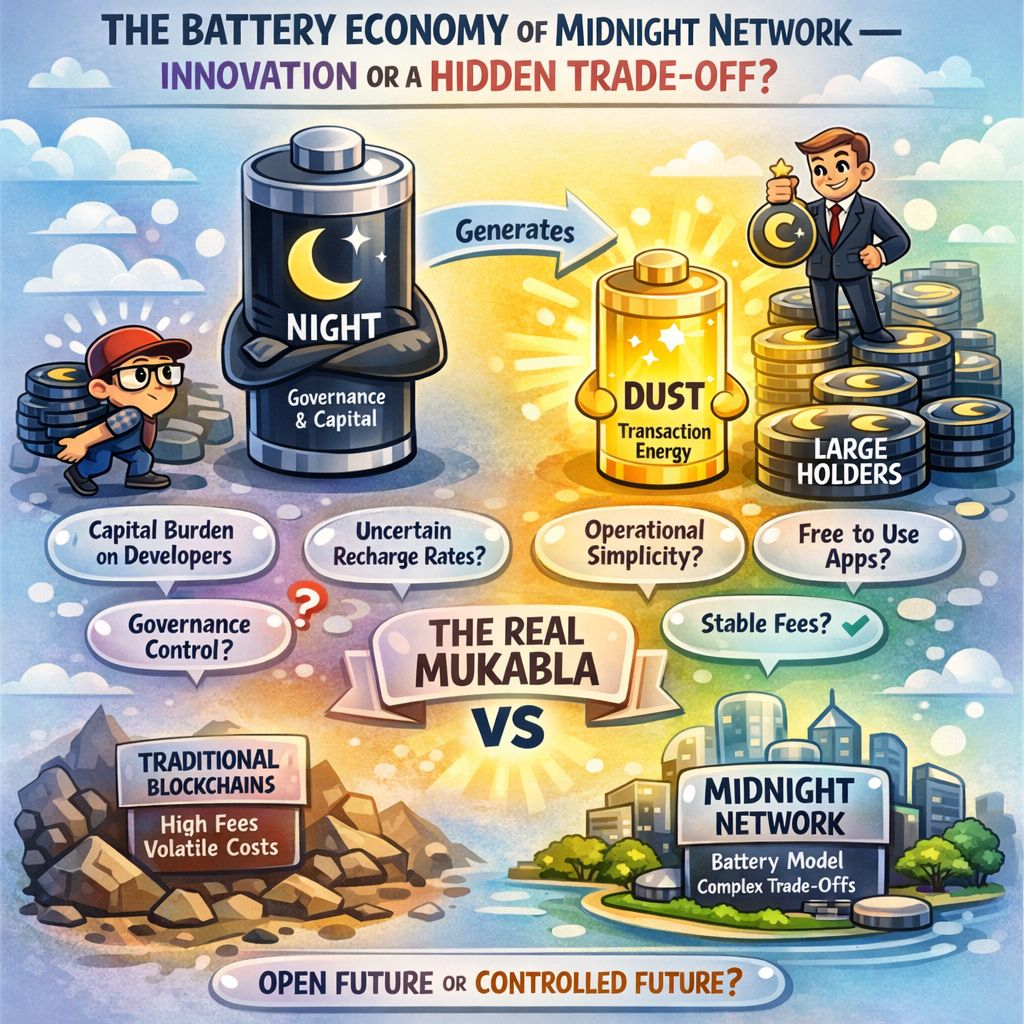
Instead of forcing users to spend the main token for every interaction, Midnight separates the economic roles inside the network. The token NIGHT functions as the capital asset of the system. It represents ownership, governance rights, and long-term participation in the network. The second unit, DUST, acts as the operational resource used for transactions and smart contract activity.
The comparison the project uses is simple: NIGHT behaves like a battery, while DUST is the energy produced by that battery.
If you hold NIGHT, it gradually generates DUST over time. That DUST can then be used to pay network fees. The advantage is obvious. Users do not constantly spend their core token. Governance power remains intact, and operational costs become more predictable.
For many observers, this design looks like a meaningful improvement over traditional gas systems.
But the closer you examine the model, the more complicated it becomes.
The first tension appears in the concept of self-funding decentralized applications. Midnight’s documentation suggests that developers can hold enough NIGHT to generate DUST and then use that DUST to pay transaction fees on behalf of their users. In theory, this creates applications that feel free to use. End users interact with the service without worrying about gas costs.
From a user experience perspective, this is powerful. One of the biggest barriers to mainstream blockchain adoption has always been confusing fee mechanics. If applications can hide that complexity, onboarding becomes much easier.
However, the cost does not disappear. It moves.
Instead of users paying the fees directly, developers must hold enough NIGHT to generate the DUST required for their application’s activity. The larger the application becomes, the more NIGHT must be held to sustain the necessary DUST output.
This quietly shifts the capital burden from users to developers.
For well-funded teams or enterprise platforms, that may not be a major issue. Large organizations can allocate infrastructure budgets and hold significant token reserves. For them, the battery model may actually simplify operational planning.
But smaller developers face a different reality.
An independent developer building a privacy-focused tool, identity application, or experimental protocol might struggle to acquire the amount of NIGHT required to keep their application running smoothly. If they cannot generate enough DUST to cover user interactions, the “free experience” disappears.
In that sense, the model could unintentionally favor well-capitalized builders over grassroots innovation.
The second layer of complexity involves the battery recharge rate itself.
DUST regenerates based on how much NIGHT is held. But developers must understand exactly how fast that regeneration happens in order to predict operational costs. If a platform expects thousands of daily interactions, it needs to calculate how much NIGHT must be locked to generate enough DUST.
Without clear and stable parameters, that calculation becomes uncertain.
If regeneration rates change through governance decisions or protocol updates, developers could suddenly find their applications consuming more DUST than their NIGHT holdings can generate. The predictable cost structure promised by the model would then depend not only on the protocol design but also on future governance outcomes.
That leads directly to the third and perhaps most important question: governance concentration.
NIGHT is also the governance token of the ecosystem. Holders vote on protocol changes, including parameters that may influence how DUST generation works. If large portions of NIGHT are controlled by founding teams, foundations, or early investors, governance power may not be evenly distributed.
This does not necessarily mean decisions will be unfair. Many networks begin with concentrated ownership before gradually decentralizing. But the concern remains: if a small group controls enough voting power, they could theoretically adjust parameters in ways that benefit large holders or institutional participants.
For smaller developers who rely on predictable DUST generation, that introduces risk.
Midnight has described a roadmap toward progressive decentralization, including governance tools and treasury mechanisms that would allow broader participation over time. That direction aligns with the philosophy of open blockchain infrastructure. The real question is whether the milestones for that decentralization are clearly defined and measurable.
In other words, at what point does governance become truly distributed?
Despite these concerns, the battery model still addresses a real weakness in traditional blockchain design. Gas fees tied directly to token speculation create unstable environments for both users and developers. Separating operational resources from the main asset is a creative attempt to break that link.
If implemented carefully, the system could make decentralized applications easier to use while preserving governance rights for token holders.
But innovation always introduces new trade-offs.
A model that simplifies fees may increase capital requirements. A system that promises predictable costs may depend on governance stability. And infrastructure designed to empower developers must still ensure that smaller builders are not pushed out by economic barriers.
This is where the real mukabla begins.
On one side are traditional blockchain fee models — simple but volatile, tied directly to token price movements.
On the other side are new economic architectures like Midnight’s battery system — more sophisticated, potentially more stable, but also more complex.
The future of Web3 infrastructure may depend on which approach proves more practical in the real world.
The battery metaphor is elegant.
Now the ecosystem will decide whether it can power an open network — or whether it simply creates a more controlled one.
#night @MidnightNetwork $NIGHT
