

I still remember when this idea stopped feeling technical to me and started feeling personal. For a long time, crypto kept repeating the same message: transparency is good, openness is good, everything should be visible. At first, that sounded powerful. But the more I thought about it, the more incomplete it felt. In real life, people do not want every payment, every agreement, every strategy, or every piece of personal information exposed in public forever. Transparency has value, yes—but so does privacy. And that is exactly why confidential smart contracts started making sense to me.
That is also where NIGHT becomes interesting.
What caught my attention is that Midnight is not simply trying to make blockchain more private in the old, narrow sense. It is trying to solve a deeper design problem. Public blockchains are excellent at verification, but they often achieve that by making too much visible. Midnight approaches that differently. Its model is built around the idea that a blockchain should be able to confirm that rules were followed without forcing users to reveal everything behind those rules. That is a much more mature vision of privacy. It is not about hiding for the sake of hiding. It is about giving people and applications enough confidentiality to function realistically in the real world.
The technology behind this is what makes the project stand out. Midnight uses zero-knowledge proofs to allow smart contracts to verify outcomes without exposing the private data involved. In simple terms, that means someone can prove they met a condition, passed a check, or followed the logic of a contract without showing all the sensitive information underneath. That changes the conversation completely. Instead of choosing between trust and privacy, the system is trying to offer both at once.
I find that important because the future of blockchain cannot depend only on public visibility. If crypto wants to move deeper into finance, business infrastructure, identity systems, and more serious forms of digital coordination, then some level of confidentiality becomes necessary. No serious company wants its internal flows exposed by default. No institution wants sensitive operational logic fully public. Even ordinary users do not want every financial move turned into permanent public history. So the case for confidential smart contracts is not theoretical anymore. It is increasingly practical.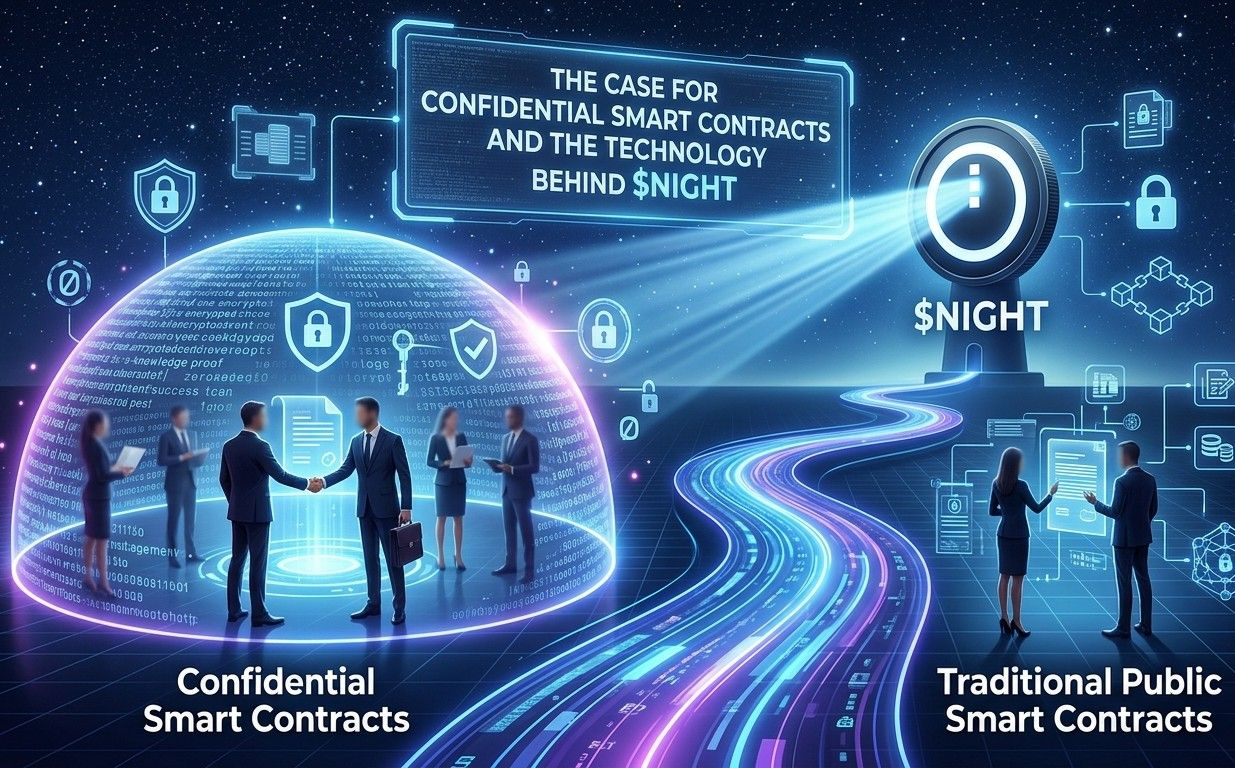
This is why the structure around NIGHT also matters. Midnight separates roles inside the network rather than forcing one asset to do everything. That design suggests the team is thinking beyond simple token narratives and trying to build an ecosystem where privacy, governance, and network operation each have a clearer place. Whether that model succeeds at scale will depend on adoption, execution, and developer traction, but the thinking behind it is more serious than many token designs that attach “utility” after the fact.
At the same time, I do not think this space should be viewed without caution. Confidential smart contracts are powerful, but they are also more complex. They are harder for average users to understand, more demanding from a technical standpoint, and often more difficult to communicate clearly. There is also the broader market challenge: privacy-related infrastructure always exists under extra regulatory attention, and that means projects like Midnight need to prove they can balance confidentiality with legitimacy. That is not a small task. Strong technology alone is never enough.
Still, that tension is part of what makes NIGHT worth paying attention to. It sits in a part of the market that touches one of blockchain’s most unresolved questions: how do you keep the benefits of on-chain verification without making exposure the price of participation? That question is bigger than one token. It speaks to where the industry may need to go next.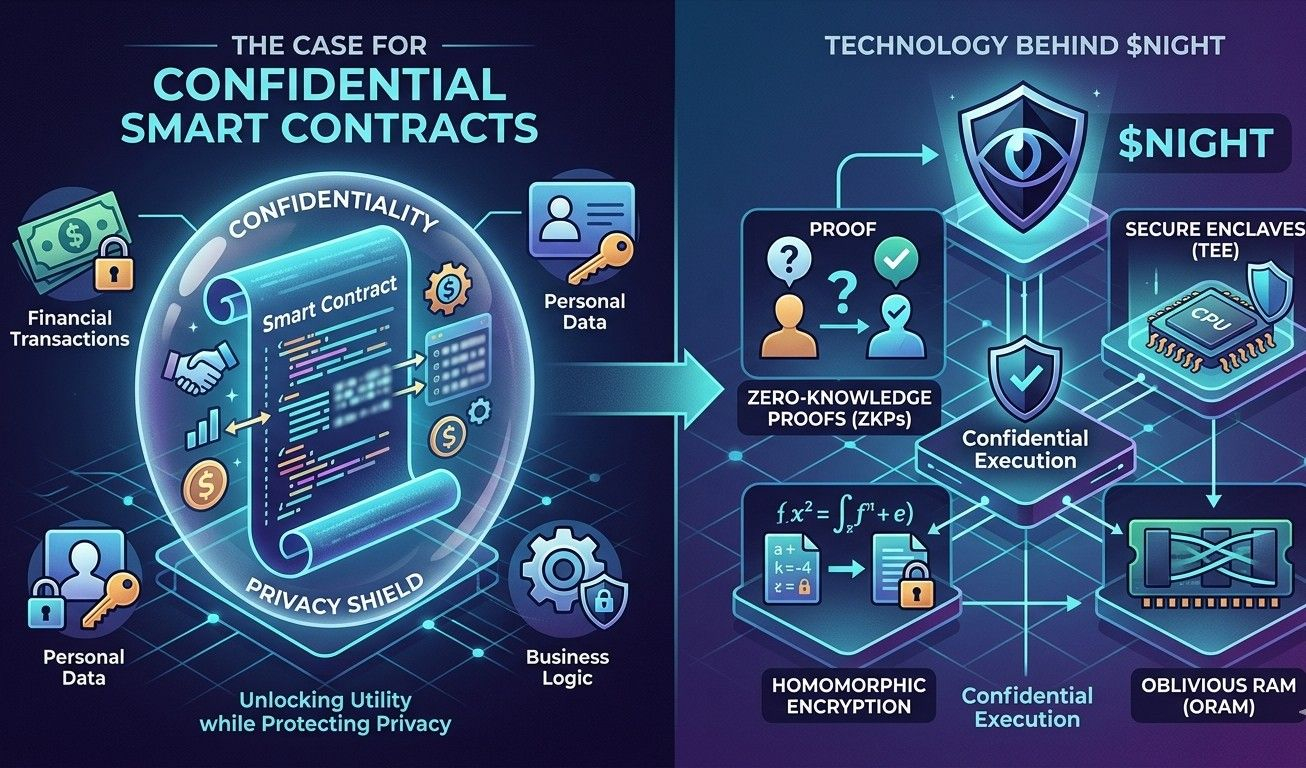
For me, that is the real case for confidential smart contracts. They are not just a privacy feature. They are an attempt to make blockchain more usable, more realistic, and more aligned with how people and institutions actually behave. And if that transition becomes more important over time, then projects like Midnight—and the role of NIGHT within that system—could become meaningful not because they reject transparency, but because they try to redefine it more intelligently.