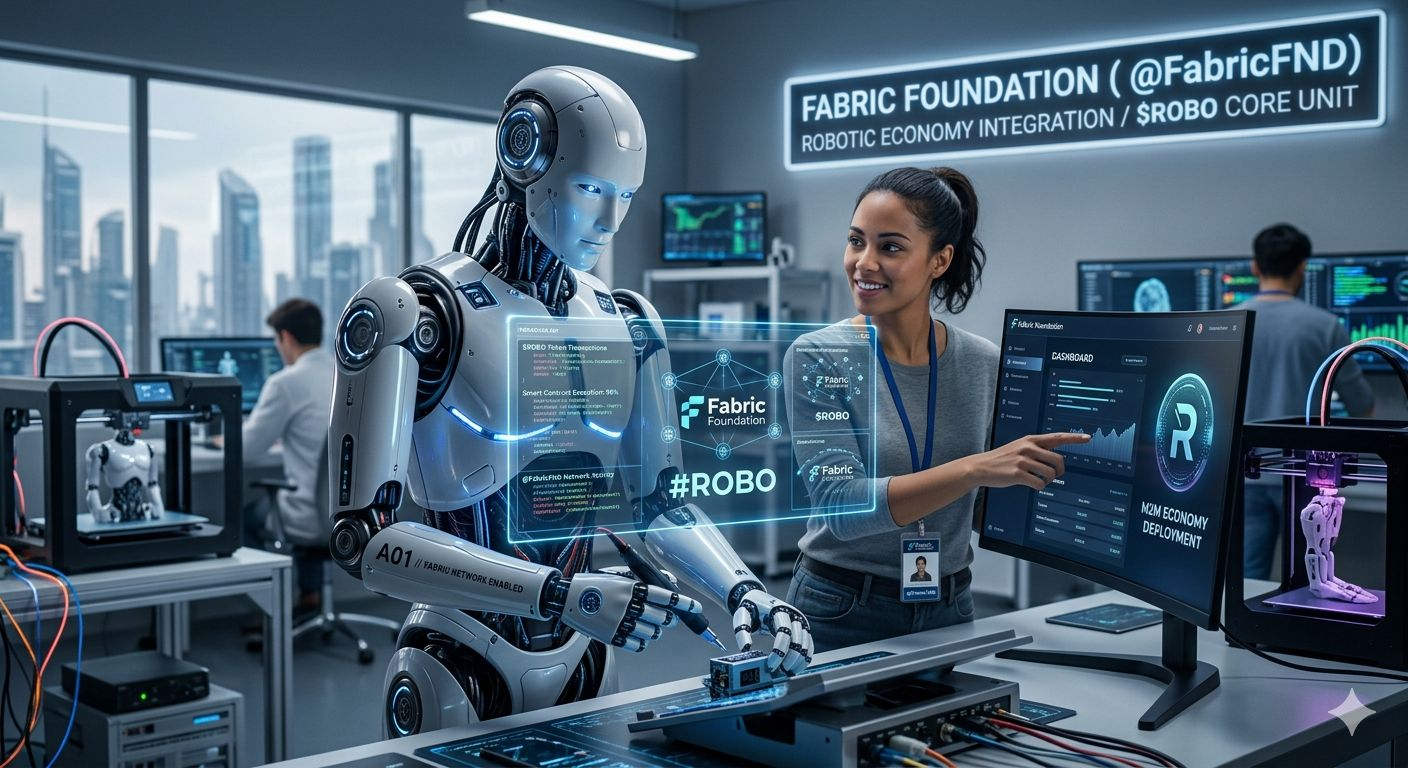
The concept of a **machine economy**—where autonomous robots and AI agents participate directly in economic activity—is rapidly moving from theory to reality. As robotics, artificial intelligence, and blockchain infrastructure converge, a new economic paradigm is emerging in which machines can perform tasks, earn rewards, and coordinate with humans through decentralized systems. At the center of this transformation is Fabric Foundation, whose protocol aims to provide the foundational infrastructure required to support this emerging machine-driven economy.
One of the core challenges in the machine economy is coordination. Millions of robots, AI agents, and autonomous systems must be able to communicate, verify tasks, and exchange value in a trustless environment. The **Fabric Protocol**, stewarded by the Fabric Foundation, addresses this problem by creating an open network designed to build, govern, and operate general-purpose robots through decentralized infrastructure. The protocol coordinates data, computation, and oversight through public ledgers, enabling transparent participation and verifiable contributions from both humans and machines.
This infrastructure is particularly important because machines require a native economic layer. Traditional systems are not designed for autonomous agents that can independently perform work and receive compensation. Fabric introduces mechanisms that allow robots and AI agents to operate as economic actors. Through systems like **Proof of Robotic Work**, contributions from autonomous systems can be verified and rewarded, ensuring that machines participating in the network are incentivized to perform useful tasks. ([Airdrop Alert][2])
At the center of this ecosystem is the network’s native token, **ROBO**, which functions as the coordination and incentive layer of the protocol. The token is designed to facilitate economic settlement, governance, and rewards within the Fabric ecosystem. Developers, researchers, and autonomous agents can all interact through this tokenized framework, aligning incentives across the network while enabling decentralized governance.
Another reason Fabric is emerging as a backbone of the machine economy is its emphasis on **open participation and modular infrastructure**. Rather than building a closed robotics ecosystem, the protocol allows developers and organizations to create interoperable agents and applications on top of shared infrastructure. This composability allows innovations in robotics, AI, and decentralized networks to integrate seamlessly. As a result, Fabric becomes not just a single platform but an ecosystem where intelligence can be built collaboratively and deployed globally.
The governance model of the Fabric ecosystem also plays a critical role. To ensure long-term neutrality and decentralization, the governance and coordination of the protocol are handled by the independent non-profit Fabric Foundation. This structure separates protocol stewardship from individual companies, helping ensure that the network evolves in a community-driven and transparent manner.
Looking ahead to 2026 and beyond, the implications of this infrastructure are enormous. As robotics hardware becomes more capable and AI agents become more autonomous, the need for decentralized coordination layers will grow rapidly. Robots could perform logistics tasks, maintain infrastructure, or deliver services while automatically settling payments through blockchain-based systems. In this future, protocols like Fabric could function as the economic operating system for machines.
the machine economy mirrors the early days of the internet: a foundational layer is being built that will enable entirely new industries and applications. Just as cloud computing and decentralized finance reshaped digital economies, protocols like Fabric are positioning themselves to power the next phase of automation. If this vision materializes, the Fabric Foundation may become one of the most critical infrastructure providers for a world where humans and intelligent machines collaborate in a shared, decentralized. #Robo @Fabric Foundation $ROBO