
The part nobody talks about: robots don’t fail because they can’t move
Whenever robotics enters crypto discourse, people jump straight to the fun stuff: humanoids, autonomy, “robots will replace jobs,” and flashy demos. But after watching enough real systems (and enough crypto narratives), I’ve started thinking the opposite way.
Robots don’t become a real economy because they can lift boxes.
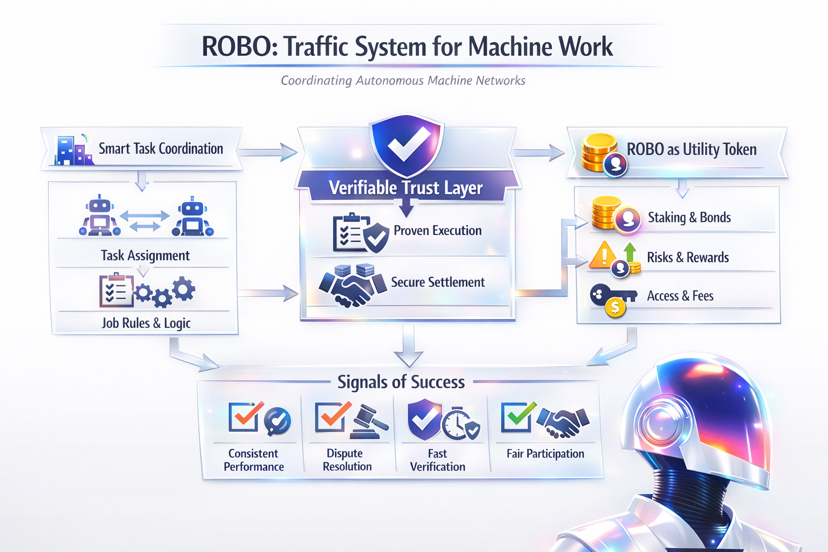
They become a real economy when they can be routed, measured, and settled like dependable services. That’s why Fabric caught my attention. It’s not really shouting “look at the robot.” It’s quietly aiming at the missing layer: the systems that decide who gets the job, what counts as completion, and how value moves without one company controlling the whole pipeline.
That’s not hype. That’s infrastructure.
If machine work becomes global, “dispatch” becomes the product
The moment you have more than one operator, more than one fleet, more than one environment, you get the same bottleneck every industry hits: allocation.
Who gets assigned first?
Who gets the clean jobs?
Who absorbs the messy jobs?
What happens when output is disputed?
How do you stop the network turning into private backchannels?
This is where I think Fabric’s thesis becomes interesting: it treats machine work less like a novelty and more like a market that needs rules. And the moment you have rules, you also need enforcement, penalties, and a way to make participants behave predictably even when conditions are messy.
That’s the part most “robot + crypto” projects skip. Fabric doesn’t seem to skip it.
The real value is in “proof you can’t fake cheaply”
In closed systems, verification is easy — because the same company owns the machine and the logs. In open systems, verification is the whole battle. Anyone can claim a robot did a task. Proving it in a way strangers can rely on is where systems usually crack.
So when Fabric emphasizes verifiable execution, I don’t read it as marketing. I read it as the core requirement for an open network to survive. If verification is expensive, the system becomes slow and fragile. If verification is cheap but fakeable, it becomes a game. The sweet spot is where cheating costs more than honest work.
If Fabric ever nails that, that’s when “robot economy” stops sounding like a slogan and starts sounding like a real economic primitive.
Where $ROBO fits in my head: not a “ticker,” more like operating capital
I’m not impressed when a token is described as “governance + utility.” Every project says that. The only thing that matters is whether the token actually sits inside the loop that keeps the system honest.
The way I understand ROBO’s role is closer to operating capital:
• you stake or commit it to participate seriously
• you risk losing it if you perform badly or try to game the system
• you use it to access the network’s coordination and settlement pathways
That’s why ROBO is interesting to me only if it stays tied to participation and consequences. If it floats above the system as pure speculation, it becomes another story token. If it stays embedded in coordination, it becomes a real infrastructure asset.
My bottom line: I’m watching for boring signals, not marketing moments
If I’m being honest, I don’t care how cinematic the demos look. I care about the boring signals that prove a system is becoming real:
• repeated task execution under real conditions
• disputes handled without human babysitting
• newcomers gaining access without needing “insider lanes”
• verification that stays fast enough to scale
• incentives that don’t get farmed into nonsense
Because that’s what decides whether $ROBO becomes infrastructure or just another narrative phase.
Right now, I treat @Fabric Foundation as an ambitious attempt at something difficult: turning machine work into something strangers can coordinate around without turning the whole thing into chaos.
And if they can pull even part of that off, ROBO won’t need to scream for attention.
It’ll just become… necessary.