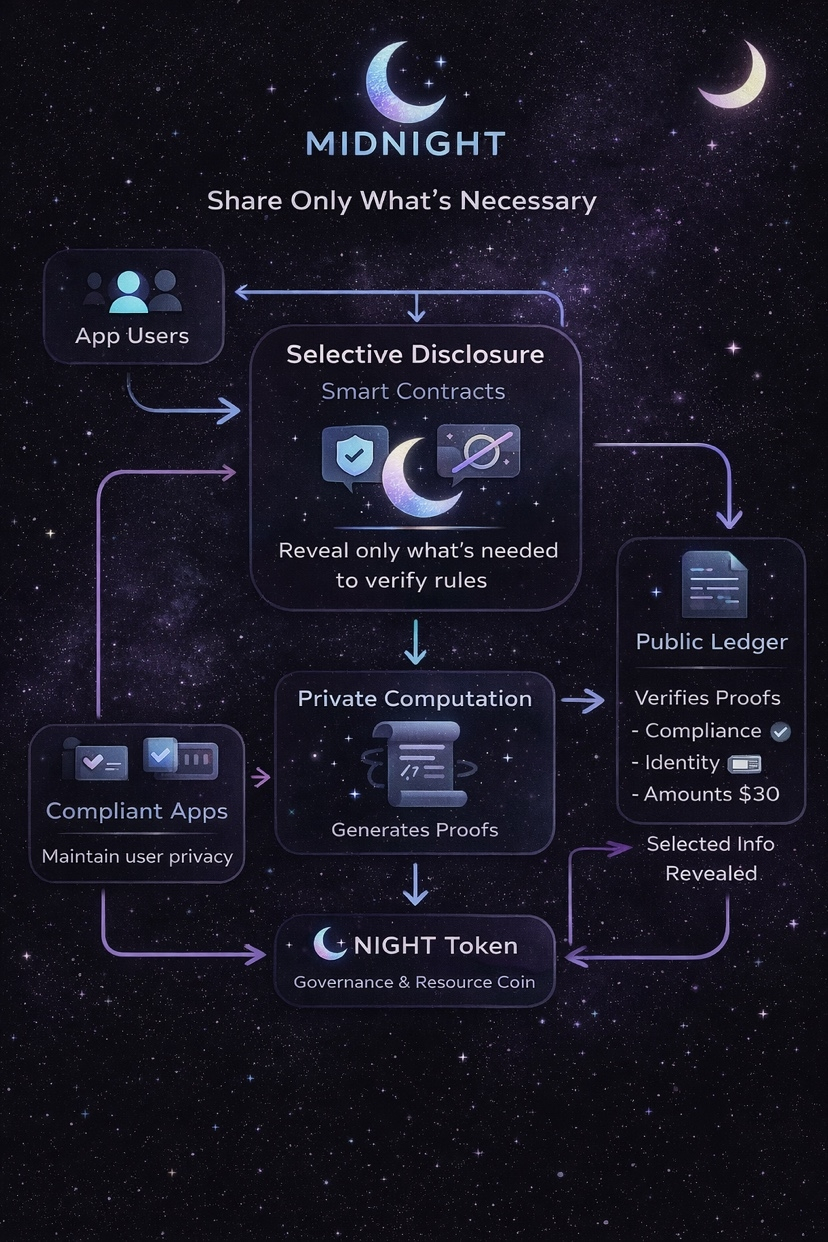
The more I look at Midnight Network, the more I stop thinking of it like a typical “privacy chain” and start thinking of it like a selective-sharing machine. I keep coming back to one simple idea: in the real world, people don’t want to expose everything… but they also don’t want to live in total darkness. They want to prove things without handing over their full life story. And honestly, that’s the first time a privacy narrative has felt practical to me, not just ideological.
The privacy problem I keep bumping into
Most public chains are built like glass houses. It’s great for verification, but terrible for normal business behavior. If I’m a company, I don’t want competitors watching my supplier payments. If I’m dealing with identity, I don’t want my entire profile to be “public by default.” And if we’re serious about institutions ever using crypto rails at scale, privacy can’t be an optional plugin — it has to be built-in and programmable.
Midnight’s “selective disclosure” feels like grown-up privacy
What I like about Midnight is the way it frames privacy as controlled disclosure. Not “nobody sees anything,” but “you reveal only what’s needed.” So the network can still verify rules were followed, while sensitive details stay private. That’s a huge shift. Because it means compliance, enterprise workflows, and everyday finance don’t need to choose between “fully public” or “fully hidden.”
Kachina (and why I think it matters)
In simple words, Midnight’s approach leans on a system where private computation happens, and then proofs get checked in a way the public ledger can verify. So the chain gets assurance without getting the raw data. I see this as the bridge between “privacy as a feature” and “privacy as an actual operating system for apps.” If this part works smoothly, it makes a lot of use cases suddenly feel possible without forcing people to leak data.
The developer angle: privacy only wins if building is easy
Another thing I watch is whether devs can actually build on it without needing a PhD. Midnight’s tooling (and its approach to private smart contracts) feels like it’s trying to make privacy usable, not just powerful. For me, that’s the make-or-break. Because the best privacy tech in the world doesn’t matter if nobody ships apps on it.
The part that made me pause: NIGHT and “resource-style” fees
I also find the dual-asset idea interesting: one asset as the “main” network token, and another as the spendable resource used for execution. In my head, that’s basically Midnight saying: “Stop turning every app experience into a gas-token headache.” If users can interact without constantly stress-buying gas, that’s a better onboarding story — especially if Midnight wants apps that feel normal to non-crypto people.
What I’m bullish on… and what I’m still watching
My bullish view is simple: selective disclosure is the only privacy narrative that doesn’t feel extreme. It feels like what businesses and regulated systems would actually accept. But I’m still watching the real-world side: how fast the ecosystem grows, how good the developer experience really is, and whether private apps can still feel smooth (privacy is pointless if it’s slow, clunky, or confusing).
My bottom line on $BNB
I’m not looking at $NIGHT like a quick hype token. I’m looking at it like a bet on a world where blockchains finally learn a basic lesson: some information should stay private, but trust still has to be provable. If Midnight keeps executing on that balance — not hiding everything, not exposing everything — it could become one of the more “real” privacy infrastructures we’ve seen.