

It was late, and I still remember the feeling of that moment. The charts had gone quiet, the market noise had faded a bit, and my mind drifted away from price action into something deeper. I was tracing a few transactions across different chains, nothing unusual, just the kind of thing you end up doing out of habit when you spend enough time around crypto. And the more I looked, the more obvious something felt.
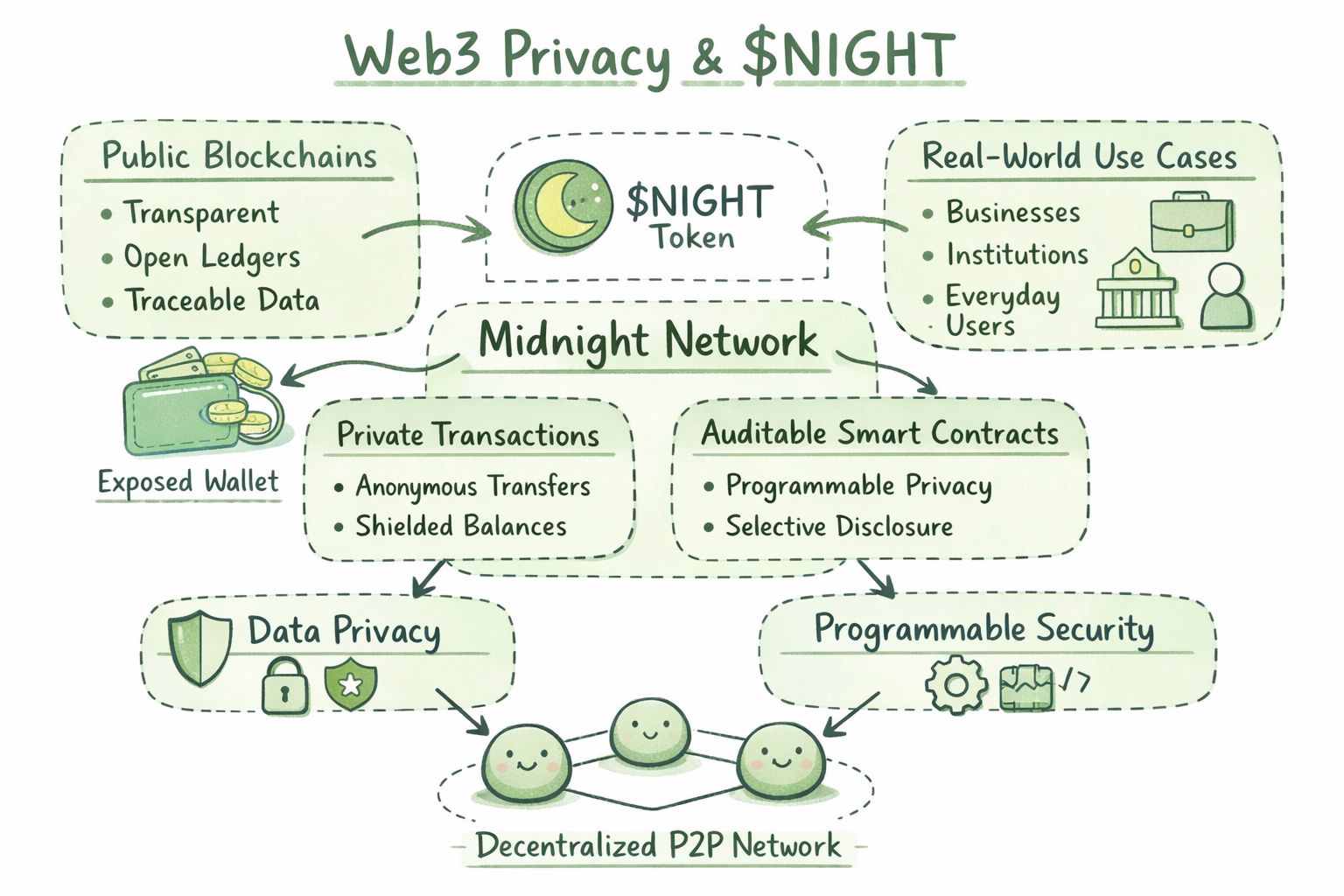
On most public blockchains, everything is just… there. Wallets, balances, transfers, interaction history. Open to anyone curious enough to follow the trail.
That transparency has always been treated like one of crypto’s greatest strengths, and in many ways it is. It gives people a way to verify things without trusting a middleman. But that night, I started wondering whether full transparency still makes sense once blockchain begins moving into more serious, real-world environments.
Because in theory, radical openness sounds powerful. In practice, it gets messy.
What happens when businesses want to use blockchain rails without revealing their financial behavior to competitors? What happens when institutions need auditability, but not total exposure? What about ordinary users who like decentralization but do not want every transaction permanently visible to strangers, analysts, and bots scraping the chain?
That was the thought I could not shake. Public verification is useful. But complete visibility comes with its own cost. Sometimes it reveals more than it should. Sometimes it turns activity into exposure.
That tension is what pulled me toward the ecosystem around NIGHT, the token tied to Midnight Network.
And to be honest, it was not just because it is “a privacy project.” Crypto has seen a lot of privacy narratives over the years. Some were interesting. Some were overpromised. Some ran straight into regulatory walls. What made Midnight feel worth paying attention to was something more specific. It is not simply trying to make blockchain private. It is trying to make privacy programmable.
That distinction matters more than it first sounds.
Most public chains were built with transparency at the center. Bitcoin made verification public by design. Ethereum expanded that idea into programmable infrastructure, but the openness remained. That model was powerful early on because it made trust visible. Anyone could inspect the ledger. Anyone could verify the rules. That openness helped crypto earn credibility.
But once blockchain starts touching finance, identity, enterprise systems, compliance workflows, or sensitive commercial activity, the cracks in that model become easier to see. Full transparency is elegant for theory. It is often awkward for reality.
That is where Midnight’s idea starts to become interesting.
At the core of the network is zero-knowledge cryptography, which, put simply, lets someone prove something is true without revealing the underlying data itself. Instead of showing every input, every amount, or every detail, the system can provide proof that a condition has been met or that a transaction follows the rules.
It sounds technical, and it is, but the logic behind it is actually pretty intuitive once you step back. Think of proving you are old enough for something without handing over your full date of birth. Or proving a payment met contractual conditions without publicly exposing the amount. The goal is not to hide truth. The goal is to reveal only what is necessary.
That is a very different way of thinking about blockchain privacy.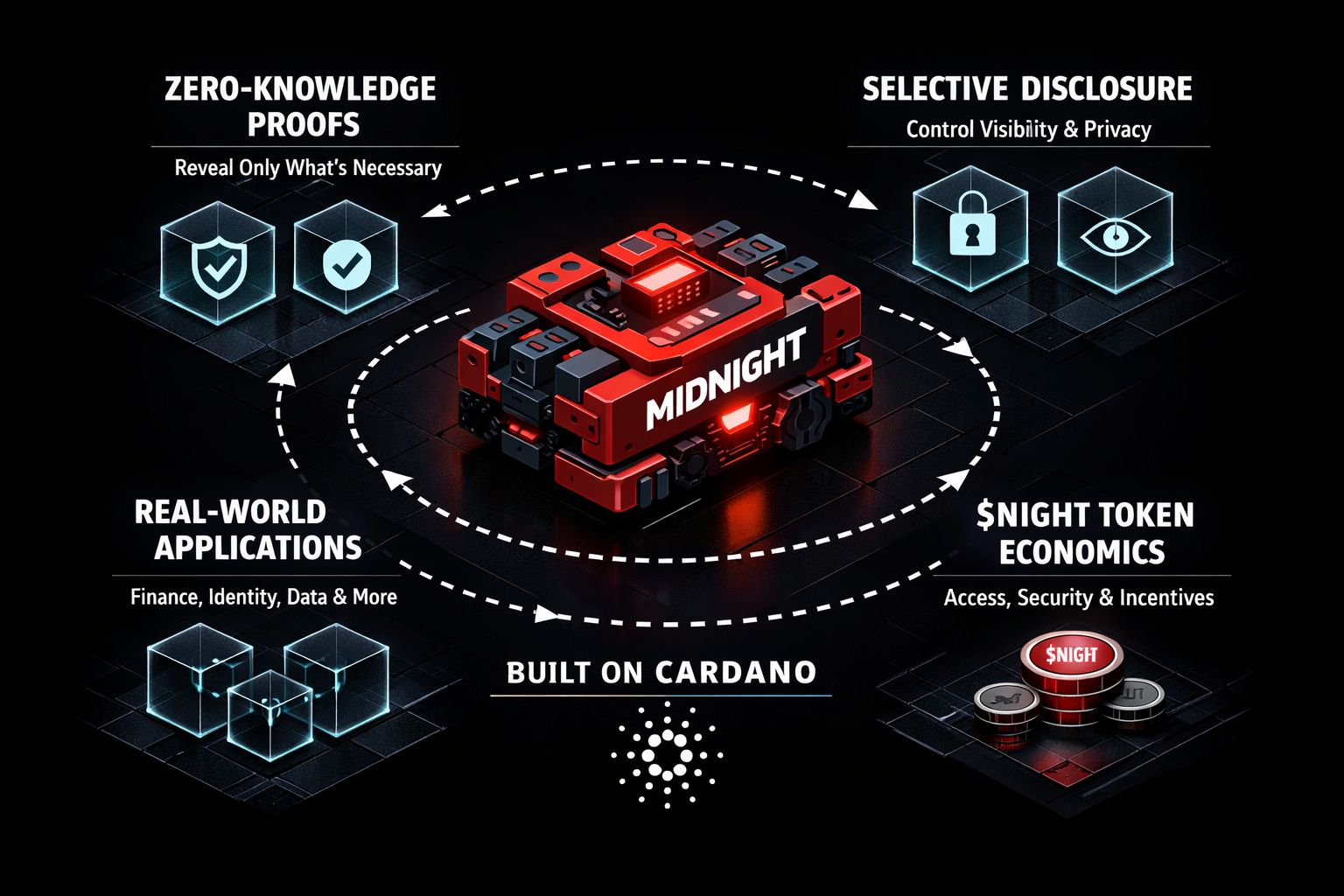
Midnight builds on that idea by giving developers the ability to decide what should be visible and what should stay protected. Not everything must be public. Not everything must be hidden. The visibility itself becomes part of the application logic.
And honestly, that feels closer to how the real world already works.
In most functioning systems, privacy is not absolute and transparency is not absolute either. Companies disclose some information, regulators access some information, counterparties see some information, and the public sees something else entirely. Midnight seems to be built around that more nuanced view — that confidentiality and verification do not always need to fight each other.
Its roots in the broader Cardano ecosystem also add another layer to how the project is positioned. Midnight comes from Input Output Global, the same organization closely associated with Cardano’s research-heavy approach to blockchain design. That does not automatically guarantee success, of course, but it does suggest that Midnight is being developed with a longer-horizon infrastructure mindset rather than as a short-cycle narrative product.
Technically, the project sits in a space that is becoming more relevant by the year. Privacy-preserving computation, verifiable data systems, and selective disclosure are no longer niche ideas. They are becoming part of a larger conversation around how digital infrastructure should work as blockchain matures.
Because once decentralized systems move beyond speculation and into sectors like finance, identity, healthcare-adjacent data, trade coordination, or enterprise workflows, data exposure becomes a serious problem. Full visibility can stop being a feature and start becoming a barrier.
That is also where the NIGHT ecosystem becomes more than just a token attached to a privacy story. The token’s role is tied to how the network functions and how resources are coordinated. In systems like this, tokens are often more than simple payment instruments. They can sit closer to access, participation, security, incentives, and computational economics.
That part still deserves careful watching. Privacy infrastructure may sound compelling at the conceptual level, but token design has to support actual usage, not just narrative appeal. If the economics are weak, even strong technology can struggle. And if developer adoption remains shallow, a technically impressive design can stay trapped in theory.
From a market perspective, that makes Midnight interesting but also complicated.
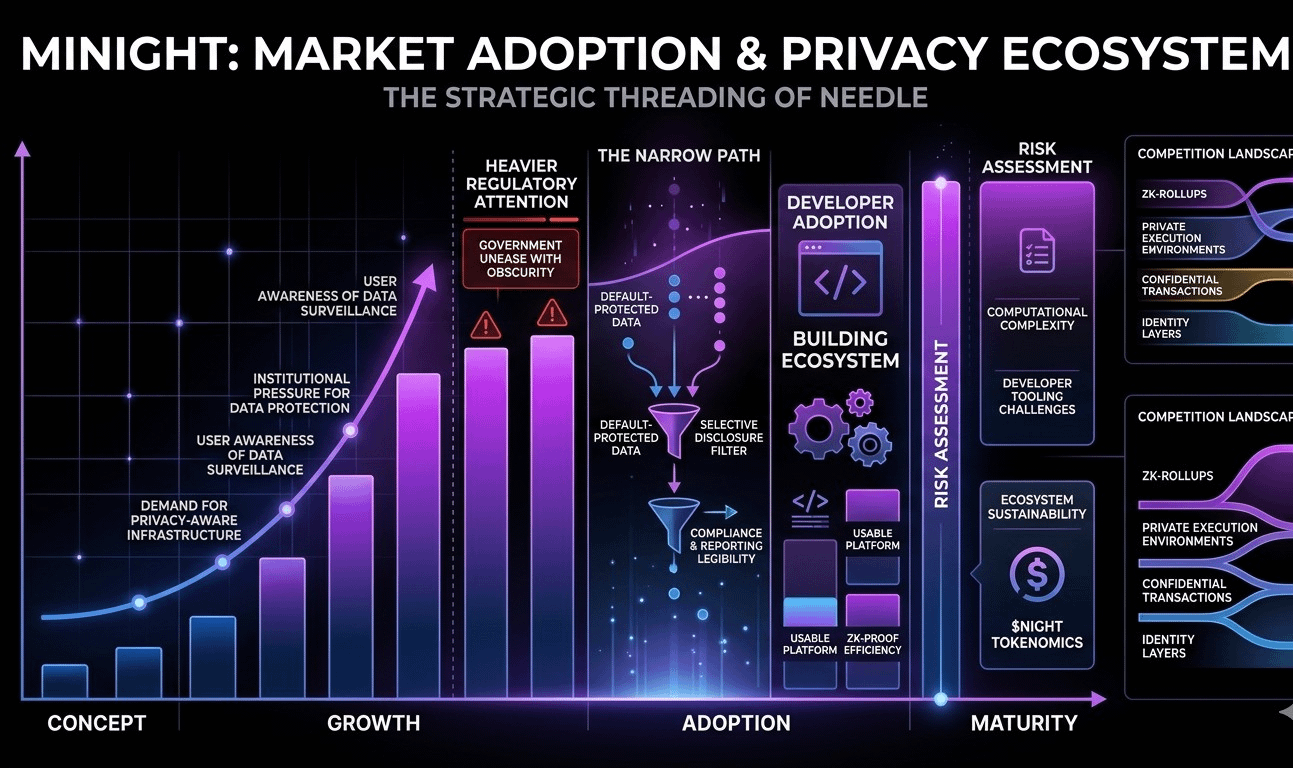
The opportunity is real. Demand for privacy-aware infrastructure is not imaginary. Institutions are under growing pressure to protect data. Enterprises rarely want business logic fully exposed on public rails. Even regular users are becoming more aware that transparency without boundaries can become surveillance with better branding.
But the risks are real too.
Privacy in crypto has always lived under heavier regulatory attention than other sectors. Governments tend to become uneasy when systems appear capable of obscuring flows too well. That has shaped the trajectory of privacy-focused tools for years. So any project in this category has to walk a narrow path: strong enough privacy to be useful, but structured enough to remain legible in a world that increasingly demands compliance, reporting, and accountability.
Midnight seems aware of that pressure. Its emphasis on selective disclosure feels like an attempt to thread that needle. Instead of treating privacy as a wall, it treats it more like a filter. Information can remain protected by default, but still be disclosed when necessary under the right conditions.
That may end up being one of its most important strategic choices.
Still, none of this is easy. Zero-knowledge systems are powerful, but they are not effortless. They can be computationally heavy. They can be difficult for developers to work with. They can introduce complexity that slows adoption if the tooling is not good enough. A lot of projects sound impressive at the cryptography layer but struggle to become usable platforms.
So Midnight’s long-term position will depend on more than vision. It will depend on execution. It will depend on whether developers actually build with it, whether institutions find the model practical, whether regulators tolerate its structure, and whether the economics behind NIGHT support a real ecosystem rather than just an interesting thesis.
Competition matters too. Privacy is no longer a side conversation in blockchain. Different projects are approaching it from different directions — zk-based rollups, private execution environments, confidential transaction systems, identity layers, and application-specific privacy tools. Midnight is entering a field where the core problem is increasingly recognized, but the winning model is still very much unsettled.
And maybe that is why the project stayed on my mind.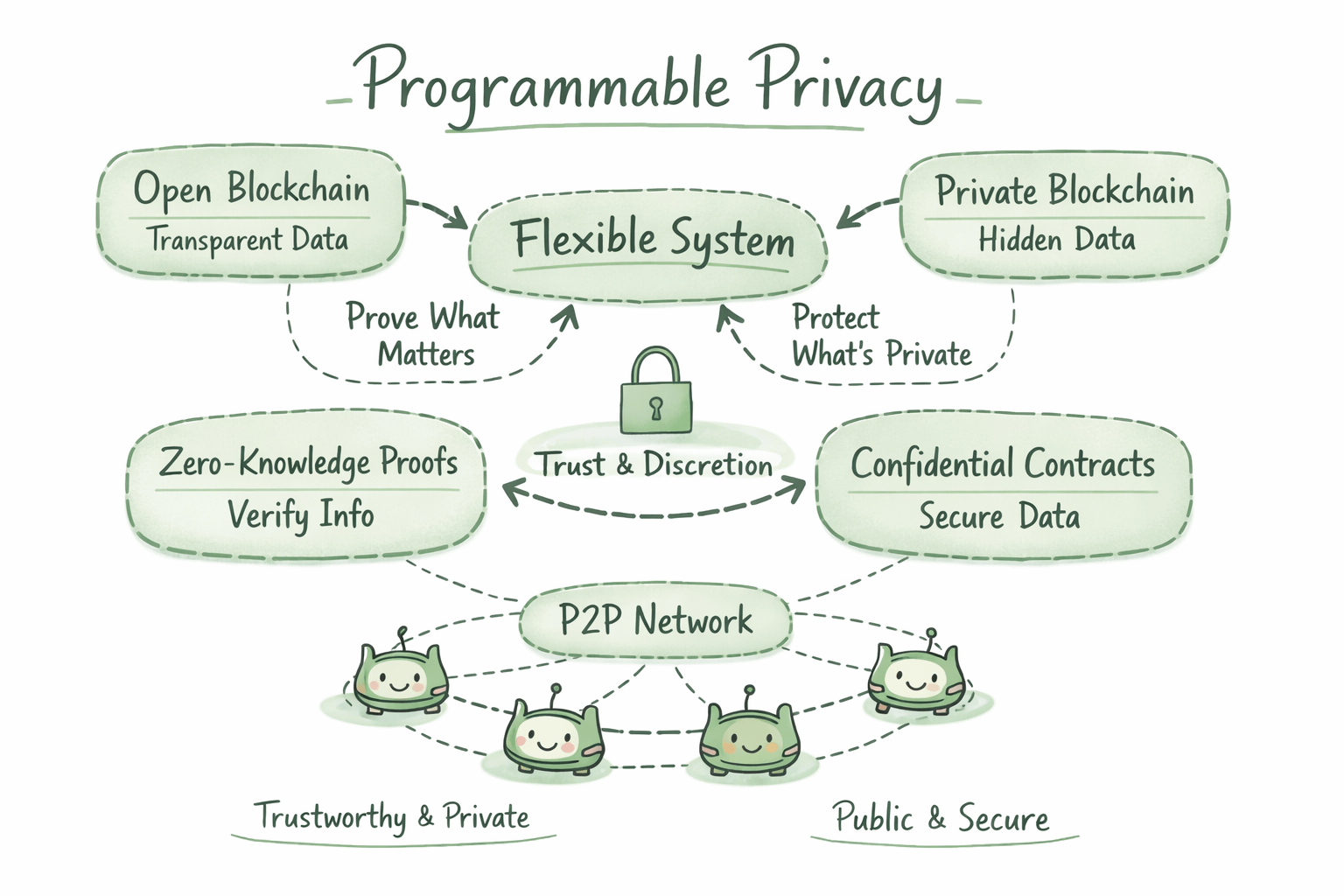
Because the bigger question here is not just whether Midnight succeeds. It is whether Web3 can mature without rethinking what transparency is supposed to mean. For a long time, the industry treated openness as the answer to everything. But maybe the next phase is not about exposing more. Maybe it is about proving more, while revealing less.
That shift feels subtle at first, but I think it changes the whole conversation.
Looking back, what started as a quiet late-night thought about privacy ended up pushing me toward a much broader question about the future of decentralized systems. Not whether blockchain should be public or private in some absolute sense, but whether it can become flexible enough to handle both trust and discretion at the same time.
That is what made NIGHT interesting to me.
Not because privacy is a trendy word. Not because the market needs another neat narrative. But because the underlying idea touches something real. If Web3 is going to move into more serious economic, institutional, and data-sensitive environments, then programmable privacy may stop being optional infrastructure and start becoming necessary infrastructure.
And if that happens, the value of systems like Midnight will not come from hiding the truth.
It will come from proving what matters, while protecting what never needed to be public in the first place.
@MidnightNetwork #night $NIGHT
