
While I closed my last position and poured the second coffee around 3 AM, the Fabric Foundation contract address — 0x32b4d049fe4c888d2b92eecaf729f44df6b1f36e — stayed open on Etherscan.
The claim window had slammed shut on March 13, 2026 at 03:00 UTC, yet the transfers that followed told a quieter story than any audit summary ever could.
@Fabric Foundation and $ROBO position the protocol’s safeguards as ironclad for the robot economy, but what actually executed was pure on-chain visibility doing the heavy lifting.
Two things stood out immediately. First, treat every visible transfer as a live audit log — no off-chain report required. Second, any future risk framework should default to real-time explorer checks before formal audits even land.
the contrast that stuck with me
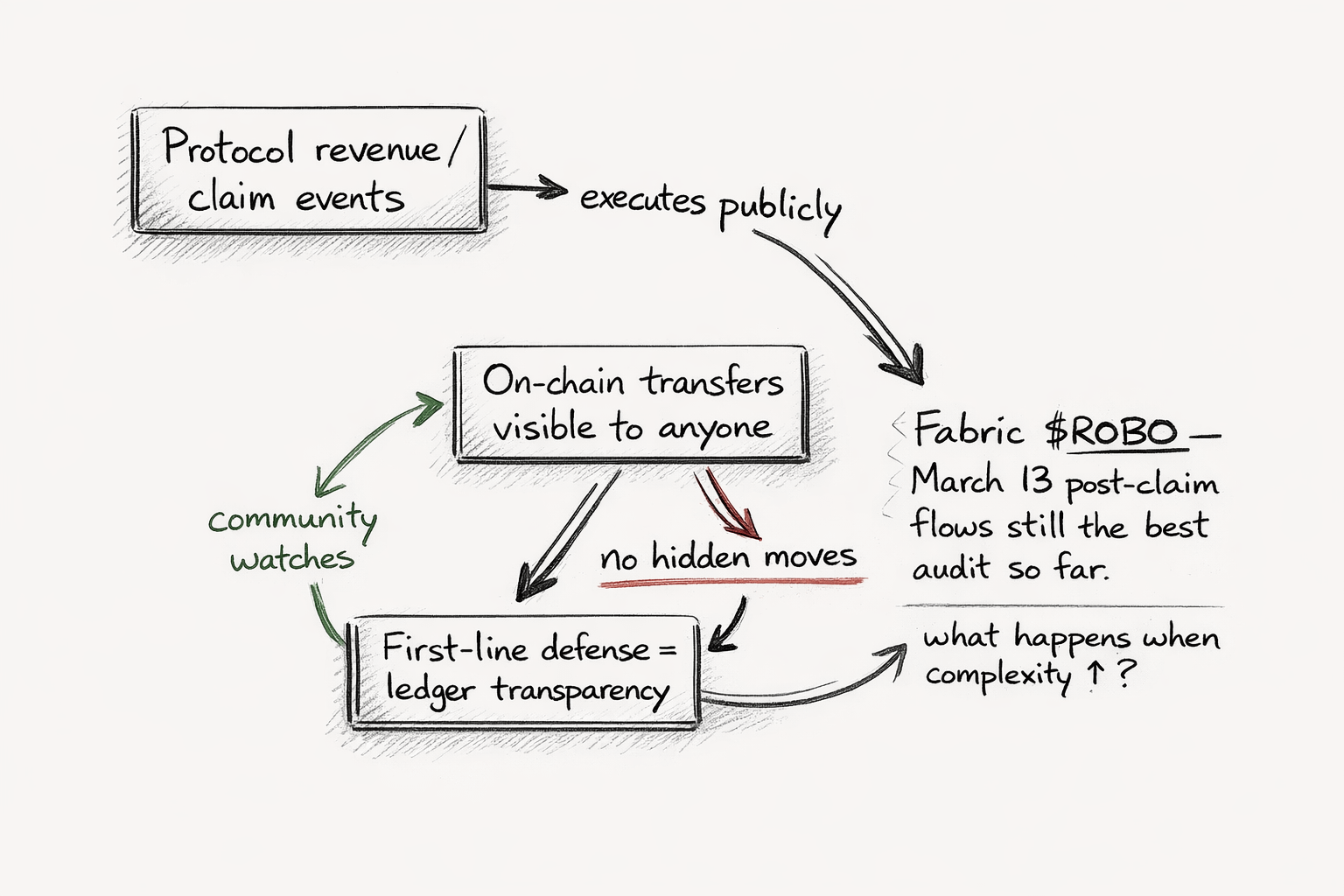
The contrast that stuck with me was how Fabric Protocol’s risks and security narrative promises layered audits and institutional safeguards, yet the real protection right now lives entirely in the immutable ledger itself.
You expect third-party reports and bug bounties front and center; instead the March 13 claim close left every wallet movement exposed for anyone to verify.
No hidden multisigs, no delayed disclosures — just the chain recording exactly what happened.
I remember running a small test allocation last month during the claim window, nothing big, just enough to watch the flows.
Wait — actually, the moment the explorer refreshed after deadline, I caught myself breathing easier because every token sat exactly where it should.
That tiny personal check turned into the real safeguard in my head.
A hidden feedback loop clicked in my notes: full transparency forces honest behavior → community self-audits emerge naturally → protocol trust compounds → fewer external attacks are even attempted.
Three quiet gears turning without a single PDF attached.
Timely examples made it concrete. Look at how early Arbitrum bridged funds stayed safe not because of endless audits but because every move stayed public; the chain itself deterred funny business.
Or take the Celestia data availability rollout — early validators relied on visible commitments long before formal security reviews caught up.
$ROBO sits in the same spot, except the stakes involve actual robot identities that can’t afford even one silent exploit.
hmm... this mechanic in practice
Hmm… this mechanic in practice still feels lighter than the whitepaper implied.
The protocol leans hard on on-chain audit trails for every governance action and treasury move, yet formal external audits remain conspicuously absent even after the claim stress test.
You see the transfers, you see the staking locks, but the deeper risk models stay community-dependent.
I caught myself rethinking the whole “enterprise-grade security” framing after that late scan.
Is the on-chain record enough, or are we one sophisticated exploit away from discovering the gap?
Skepticism crept in honestly — maybe pre-mainnet this transparency buys time, but if the pattern holds, the robot economy could scale faster than the safeguards mature.
Yet the March 13 flows keep pulling me back.
No anomalous dumps, no sudden treasury drains — just steady, verifiable accumulation that proved the basic ledger safeguards worked under real pressure.
Late-night moments like this always leave loose threads.
The claim deadline wasn’t flashy, but it quietly validated how the protocol turns visibility into the first line of defense.
It’s almost elegant in its minimalism: no need to trust the Foundation when the chain never lies.
Still, I keep circling the same thought.
Risks and security in Fabric Protocol ultimately hinge on whether this on-chain audit trail can evolve fast enough to match the complexity of real robot coordination ahead.
No predictions, just the quiet weight of those post-claim transfers still sitting there.
What if the next safeguard upgrade simply made every robot action as readable as those March 13 flows?
The ripple from that deadline is still moving outward.
I’d be curious to hear how other on-chain watchers are reading the same explorer — does the transparency feel like enough protection right now, or is something still missing in the safeguards?
#Robo