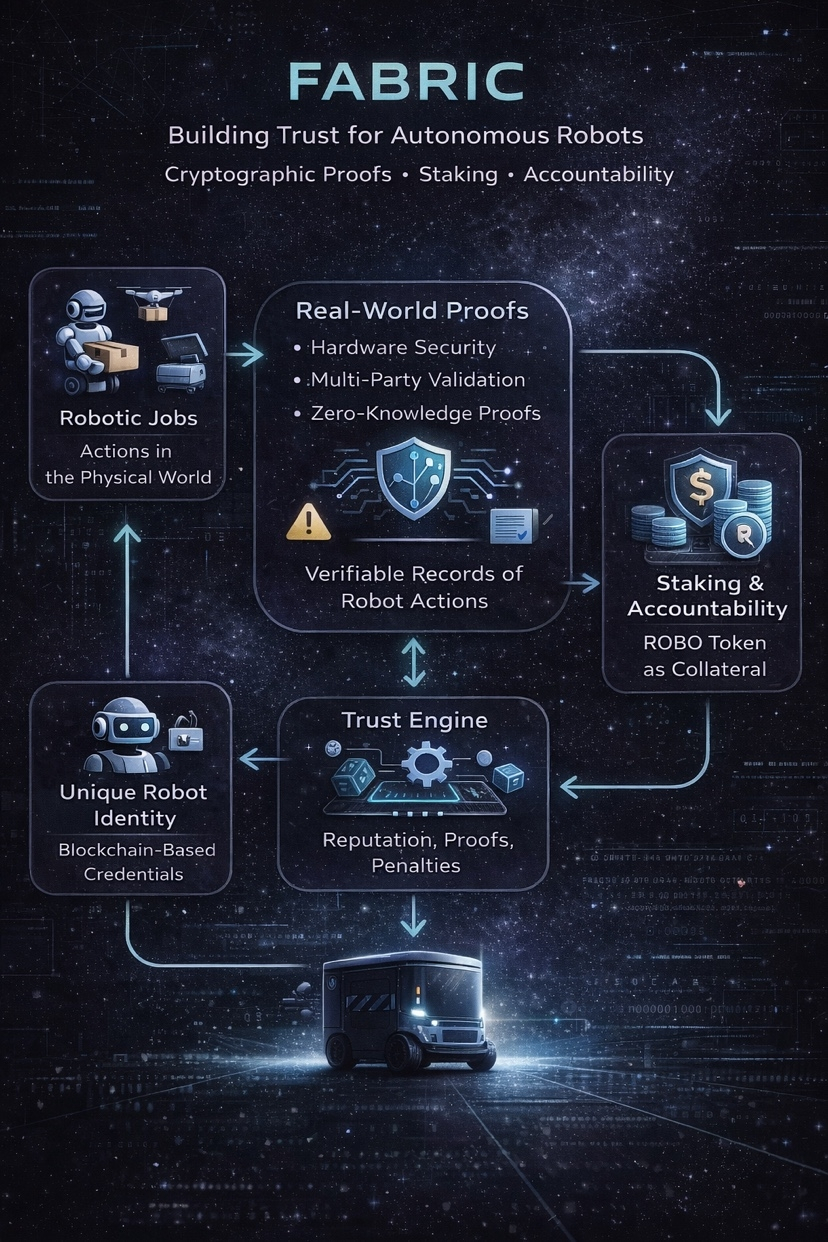
The more I read about @Fabric Foundation and $ROBO, the more I realize I’m not even watching a “robot project” anymore. I’m watching a trust project that just happens to live inside robotics.
Because robots doing work is the easy part. The hard part is what comes next: who takes responsibility when something goes wrong, and how do you prove what really happened without turning every incident into a human argument?
That’s why Fabric’s direction keeps pulling me in. I’m not sold on hype. I’m sold on structure.
I keep coming back to one question
If a robot is going to deliver packages, move inventory, handle sensitive areas, or run tasks people depend on… then “trust me bro” doesn’t work.
You need a system where a robot can’t just claim it did the job — it can show it.
And Fabric’s whole thesis feels like:
“Make machine work provable. Make participation accountable.”
Where the “robot identity” idea actually matters
I like the concept of robots having a cryptographic identity — not as branding, but as a practical tool.
In my head, it means:
• This robot is this machine (not a fake client).
• This machine has a history (good or bad).
• This identity can be checked again and again, not just once.
If you want an open network where strangers coordinate machines, that identity layer becomes the base. Without it, you don’t get an economy. You get chaos.
What makes it feel different: “skin in the game”
This is the part that makes sense to me.
In a robot economy, if anyone can join and claim jobs, then people will game it. It’s crypto — they always do. So the idea of staking/bonding as “entry permission” feels like the right pressure.
Not because staking is magical, but because it forces a real choice:
• If I want access, I risk capital.
• If I mess up, I lose capital.
• If I keep performing well, my position strengthens.
That’s the closest thing to accountability you can create in a system that isn’t run by one company.
The hardest part is still the real world
Let me be honest: verifying physical actions is messy.
Robots live in the world where:
• sensors can fail,
• environments change,
• logs can be incomplete,
• and “truth” isn’t always clean.
So I don’t treat “proof of robotic work” like it’s solved. I treat it like the real battlefield.
And this is where Fabric gets interesting again, because the direction isn’t just “robot says it did it.” The direction is stacking tools like:
• hardware security (to reduce tampering),
• multi-party verification (cross-checking events),
• and eventually privacy-preserving proofs (show something happened without exposing everything).
Even if it’s early, it’s still the right direction.
Why I keep watching $ROBO
I’m not watching it because I think every demo will become production overnight. I’m watching it because the project is aiming at the boring, ugly, difficult layer that most narratives avoid:
Proof + penalties + reputation + coordination.
If Fabric can actually make “machine work” verifiable enough that people trust the output without needing a human supervisor every time, then that’s not just a robotics story.
That’s an infrastructure story.
And in crypto, infrastructure stories are the ones that quietly survive when hype burns out.