
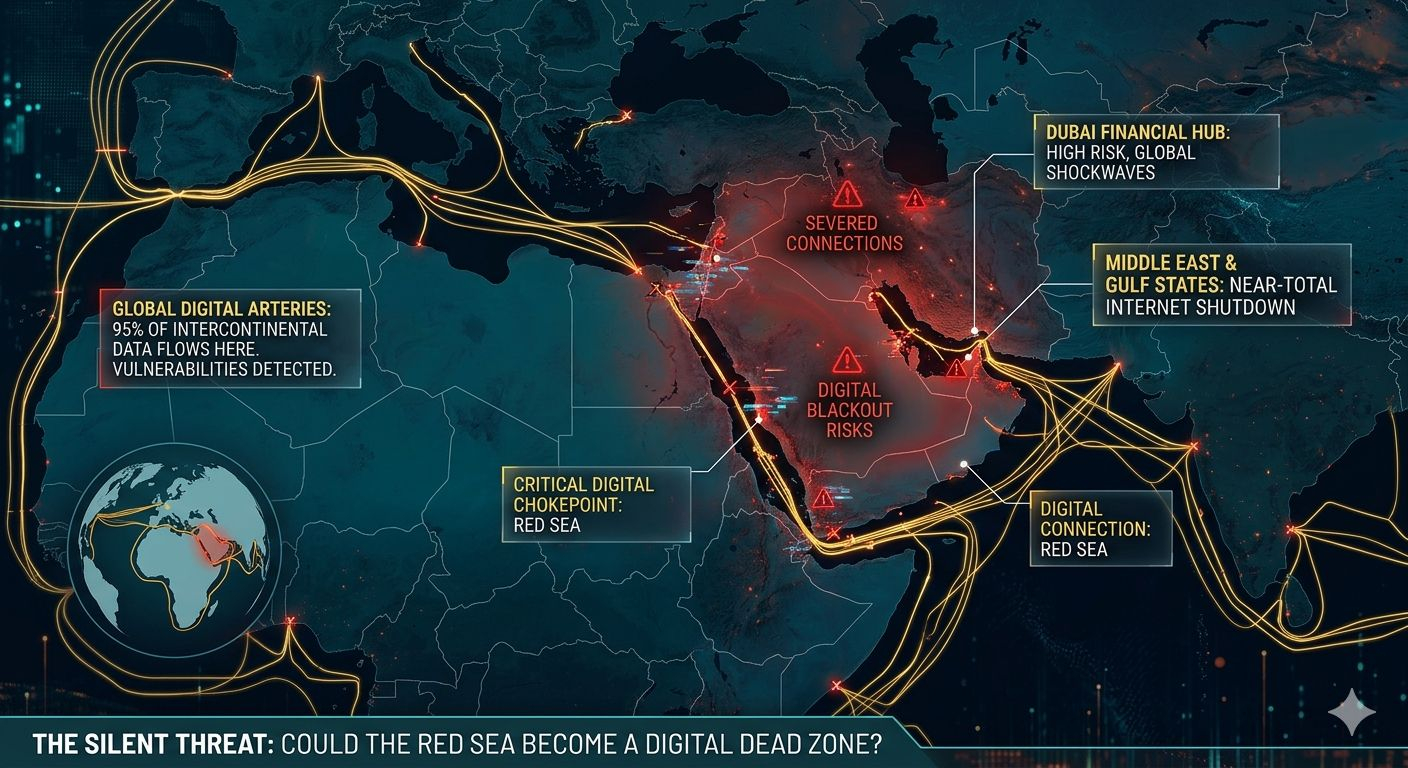
The Silent Threat: Could the Red Sea Become a Digital Dead Zone?
While the world watches the skies for missiles and the straits for tankers, a more profound vulnerability lies silent on the ocean floor. In the high-stakes game of Middle Eastern geopolitics, the most devastating weapon may not be an explosion, but a severed connection.
As of March 2026, the global digital infrastructure is on a "knife-edge." Recent escalations have turned the Red Sea and the Persian Gulf—traditionally maritime chokepoints for oil—into critical bottlenecks for the world’s data.
The Undersea Reality
Over 95% of intercontinental data travels through a network of fiber-optic cables no thicker than a garden hose. These cables are the "digital arteries" of the modern world. If these arteries were to be cut in the Middle East, the fallout would be catastrophic:
Regional Blackout: Nations like Kuwait, Qatar, and the UAE would face near-total isolation. In an era where even basic utilities and healthcare are digitized, a "digital blackout" is not just an inconvenience—it's a societal collapse.
Financial Shockwaves: Dubai and Riyadh are global financial hubs. Severing their connection would freeze trillions in transactions, likely triggering a global recession faster than any oil embargo.
The "Mutual Destruction" Paradox: For a state that feels "cornered," the logic of Mutual Assured Destruction (MAD) shifts from nuclear to digital. If a nation cannot participate in the global economy, it may choose to ensure no one else can either.
The Repair Crisis
The world is dangerously unprepared for a mass-severing of cables. Undersea repairs are not a simple "plug and play" fix:
Specialized Fleet: There are only about 60 cable repair ships globally. Most are aging (20-30 years old) and are currently stretched thin by natural wear and tear.
The Permission Problem: In a conflict zone, repair ships cannot enter without security guarantees. If Iran or its proxies control the waters, these ships become targets, extending a "two-week repair" into a months-long outage.
The Domino Effect: Modern internet architecture relies on rerouting. However, with the Red Sea already seeing disruptions from "grey-zone" activities, the remaining cables are operating at peak capacity. One more major cut could lead to a systemic failure across Europe, Africa, and Asia.
Are We Prepared?
The short answer is: No. While tech giants like Meta and Google are investing billions in "diversified routes," these projects (like 2Africa Pearls) are currently being halted or delayed due to the very instability they seek to bypass.
In the 20th century, power was measured in barrels of oil. In 2026, it is measured in terabits per second. As the geopolitical temperature rises, the world must ask: how long can a digital civilization survive if its foundations are left unprotected in the most volatile waters on Earth?