
I was sitting in the kitchen this morning, staring at my coffee getting cold, thinking about how we keep chasing "the next big thing" in crypto like it's going to fix something fundamental. It's a quiet habit—scrolling feeds, reading posts, convincing ourselves utility is coming tomorrow. Then I opened Binance Square to do the CreatorPad campaign task for Fabric Foundation. You know the one: scroll through the project posts, find the Vision Roadmap section, read the phases about robot identity, task settlement, modular infrastructure.
While I was on that roadmap screen, scrolling past the 2026 Q1 base layer stuff and the talk of agent-native governance, something hit me sideways. The uncomfortable idea that crept in wasn't about the tech itself—it's that most of us in crypto have quietly accepted decentralization as the ultimate good, but what if layering blockchain on top of autonomous machines actually centralizes control in ways we pretend aren't happening?
We love saying "no single point of failure," "trustless," "power to the edges." But staring at that roadmap breakdown—the structured plan from identity verification to full machine autonomy—I realized the irony. To make robots safe, collaborative, and economically viable on-chain, you need verifiable identities, standardized task ledgers, governance that agents can participate in. That sounds like building rails, not removing them. The more "decentralized" the robot economy becomes, the more it demands shared protocols, common data formats, and coordinated evolution. That's not chaos. That's coordination dressed up as freedom.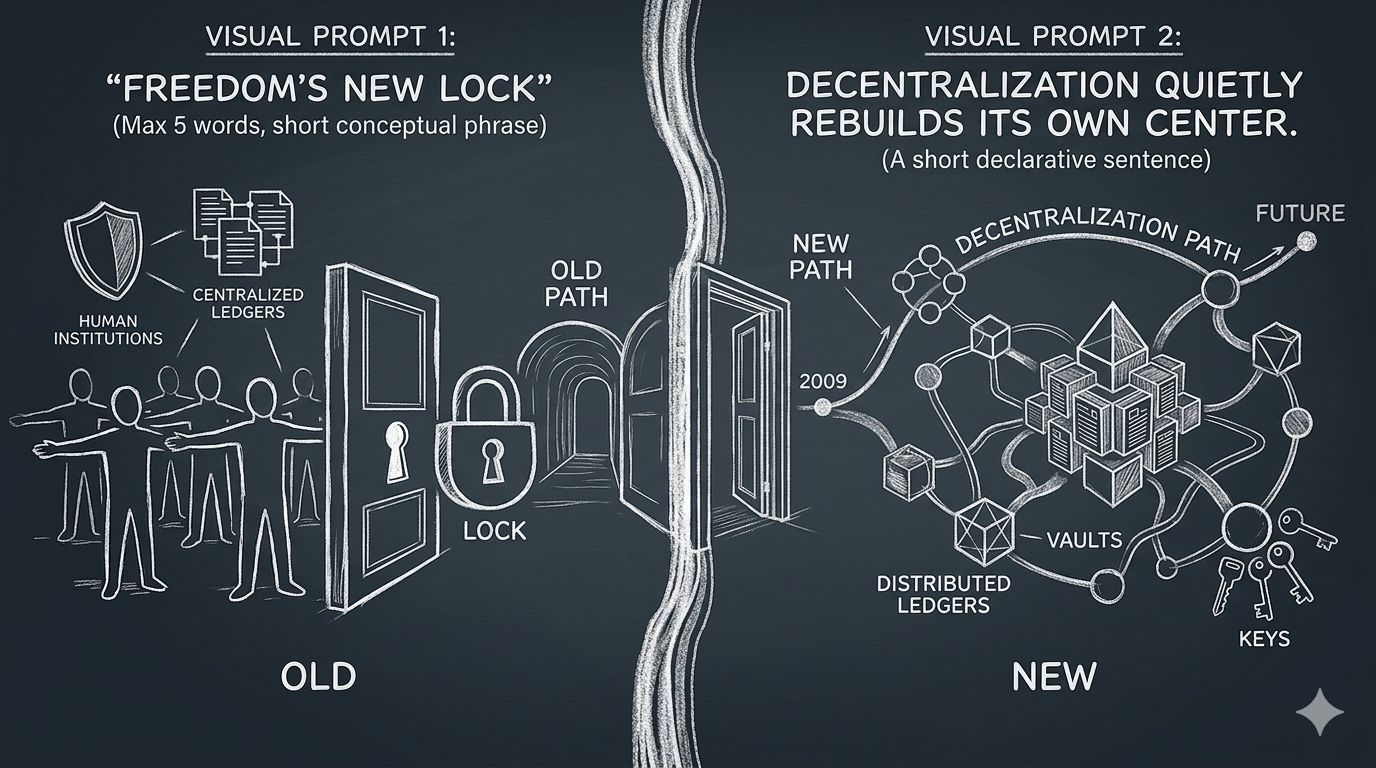
Fabric Protocol is the clearest example right now. Their posts keep emphasizing it's not about selling hardware or tokens first—it's infrastructure for robots to have on-chain presence, settle tasks, evolve together. But to get there, everything funnels through defined layers: base identity, settlement mechanisms, then higher governance. It's not wild-west permissionless innovation; it's engineered permissionless within boundaries. The moment I lingered on the "modular infrastructure + agent-native governance" line in the roadmap, it clicked—crypto's favorite story about breaking free from central control might be quietly rebuilding a different kind of center, one that feels neutral because it's code instead of a CEO.
This extends far beyond one project. Look around: layer-1s, oracles, bridges, identity solutions—all promise openness, yet each adds dependencies and standards that concentrate influence. The dream of thousands of truly independent agents feels good until you need consensus on what "agent" even means, how tasks are verified, who (or what) arbitrates disputes. We criticize banks for gatekeeping, then build gatekeeping into smart contracts and call it progress.
The risk in saying this out loud is it sounds anti-decentralization, which is heresy in these circles. But it's not against the idea—it's against pretending the current path doesn't quietly recentralize under prettier names. Fabric's roadmap just made it visible: to enable a machine economy, you first build the constitution for machines. Constitutions concentrate power, even if distributed.
So now I'm left wondering: are we actually decentralizing anything, or are we just trading old gatekeepers for algorithmic ones that feel fairer because we can fork them in theory? #robo $ROBO @Fabric Foundation