
As someone who spends a lot of time analyzing blockchain ecosystems, I usually try to focus on projects that are working on long-term technological solutions rather than short-term hype cycles. The crypto industry is evolving quickly, and many of the most interesting innovations are happening in areas such as infrastructure, privacy, and interoperability. Recently, while reviewing several emerging Web3 projects, I spent time researching the ecosystem being developed by @MidnightNetwork

From my perspective as a researcher and market observer, privacy is one of the most important challenges that blockchain technology still needs to solve. Public blockchains have created incredible transparency and trustless systems, but they also introduce the problem that every transaction and interaction can be visible on a public ledger. For many real-world applications, especially those involving businesses, personal data, or sensitive financial activities, complete transparency can actually become a limitation.
This is where privacy-focused blockchain solutions become extremely important. During my research, I found that the concept behind the NIGHT token is closely connected to enabling confidential and secure interactions within a decentralized network. Instead of treating privacy as an optional feature, the ecosystem being developed around this token appears to focus on integrating privacy directly into the infrastructure layer.
When analyzing new blockchain technologies, I usually evaluate several different aspects: the purpose of the protocol, the innovation it introduces, the community activity around the project, and the long-term vision that the team is trying to achieve. In the case of Midnight Network, the focus on enabling confidential smart contract interactions stands out as a unique and potentially impactful direction.
Smart contracts have become one of the most powerful tools in the Web3 ecosystem. They allow developers to create decentralized applications that operate automatically based on predefined conditions. However, many current smart contract systems operate entirely in the open, meaning that transaction details, user behavior, and contract interactions can be publicly visible. While transparency can be beneficial in some situations, it can also create privacy concerns for users and organizations.
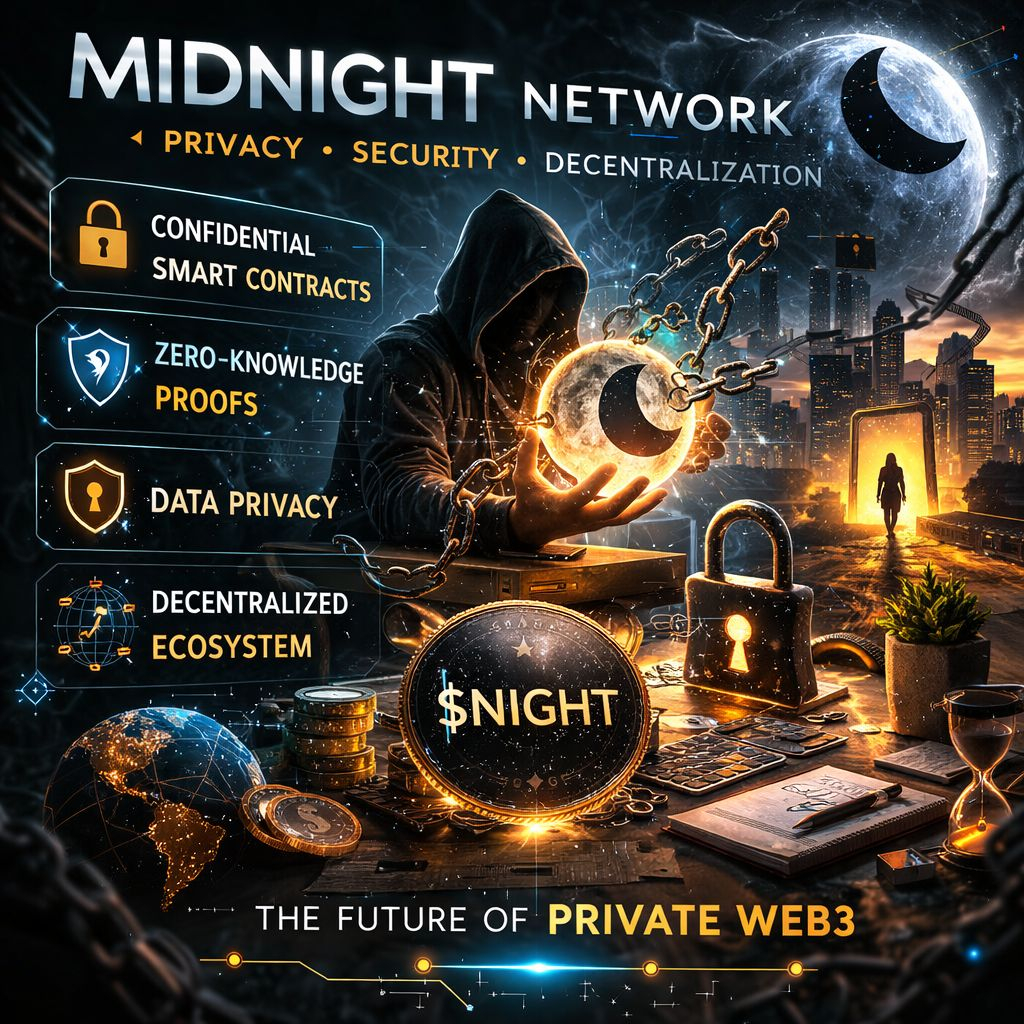
During my analysis of privacy-focused blockchain infrastructure, it became clear that solutions like those being explored within the Midnight ecosystem aim to address this challenge. By enabling more confidential interactions between users and applications, such systems could help expand blockchain adoption into industries where privacy is essential.
Another interesting aspect I noticed while researching the ecosystem is how privacy technology can coexist with decentralization. In the past, there has often been a trade-off between transparency and confidentiality in blockchain systems. However, modern cryptographic techniques and innovative protocol designs are starting to make it possible to achieve both security and privacy at the same time.
From a research perspective, projects exploring these kinds of solutions are particularly interesting because they represent the next stage of blockchain evolution. The early years of crypto focused heavily on digital payments and decentralized finance. Now the industry is gradually expanding into areas such as data protection, decentralized identity, and privacy-preserving computation.
The role of $NIGHT within this ecosystem appears to be connected to supporting the functionality and economic activity of the network. In many blockchain systems, tokens serve multiple purposes, including facilitating transactions, supporting governance mechanisms, and enabling participation in decentralized applications. Understanding how a token fits into the overall infrastructure is always an important part of analyzing a project.
Another factor that often influences the long-term success of a blockchain ecosystem is the strength of its community. Community participation, developer interest, and user engagement can significantly impact how quickly a project grows and evolves. Campaigns and discussions around emerging networks often help introduce new audiences to the technology and encourage people to explore the project in more depth.
While researching different blockchain ecosystems, I also try to compare their goals with broader industry trends. Privacy, scalability, and interoperability are currently three of the biggest areas of innovation in Web3. Projects that successfully address these challenges could play a major role in shaping the future of decentralized technologies.
In the case of Midnight Network, the focus on confidential interactions could open the door to many different use cases. For example, businesses that want to use blockchain technology may require transaction privacy to protect sensitive operational data. Similarly, individuals may prefer systems where their financial activity or digital identity information is not permanently exposed on a public ledger.
Another important point that researchers and investors often consider is the technological roadmap of a project. A clear roadmap can provide insight into how the ecosystem plans to evolve over time and what types of features or improvements may be introduced in future development phases. Observing how a project progresses toward its stated goals can provide valuable information about its long-term potential.
From my perspective, analyzing projects like this is valuable not only for understanding a specific token or network but also for gaining insight into the overall direction of blockchain innovation. The Web3 ecosystem is still relatively young, and many new ideas are being explored simultaneously. Some of these experiments may eventually become foundational technologies that support the next generation of decentralized applications.
It is also important for anyone exploring cryptocurrency projects to conduct their own research and analysis. The digital asset space is highly dynamic, and understanding the fundamentals behind a project can help people make more informed decisions. Looking at factors such as technology, ecosystem design, and real-world use cases often provides a much clearer picture than simply following market trends.
After spending time studying the ideas behind Midnight Network and the role of $NIGHT within its ecosystem, I believe the concept of integrating privacy directly into blockchain infrastructure is a direction worth paying attention to. As decentralized technologies continue to mature, solutions that balance transparency, security, and confidentiality could become increasingly important.
For analysts, developers, and crypto enthusiasts, observing how privacy-focused ecosystems evolve over time can provide valuable insight into the future of Web3 innovation. Whether someone is exploring the technology, participating in discussions, or simply learning about new blockchain architectures, understanding the vision behind projects like this helps us better appreciate the possibilities of decentralized systems.
The blockchain industry continues to evolve rapidly, and each new infrastructure project contributes to shaping the future of the digital economy. By studying emerging networks and the technologies they introduce, researchers can gain a deeper understanding of how decentralized platforms might transform the way data, value, and digital interactions are managed in the years ahead.